Colin Sheridan: Football medicine worked, don't change the prescription
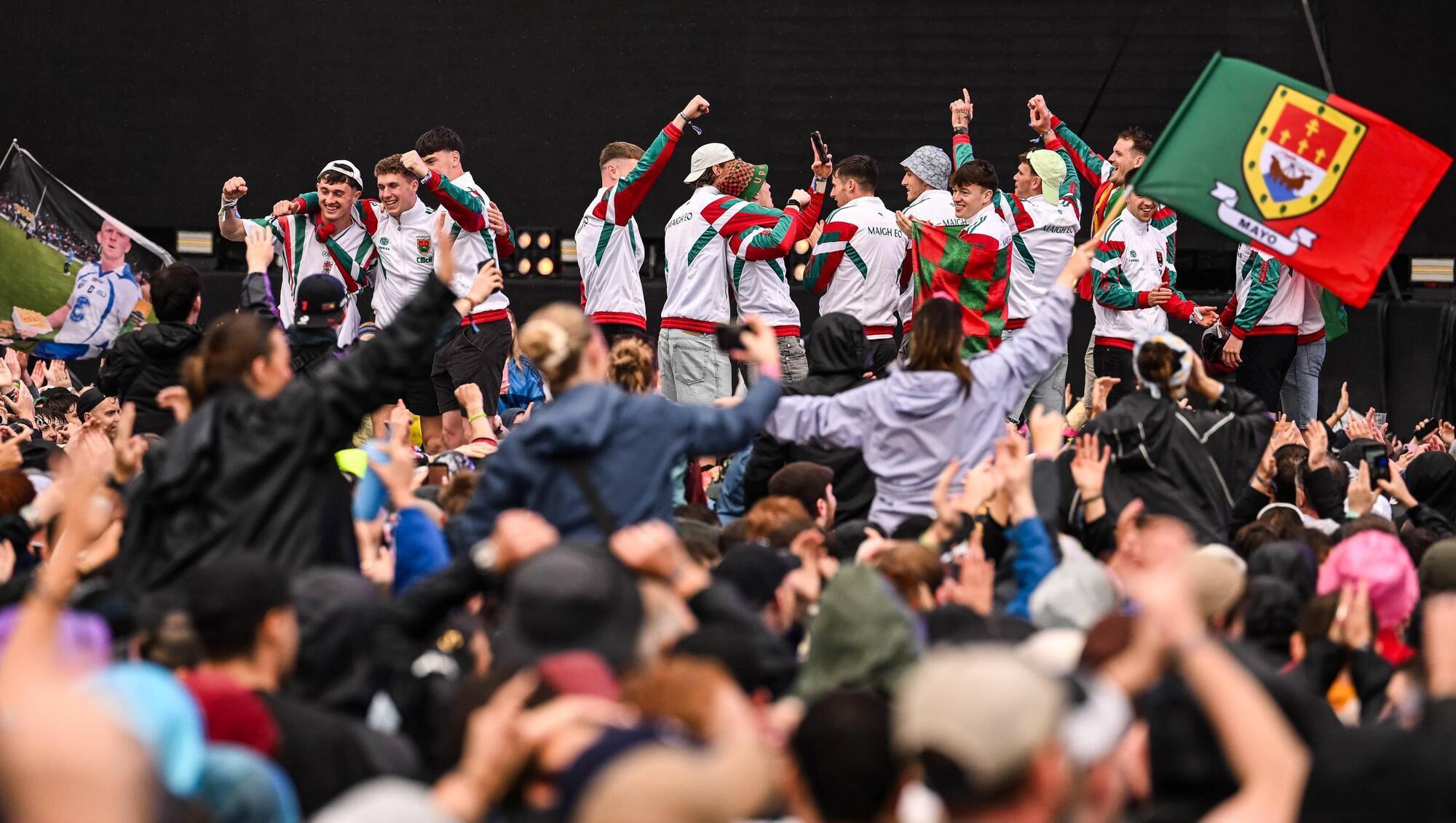
NO PICNIC: The Mayo All-Ireland Football Championship winning team join The Saw Doctors on the Electric Picnic Main Stage. Pic: Ramsey Cardy.
There are few things more dangerous in sport than an expert advisory group standing beside something that is working perfectly well with a hammer in its hand.
Kevin McStay and his Expert Advisory Group on Gaelic Football have been tasked with minding the considerable inheritance left to them by Jim Gavin's Football Review Committee.
And in fairness to McStay, he has been at pains to describe what comes next as "polishing" and "tweaking", rather than another attempt to dismantle Gaelic football and put it back together again.
The problem is that Gaelic football doesn't look particularly in need of polishing right now. A month after one of the most enjoyable All-Ireland championships in memory, the latest proposals landed: four points for a goal, a maximum of three consecutive handpasses, no fisted points except those finished in flight, an over-and-back rule preventing teams from retreating into their own half, shorter kick-outs and an extension of the 40-metre arc are among nine adjustments to be trialled in the third-level Ryan Cup this autumn.
Some may eventually prove worthwhile. Others leave you wondering what problem we are trying to solve. And that question should probably be written in enormous letters across the wall of every room in which the rules of Gaelic football are discussed.
Read More
What problem are we trying to solve? Because there certainly was a problem. For years, football became progressively more conservative.
Possession became almost an end in itself. Risk was something to be eliminated. Players retreated, coaches devised increasingly elaborate defensive systems and spectators occasionally found themselves watching 30 exceptionally athletic men standing in roughly the same half of a football field.
The FRC deserves credit for confronting that. Indeed, one of the most encouraging developments in the GAA has been the organisation's newfound willingness to interrogate its games.
The old instinct was often to resist change until the evidence became overwhelming. Gavin's committee demonstrated what could happen when evidence, expertise and imagination were brought together.
Football became fun again.
Which brings us to the slightly awkward question: if the medicine worked, why are we already changing the prescription?
Mayo's All-Ireland victory matters here for reasons beyond Mayo. They won Sam Maguire playing with ambition. They accepted risk. They attacked space. They were prepared occasionally to leave themselves exposed because they believed the rewards at the other end were greater.
Most importantly, they won. That matters because coaches copy winners. Had Mayo played beautiful, adventurous football before gallantly departing the championship, the lesson might have been familiar: lovely stuff, but you can't win an All-Ireland playing like that. Except now you demonstrably can.
Perhaps the greatest rule change Gaelic football received this summer wasn't a rule at all. It was Mayo lifting Sam.
The new regulations changed the incentives; Mayo demonstrated what could be done with them. Before interfering further, perhaps we should allow the rest of football to respond.
Tiger Woods famously rebuilt his golf swing after winning the Masters by 12 shots. Pádraig Harrington has spent much of his life searching for another tiny improvement in a game that made him a three-time major champion. There is something admirable in that restlessness. There is also something to be said for not changing your swing when you're winning majors.
Gaelic football spent years looking for a better swing. This summer it found one. That doesn't mean every proposal from McStay's group is wrong. The group exists precisely because the FRC wisely recognised that football must continue to be monitored. Rules create unintended consequences. Coaches find loopholes. Games evolve. Standing still indefinitely would simply repeat the mistake that helped create football's problems in the first place.
But vigilance and intervention are not the same thing.
Take the three-handpass proposal. If excessive handpassing is creeping back into football, by all means monitor it. But forcing a kick after three handpasses moves us from incentivising attacking football towards prescribing how football must be played.
Likewise, four points for a goal. Goals are already fairly consequential events. Are teams insufficiently interested in scoring them?
Again: what problem are we solving?
There is another issue with using the Ryan Cup as the laboratory. Third-level football isn't a collection of willing guinea pigs. It is a competition that already exists under enormous pressure. Managers have precious little time with their players. Club championships consume the autumn and winter; county preparations follow rapidly behind. University teams are assembled amid academic commitments, injuries and competing loyalties, with much of the available time devoted simply to preparing for the next game. Now those coaches and players must also learn an experimental version of Gaelic football before many of them return shortly afterwards to teams playing another version. The Ryan and Sigerson Cups have enough existential problems without becoming Croke Park's test kitchen.
None of this is an argument against McStay or against the body he chairs. Quite the opposite. The fact that Gaelic football now has people permanently studying its health is something worth welcoming.
Study everything. Gather the data. Watch what coaches do next. Keep the toolbox close. But occasionally the smartest intervention is no intervention at all. For decades, the GAA's problem was that it wouldn't change Gaelic football. The danger now is assuming that because changing it worked, we must keep changing it.
Maybe, for a little while at least, we should simply let them play.
There are not many occasions when this column feels compelled to say something kind about UEFA, so perhaps everyone should enjoy the moment. The Conference League is a good idea. For all the grotesque wealth concentrated at the summit of European football, UEFA has at least created a competition offering clubs from leagues such as ours something increasingly denied elsewhere: a realistic route into meaningful European football. And money. Lots of it, relatively speaking. Which makes Shamrock Rovers’ European campaign this summer particularly disappointing.
Thursday’s 1-0 defeat to KuPS in Finland, eliminating Rovers 2-1 on aggregate one game short of the Conference League proper, completed a miserable sequence away from Tallaght. There was defeat against Ararat-Armenia and, most unforgivably, the extraordinary 5-1 collapse against Egnatia in Albania after Rovers had travelled with a 3-1 advantage. Stephen Bradley called it the worst performance he had witnessed from his team.
This is not an argument that Irish clubs should suddenly be beating Ajax. Nor should one poor European campaign obscure what Bradley and Rovers have achieved previously. Indeed, their recent European experience is precisely why more should reasonably have been expected. The Conference League was created partly to widen European football beyond the aristocracy. It offers champions from Ireland, Finland, Iceland, Albania and elsewhere a stage, significant income and the possibility of actually winning football matches in Europe rather than merely surviving qualifying rounds against vastly richer clubs. Those opportunities matter enormously to the League of Ireland. They therefore have to matter enormously to its best teams. Rovers did not owe UEFA anything this summer. But they did owe themselves, and perhaps Irish football, something better than this.
The circus will roll into Doonbeg for the Irish Open, and we can safely assume Donald Trump’s presence will consume rather more oxygen than anything happening inside the ropes But before that, something arguably purer arrives in Clare. The Walker Cup comes to Lahinch next weekend, bringing the finest amateur golfers from Britain and Ireland and the United States to one of the world’s great links. Tickets are already sold out, with 8,000 spectators expected each day. Ireland has one representative, Amateur champion Stuart Grehan. The roll-call of former Walker Cup players includes Tiger Woods, Jack Nicklaus, Rory McIlroy and Pádraig Harrington. In other words: we should watch closely, because we may be watching the future.
For all the serious questions still confronting Rowing Ireland, the medals keep coming. Allegations concerning athlete welfare and culture within its high-performance programme cannot be obscured by success, and an independent review into those issues remains under way. But neither should they obscure an extraordinary sporting story. Margaret Cremen and Zoe Hyde’s thrilling World Championship victory in Amsterdam on Friday - Ireland’s first gold in the women’s double sculls - represents yet another triumph from a system which continues producing world-class rowers with remarkable regularity. The challenge for Rowing Ireland now is surely clear: create a culture every bit as exceptional as its athletes.