Tommy Martin: Flares and foreign policy a political football
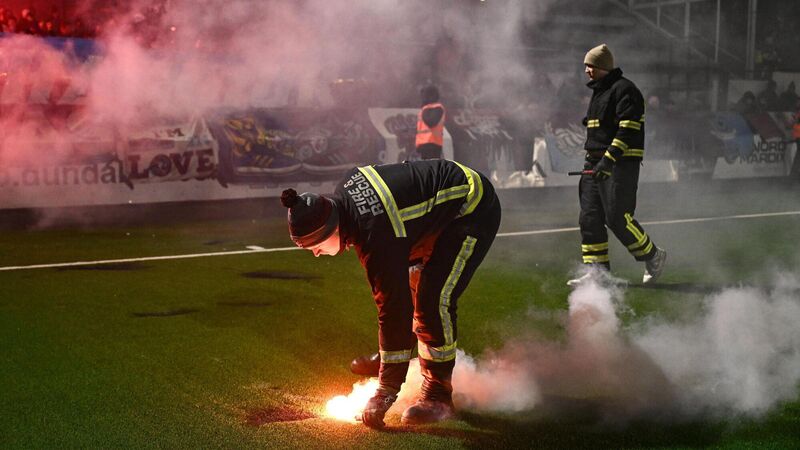
Fire stewards remove flares from the pitch before the SSE Airtricity Men's Premier Division match between Dundalk and Drogheda United at Oriel Park. Pic: Ben McShane/Sportsfile

The relationship between Irish football and the concept of crisis is like that between Ireland and the concept of rain, in that it is never far away and often seems to come from several directions all at once.
This week was a particularly drenching one as the League of Ireland dealt with the fallout from Drogheda United fans going all Bomber Harris on Dundalk’s new astro pitch, while the FAI continued to handle the almighty headache of sharing a Nations League group with Israel.
The two issues might seem totally unrelated, other than the corner of the Oriel Park pitch looking like the IDF had done their worst on it by kick-off last Friday night.
Both, however, highlight Irish football’s institutional weakness and its ongoing struggle to heave itself away from the monsoons of permacrisis.
Having had the Liveline treatment earlier in the week, the Oriel Park incident appeared to complete the full crisis life cycle by Thursday evening when Minister for Sport Patrick O’Donovan pronounced himself happy with the punishment meted out to Drogheda by the FAI’s Independent Disciplinary Committee, as well as plans for tough new security measures to clamp down on the use of flares in League of Ireland grounds in future.

Drogheda were fined €15,000 while their fans have been banned from the next four away matches, as well as a season-long exclusion from the pleasures of attending matches at Oriel Park.
Meanwhile, mandatory CCTV will be introduced in League of Ireland grounds from next season, while specially trained sniffer dogs will apprehend wannabe pyro enthusiasts at the turnstiles.
While plenty will bemoan the absence of pyro from League of Ireland grounds for reasons of atmospheric vibes, grounds will be safer and astro pitches less likely to look like the 8th Panzer Division have just rumbled into town.
Justification then, for the minister’s histrionic take on the matter on RTÉ Radio on Monday, including the now-notorious “plague on all their houses” threat to suspend all funding for astro pitches for League of Ireland clubs.
Though government colleagues, including Taoiseach Micheal Martin, reckoned O’Donovan was going a bit OTT, any threat of the funding taps being shut off tends to focus the minds in Irish football these days.
While the minister was right to deem the scenes at Oriel Park unacceptable and to demand strong action be taken, the hectoring tone of his Monday morning lecture made anyone connected to Irish soccer bristle. It was at once a reminder of that when it comes to the corridors of power, domestic soccer is a supplicant rather than a partner.
Many felt the minister’s wrath spoke of a sense that Irish football should be expected to bow and scrape in gratitude at the benevolence of those entrusted with the public purse, as if the grant issued to Dundalk for the cost of their new pitch were an act of extraordinary largesse rather than the proper use of taxpayer’s money for the common good.
Some wondered if GAA and rugby, typically viewed as having cosier relationships with political classes, would have been treated with the same scolding attitude.
O’Donovan’s wording in relation to any cost of repairs to the pitch - “I won’t be paying for the damage, that’s guaranteed” – introduced an extra layer of aristocratic hauteur to proceedings, the minister making clear that when it came to departmental purse strings, the divine right of kings reigned supreme.
But the FAI and its domestic league offshoot are in no position to take umbrage at being made to humble themselves at the ministerial throne. The mere mention of a suspension of funding is DEFCON 4 for Irish soccer’s governing body.
Public money keeps the association afloat in its post-Delaney state of financial intensive care and underwrites all its plans for a better future. Youth academies, stadium and facilities infrastructure, the hosting of high-profile international tournaments and UEFA showpiece matches – all the things that might see Irish soccer kick free of its struggles are dependent on investment from national and local government.
Hence why the FAI must play nice with the likes of O’Donovan, even if such funding is only right after decades of underinvestment and given the social and cultural value the game provides.
Playing nice with power is also behind the association’s resolute stance on going ahead with the Nations League ties with Israel. We pointed out in these pages when the draw was made how the FAI being financially in hock to UEFA meant they were always likely to toe the line with the continental governing body.
The same rules apply when it comes to the state. It is clear the government, having taken an admirably strong line in the past, has toned down its rhetoric about Israel’s actions in Gaza. Whether through pressure from Washington or Silicon Valley, the prospect of St Patrick’s Day in the White House or the resurgent threat of Trump’s tariffs, it feels like the state has decided Irish economic interests must take priority over any moral leadership over Palestine.
No sooner had Patrick O’Donovan finished admonishing the flare boys of Oriel Park, than he was telling the FAI to keep sport and politics separate when it came to the Israel issue and accusing those of calling for a boycott of the matches of “bandwagoning” and being “people who just want a headline".
It is clear the government does not want the international hoo-ha that Ireland initiating a sporting boycott of Israel would bring.
In this at least, O’Donovan was in lockstep with his ministerial seniors, with Micheal Martin and Tánaiste Simon Harris having also backed the FAI board’s stance.
Plenty have argued that the FAI should instead be listening to its own General Assembly and to this week’s survey from the PFAI which said that a majority of League of Ireland players do not want the Republic of Ireland to play the games.
But while the claim that some things are more important than football is valid, there is no chance of an organisation in as weak a position as the FAI acting in opposition to the expressed wishes of its own government, especially one in whom it is so financially dependent, no matter how much it may be right thing to do morally.
Until the storm clouds of crisis eventually clear, on all these issues, the FAI finds itself with no alternative than to say “yes, minister”.