Inspirational Ohtani beats the Americans at their own game
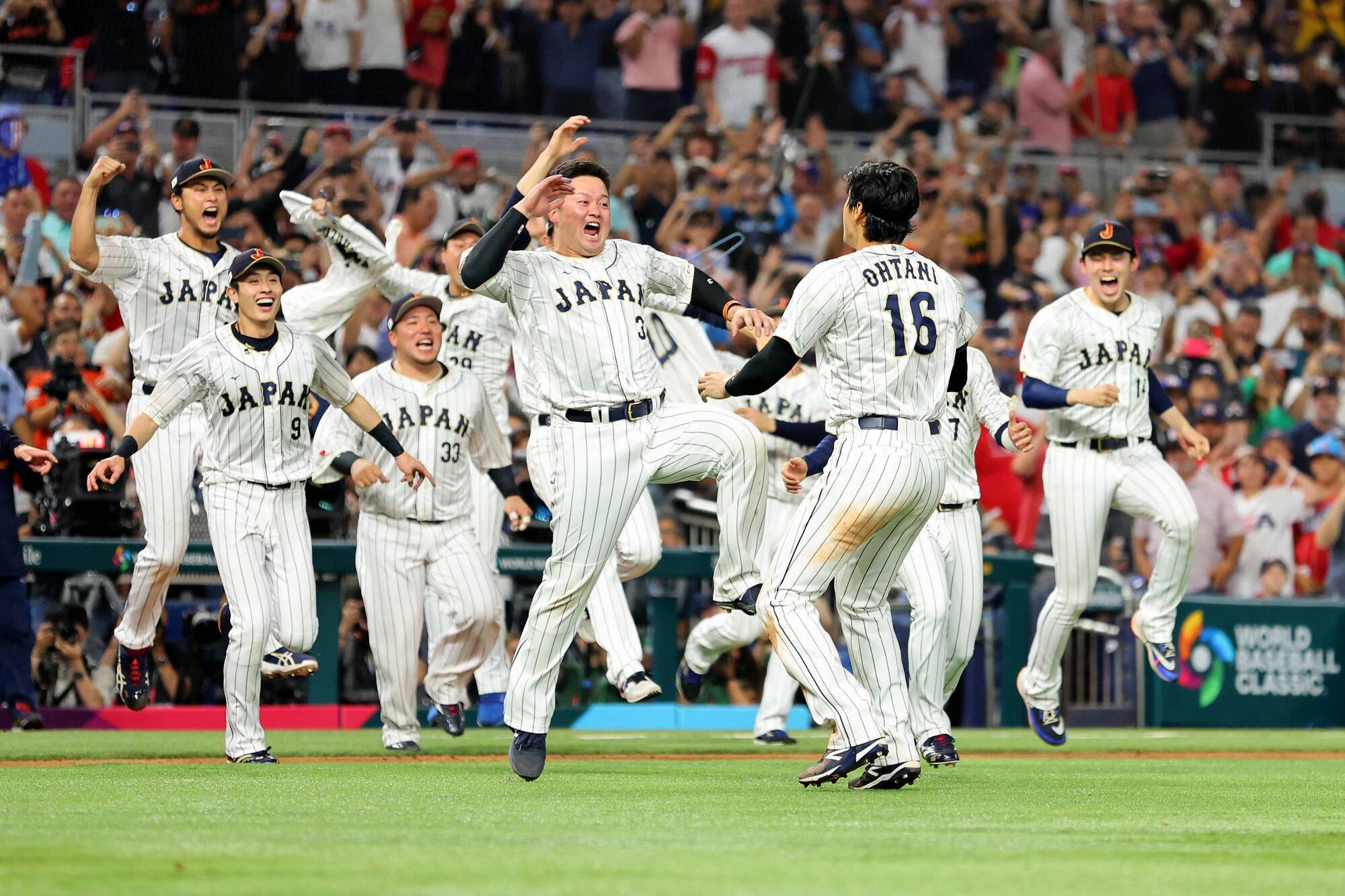
Shugo Maki #3 and Shohei Ohtani #16 of Team Japan celebrate after defeating Team USA during the World Baseball Classic Championship at loanDepot park on March 21, 2023 in Miami, Florida. (Pic: Megan Briggs/Getty Images)
The greatest baseball player in the world and potentially of all time gathered his Japanese teammates around him in the depths of the Miami Marlins ballpark on Tuesday evening.
Shohei Ohtani’s rousing speech to fire the players up before they left the locker room will go down as an all-timer, too.
Soon they would enter the field and go through an entire circus of pre-game pomp and circumstance so typical and necessary for a contest aimed at deciding global superiority.
Their opponents in the first final of the so-called World Baseball Classic since 2017 were the US, the reigning champions and, of course, the inventors of a sport that they subsequently seeded in Japan in the 1870s before solidifying its popularity with a star-packed tour in the early 1930s.
When you think of baseball, you think of America and you probably think of other negative thoughts. Too boring? Too complicated? Too commercial? When Babe Ruth and Lou Gehrig travelled to Japan in 1934, the locals were ready to embrace their greatness. Soon after, a professional league was founded and it thrives to this day.
Thriving to the extent that the best players in Japan are in no particular rush to make it big in the biggest league on the other side of the Pacific Ocean.
One of the few extremely notable exceptions is Shohei Ohtani who as a teenager caused chaos in Japanese baseball a decade ago by forcefully expressing his desire to jump straight from highschool to the Major Leagues in the US. He eventually got to Southern California's moneyed Anaheim in 2016 where he has been an outsized talent on a perennially failing LA Angels team.
Just like a young Babe Ruth, what sets Ohtani apart is that he is both a hitter and a pitcher. What will eventually (or has arguably already done so) set him apart from the Babe is that it doesn’t look like he’ll quit hitting or pitching any time soon. Added to that is the fact that he excels at both, not just in an all-rounder type of way but in a truly excellent type of way.
Pitching is exhausting and often debilitating. Hitting for power and accuracy when a ball is flying towards you at 100mph is a talent few can ever hope to master. And yet Ohtani is hungrily racking up impressive stats on both sides of the game.
Baseball doesn’t know what to do with him but he knew what to do on Tuesday evening when he played the captain’s role, having the stage and the final say before heading out to challenge and ultimately beat their vaunted opponents.
“Let’s stop admiring them,” he urged his teammates. “If you admire them, you can’t surpass them. We came here to surpass them, to reach the top. For one day, let’s throw away our admiration for them and just think about winning.”
America is not unique in its slow realisation that there’s a whole world out there but that attitude sadly excels here and particularly so in the especially conservative world of baseball.
Before pitcher Masanori Murakami, the first Japanese player to dip his toe into the league in the 1960s, the influx of talented Latin American players was ruffling feathers, not long after Jackie Robinson’s own breakthrough in the late 40s.
The battle for acceptance was arduous for the non-American players but over time, attitudes have progressed, the multicultural nature of Major and Minor League Baseball is now its greatest strength.
I don’t want to hold up the World Baseball Classic (WBC) as some sort of cosy encapsulation of the winding road travelled by the professionals playing the game, the fans who worship them and the media grappling with the fast-evolving landscape.
But this week was a breakthrough where the breakthrough most needed to happen. Already the talk is that the 2026 event will be tailored to draw on the well of goodwill built over a fortnight or so of crowd-pleasing action.
The WBC was hastily assembled as a World Cup-style tournament after the International Olympic Committee's decision to remove baseball as an Olympic sport in 2005. It was never the intention to threaten the dominance of any of the other major world events, restricted of course by its geographical limitations, but it felt right to give top professionals a non-financially beneficial flag to fly.
Nobody knew how to approach this running of it, initially. Its timing is a primary inhibiting factor, right in the jaws of pres-season “Spring Training” when highly paid players are slow to fathom throwing their bodies into high-paced action, especially pitchers with contract renewals due up before the end of the year.
Indeed, a low point for this tournament was when New York Mets Closing Pitcher Edwin Diaz collapsed after seeing out Puerto Rico's big rivalry win over the Dominican Republic. His teammates gathered around him to celebrate his prevention of a DR comeback and his knee collapsed in the middle of what was a relatively tame melee considering the implications of the achievement. Panic and tears ensued and it was immediately apparent that a long layoff was imminent.
The Mets are the highest spending team in the Major Leagues and such is the importance of Diaz’s role at the end of any game that’s tight, their season ended right there and then, before they had even reached Opening Day. Which if you know the history of the Mets is a new level of cruel joke.
But in spite of that, the balance of opinion tipped towards the joys of the overall event and the chances are that with better timing in three years, the Americans will be climbing over each other to be involved.
You only have to look at Ohtani’s followers on Instagram tripling to just under 5m or the fact that 60 million people in Japan alone watched Ohtani pitch the ending of a win for the ages. Or the way the vanquished American players lingered to stand in their dugout and admire, good-naturedly, the celebrations of the slightly better team. That’s not the baseball way.
Ohtani comfortably soaked up the adulation, the player of the tournament baubles, the honour of bringing the trophy to his team, fully cognisant of the fact that his stature had moved up several notches.
There’s always plenty to choose from when we seek to confirm the American stereotypes as they project out to the world but the good news here is that a narrow loss on the highest international stage possible in baseball has been greeted as an overall win-win for all baseball fans.
In what was a dream culmination to the game that couldn’t have possibly been scripted without Hollywood levels of corniness, Ohtani was moved from his hitting role to a closer role. The Americans had narrowed the well managed Japanese lead to 3-2 and now their leader had to prevent any further runs.
As chance would have it, America’s final hope was the other great player of the modern game, Ohtani’s teammate at the Angels, Mike Trout. It’s the great shame of that club that they have two all-timers and yet can’t show them off in the playoffs. The poetry of their showdown was too much to comprehend.
Two of the better pitches that whizzed past the helpless Trout caused him to wince in a slightly amused way. Nothing he could do. Ohtani struck him out and the deal was done.
The Japanese squad will have more American teams than ever courting them for the chance of larger contracts but they would be giving up a Nippon League where full houses, high standards and decent contracts are the norm.
Ohtani's pre-game speech spoke to that new reality; the gratitude of importing a game they love but long past the point where they need to play second fiddle to anything the Americans have to offer.
And the counter from the US in three years will be an acceptance that their beloved pastime is no longer an indigenous birthright but rather something which belongs to a greater diversity.
The Japanese can throw away their admiration again when they need to and the Americans will have to adjust in 2026, spurred on by their own need to reach the top again.
@JohnWRiordan