Eimear Ryan: Does intent – or lack of intent – matter in sport?
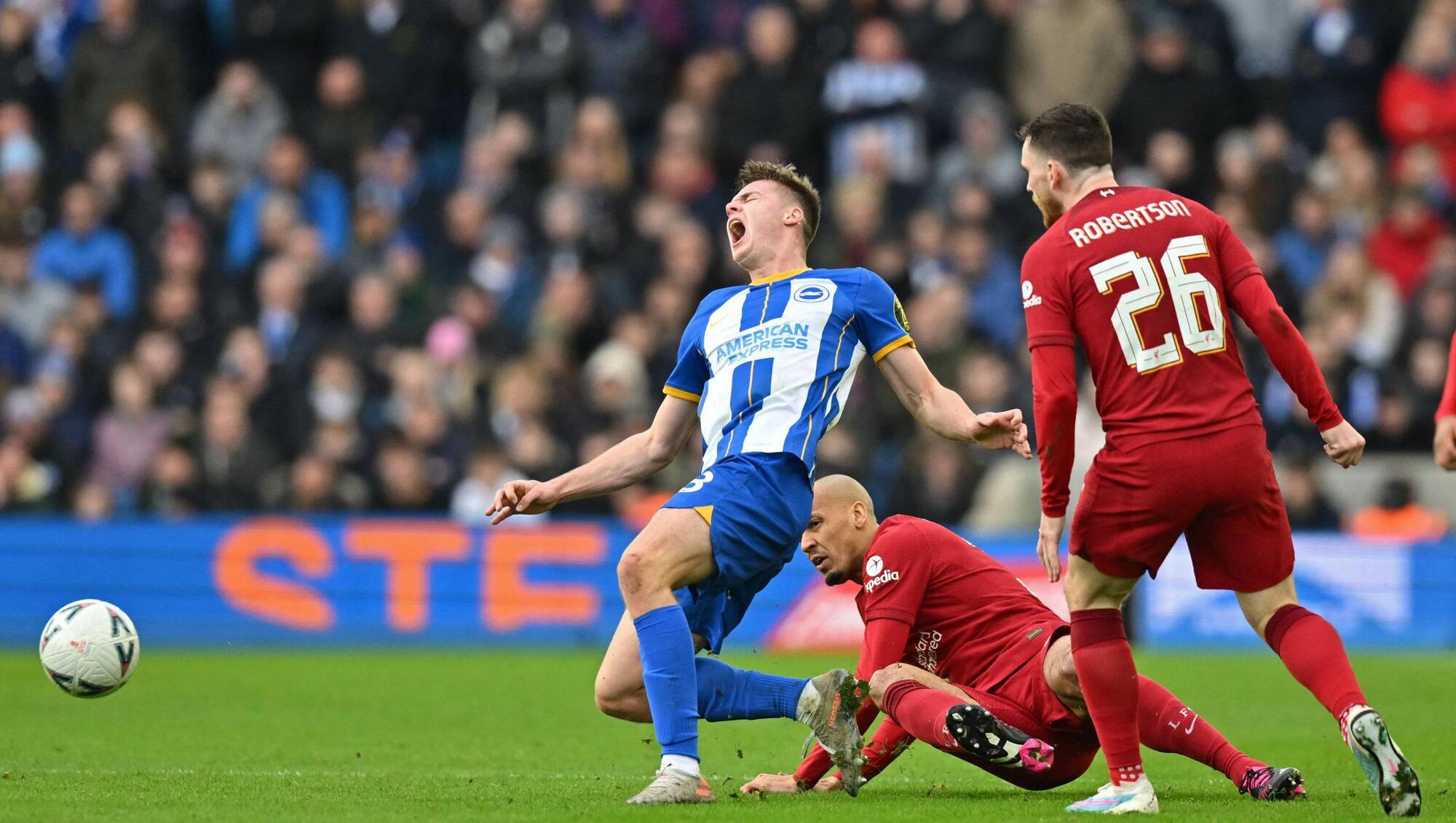
INTENT?: Liverpool midfielder Fabinho fouls Brighton's Irish striker Evan Ferguson during the English FA Cup fourth round match at the Amex stadium in Brighton. Pic: Glyn Kirk/AFP via Getty Images
It’s been a tough time to be a Liverpool fan, or in my case, to be Liverpool fan-adjacent. The club’s woes continue unabated, with a 2-1 defeat to Brighton last weekend eliminating them from the FA Cup. Though it’s a pity for Liverpool fans not to have put up a sterner defence of last year’s title, you could say it’s still a slight improvement on their 3-0 defeat to the same opposition in the Premier League mid-January; at least they looked competitive here.
The Reds ran afoul of the Brighton supporters, and of Irish Twitter, however, when midfielder Fabinho landed a horrendous, studs-up tackle from behind on 18-year-old Evan Ferguson – a Meath native and a revelation for Brighton in recent months. Ferguson has shown spark and poise off the bench, scoring his first Premier League goal against Arsenal on New Year’s Eve, and becoming both Brighton and Ireland’s youngest Premier League goalscorer in the process. He has seemed to relish playing on the big stage, and is a hugely exciting prospect for Ireland, especially heading into Euro qualifiers in the coming months.
Early reports suggest that, thankfully, Ferguson should be okay, though Fabinho’s kick into his literal Achilles heel could have resulted in much worse. Fabinho’s reaction to the tackle was notable: he grimaced, put his hand up, apologised, put his head in his hands, and visibly prepared himself for a red card. How he only received a yellow is a mystery. (Unsurprisingly, PGMOL – the body overseeing refereeing in English soccer – has since said that referee David Coote got it wrong on the day and that Fabinho should have seen red.)
What leads referees – especially refs who are backed by the highest-level technology – to make such human errors in judgement? Did the crowd’s incensed reaction have a countereffect on the ref, causing him to make a conservative call? Did Fabinho’s remorse help his case in any way? But then, did Fabinho’s remorse make a blind bit of difference to the outcome for Ferguson? It was unjust that he was the one that had to leave the field of play, not the player who committed the foul.
Fabinho’s response suggested that the tackle was one of reckless stupidity rather than malice, but should that make a difference in the referee’s decision-making? It raises an interesting question for rulebooks in all codes: does intent – or lack of intent – matter in sport?
In criminal law, the intent of the offender is taken into consideration and weighed in balance with the harm done to the victim. Hurting someone on the spur of the moment, in a sudden flash of anger, will result in a shorter sentence than plotting to hurt someone in advance. But can this logic be applied in sport? If one were to swing one’s hurley in wild abandon, but end up catching someone in the head, is that as bad as if you had set out to whack them in the first place? Does context matter, or does it just muddy the waters?
There’s a similar philosophical question at the heart of the ongoing Kilmacud-Glen saga. Not, so much, on the matter of intent: it would be a stroke of madness if the 16th man had stayed on the pitch on purpose, and it seems much more likely that his presence was the result of miscommunication and a lack of vigilance by officials. The question is to do with impact. Everyone agrees that the rules were broken, but did this infraction impact the result? Is it even worth asking the question, or is the fact that rules were broken reason enough to cancel Kilmacud’s win?
While the GAA’s initial passivity in this case was disappointing, ultimately the CCCC made the right call. Of the three choices on the table – fine, forfeit, replay – the third option is the most viable. Had the margin between the teams been insurmountable, a fine for Kilmacud might have been appropriate – but it is feasible that Glen might have scored a late goal had the 16th man not been present. A forfeit would have succeeded in making exactly no one happy, devastating the Kilmacud players and presenting Glen with a victory that they did not get to enjoy on the day. The replay’s the thing – whether it actually gets played now or not is another matter.
In all of the noise surrounding this unfortunate incident, it’s been fascinating to observe the breadth in opinion from former players. Dublin icon Philly McMahon wrote: "As a player, you’d be embarrassed to play that game again after losing the first day. Win, and it’s the most tainted medal you’ll ever own. Lose and you can double the embarrassment."
While I disagree, I can see the argument here – in some ways, the emotional arc of the All-Ireland is already played out. The win has been savoured, the defeat (partially) digested. But most other pundits, such as John Maughan and Joe Brolly, have argued in the opposite direction, pointing out that the result is already tainted; regardless of what happens next, there will always be an asterisk after this club All-Ireland. Just like the multiple camera angles of Fabinho’s horrific tackle, the lingering image of this final will be that much-reproduced behind-the-goal shot, with Kilmacud players labelled neatly 1 to 16.
The first incident that sprang to my mind in the wake of this fiasco was the 2016 All-Ireland ladies football final between Cork and Dublin. You remember it: HawkEye wasn’t switched on that day. Cork won by a single point in the end, but a point scored by Dublin’s Carla Rowe was incorrectly waved wide by the umpire. It should have ended in a draw. Controversies like this have always happened, and will probably continue into the future, human error being what it is. One can only hope that, if anything good comes of this mess, it’s that the GAA will respond more decisively next time.