Eimear Ryan: Boycotting the World Cup in Qatar is not as easy as it sounds for fans
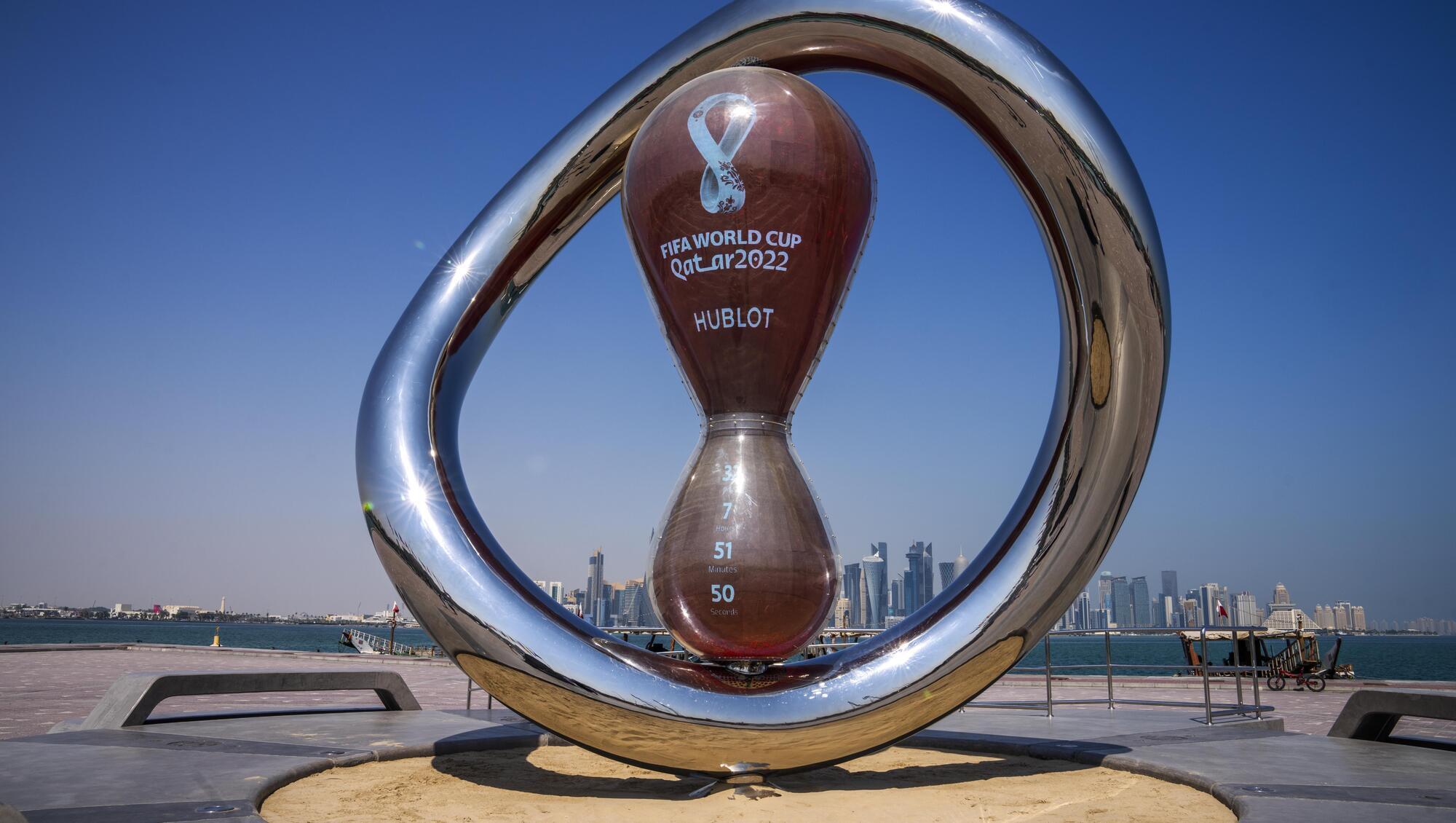
COUNTDOWN: The official FIFA World Cup Countdown Clock on Doha's corniche, overlooking the skyline of Doha, Qatar. Pic: AP Photo/Nariman El-Mofty

My Twitter feed is in chaos. Since Elon Musk’s acquisition of the social media app in late October, I’m seeing three broad categories of tweet: (1) users announcing their departure from the platform and explaining where they can be found online going forward; (2) Twitter employees announcing that they’ve been fired in one of Musk’s waves of layoffs; (3) parody accounts making fun of Musk, most of which are quickly shut down. So much for Musk’s much-trumpeted commitment to free speech.
There is another trend, on sports Twitter: longtime soccer fans announcing, in sorrow, that they won’t be tuning into the 2022 World Cup, due to kick off on Sunday week. The deaths of more than 6000 migrant workers during the building of World Cup infrastructure, as well as Qatar’s multiple human rights violations (homosexuality is illegal, for example), have made it difficult for fans to feel excited about the upcoming tournament.
In this pervasive multimedia age, however, boycotting the tournament is more complicated than ever. Is it enough to avoid sitting down to watch the matches? Or does a true boycott mean avoiding the sports pages for a full month, pausing your favourite soccer podcasts when they pivot to the World Cup, and – back to Twitter – resisting watching highlights clips when they pop up in your social media feed?
This is a compromised World Cup, unlike any in recent memory. Tony Burnett of anti-discrimination group Kick It Out has likened Qatar to apartheid-era South Africa – why would you reward such a regime with a global stage like this? It’s not ideal for the players, particularly those from countries who aren’t guaranteed qualification every four years.
For example, it’s Wales’ first World Cup since 1958, truly a once in a lifetime opportunity – what a pity, for players and fans alike, that’s it’s such a problematic iteration of the tournament. (It’s also not ideal for journalists on the ground, who will be grappling with Qatar’s propaganda machine and operating under rigid media restrictions.)
Small gestures, like Harry Kane’s pledge to wear a rainbow captain’s armband, seem feeble and tokenistic in the context of such a repressive regime, but it’s probably better than nothing. At the end of the day, soccer players are powerful – it will be interesting to see how they wield that power, for better or worse, on soccer’s biggest stage.
England players Lotte Wubben-Moy and Beth Mead recently made headlines by announcing that they wouldn’t be watching their male counterparts in the World Cup, citing Qatar’s anti-LGBTQ laws. Katie McCabe also announced she wouldn’t be watching, but for different reasons – she’ll be too busy playing Champion’s League fixtures with Arsenal, and anyway, Ireland aren’t playing in the tournament. Which is a fair point – this is an easier decision for Irish soccer fans to make. We have no skin in this game.
The disquiet over Qatar isn’t confined to modern-day Twitter wokeness, either – there has been talk of a boycott ever since FIFA made the decision way back in 2010. Sepp Blatter, whose very name sounds like a punchline from a bygone decade, has cast a long shadow. In a recent interview with a Swiss media outlet, he spoke of regret.
"It’s a country that’s too small," the 86-year-old said. "Football and the World Cup are too big for that … It was a bad choice. And I was responsible for that as president at the time."
Now he tells us.
**************************************
November: not ideal hurling conditions. As a spectator, I’m not complaining – it’s a privilege to get to watch the provincial hurling championship matches, such as last Sunday’s clash between Kilruane MacDonaghs and Ballygunner, on TG4. It was not a close game, but it was a spectacle nonetheless, and it’s always a privilege to see hurlers of this calibre – Dessie Hutchinson, Pauric and Kevin Mahony, Niall O’Meara, Cian Darcy, and national treasure Harry Ruddle – in action.
But your heart would go out to Kilruane in particular. It was their third match in a little over two weeks, and they paid the price in injuries, with crucial defenders Niall O’Meara and Aaron Morgan departing the game early. Compare this to Ballygunner’s eight-week layoff. In some ways it’s the opposite problem, in that you’re trying to keep lads focused and motivated, but at least the legs are fresher – that much was apparent on the pitch.
Besides this, Kilruane had to be emotionally exhausted as well as physically. Coming off a hard-fought replay against Kiladangan to win their first county title in 37 years, they had only a week to celebrate, process and refocus for the Munster match against the All-Ireland champions. The county final victory in Semple Stadium was an extraordinary bookend to their season, echoing the round 2 game against Clonoulty Rossmore at which Dillon Quirke collapsed. The trauma of Dillon’s death has galvanised and bonded the squad, and the club dedicated their win to the late Tipp hurler.
Reflecting on Kilruane’s season, it’s hard not to feel that the county championship means more to most players than the provincial or All-Ireland club championships. The county is the medal that most players want in their cabinet. The county final represents such a climax in the hurling calendar that it’s hard to see past it. When you win the county, it’s against familiar club rivals that you have a history with and have been trying to best your whole life. Obviously, if you get a chance to play provincial or All-Ireland club championships – the vast majority of players never do – you want to win them. But can it ever feel as personal, as urgent as the county championship?
‘A bridge too far today in the Munster Club Quarter-Final against an outstanding Ballygunner side,’ tweeted @MacDonaghsGAA last Sunday. ‘Dan Breen will spend the winter in the parish. We’ll settle for that.’
And isn’t that what it’s all about?