Paul Rouse: Why did Irish rugby stop for a Royal funeral?
The death of King George led to the cancellation of rugby matches in Cork and Limerick in independent Ireland in 1936.
Paul Rouse: Why did Irish rugby stop for a Royal funeral?

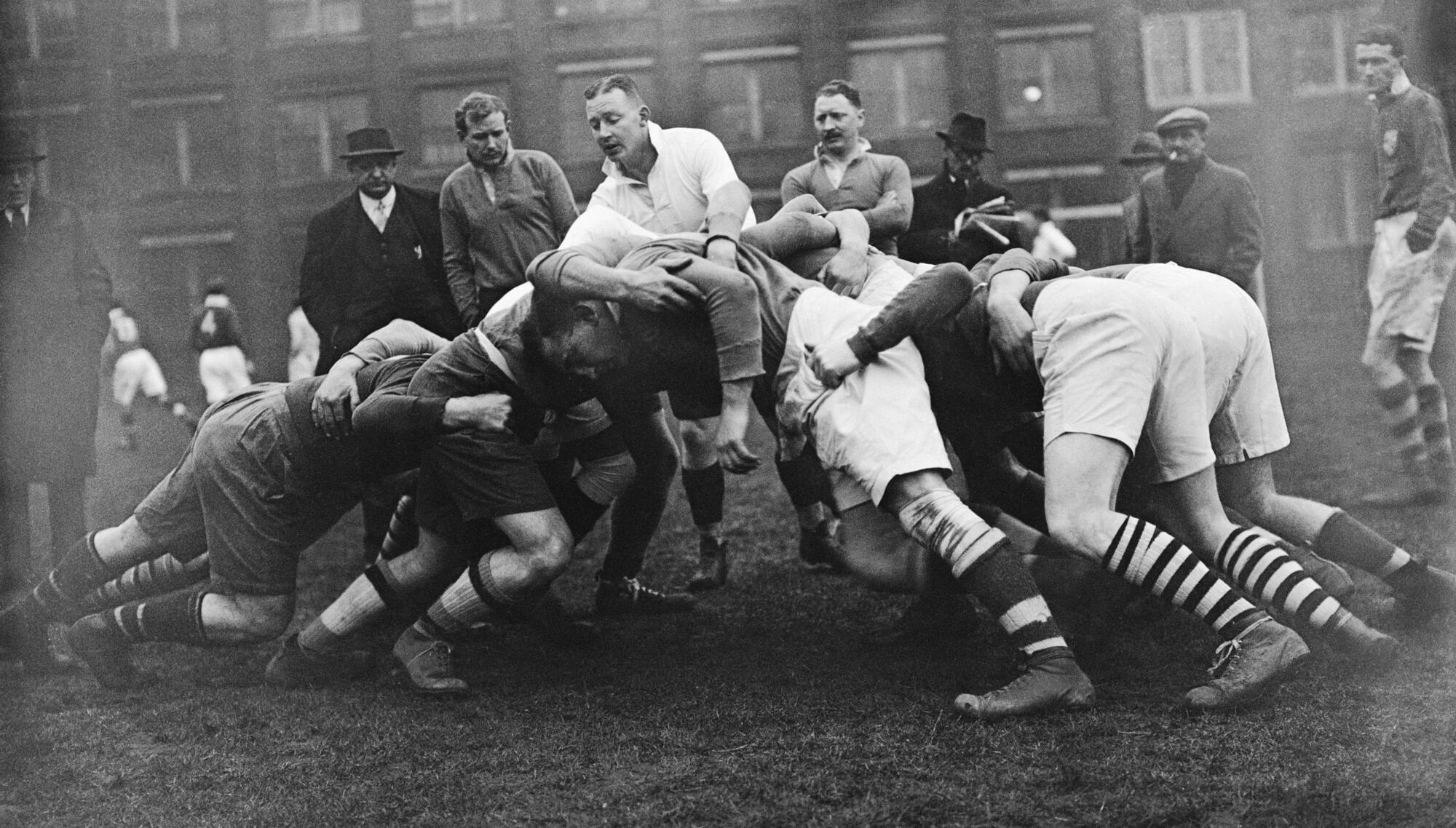
Way back then: Members of the Irish rugby team practising a scrum-down at the H.A.C. ground in Finsbury, London, before a match against England. 12th February 1937. (Photo by E. Dean/Topical Press Agency/Hulton Archive/Getty Images)

There were two small match reports in the sports pages of The Cork Examiner on the day before the funeral of King George V which caused a fair bit of trouble.

The paper came out on Monday, 27 January 1936 and the funeral took place in London on the following day.


The first report was headed “FRIENDLY DECLARED OFF” and it read: “The senior friendly rugby match between Constitution and Sunday’s Well billed for the Mardyke yesterday was postponed.” No explanation was given for the postponement.

The headline on the second report read “LIMERICK MATCH POSTPONED” and announced: “The match fixed for Thomond Park, Limerick, on Sunday, between Bohemians and Young Munster, was postponed by direction of the Irish Rugby Football Union, who have caused all fixtures to be cancelled owing to the death of King George.” 

The Cork Examiner on Monday, 27 January 1936

As always with history, of course, things were not quite as neat as all that: not all rugby fixtures were actually cancelled that weekend. For example, there was a Cork Junior League game at Model Farm Road where Highfield beat Dolphin and there was a Munster Junior Cup match where UCC beat Bantry.

Nonetheless, the simple fact is that the death of King George led to the cancellation of rugby matches in Cork and Limerick in independent Ireland in 1936.

By contrast, the Examiner’s sports pages record that all across Munster there was all manner of sport played on that weekend. There were golf competitions played out at Muskerry and Douglas, three different levels of soccer competitions played across Munster with many teams active, gun dog trials at Crookstown, and boxing and bowls contests.

The question at issue is: why were the rugby matches postponed when other sports were not?

The answer lies, in large measure, in the attempts by the IRFU to keep an all-island organisation intact. By 1936, soccer had been essentially partitioned for 15 years, while boxing, bowls and golf were defined by local dynamics more than anything else.

But rugby had embarked on a series of compromises that were designed to keep the four provinces federated in one overarching structure.

It was by this logic that one of the home matches for the Five Nations championship was played annually in Belfast, with the other in Dublin. It was for this compromise too that the Irish team stood for ‘God Save the King’ as the anthem in Belfast.

It was for this reason also that the IRFU designed its own flag in 1925. A considerable body of opinion argued that "when Ireland played at Lansdowne Road, she should do so under the national flag", but IRFU committee members noted that the common interest in rugby was not matched by political allegiance and that only the flag of the IRFU should fly at home matches.

There the matter lay until January 1932 when a letter from the University College Galway club complained at the failure to fly the Tricolour at international matches at Lansdowne Road. The letter asked other clubs to assist in "ridding rugby of its anti-national bias". A public controversy around the matter now emerged, however, and it was debated in the press and in politics. The Limerick Leader noted how British symbols were flaunted at rugby matches in Belfast so "we appeal to our clubs to protest against this unwarranted insult to each and every Irishman". The appeal was supported by rugby clubs from across Limerick, Cork and Tipperary.

The IRFU was then forced to change tack and it was agreed on 5 February 1932 that the Tricolour would fly beside the IRFU flag at all international matches in Dublin.

The following year – 1933 – there was further controversy over the fact that the IRFU had “to the King of England” as its first toast at its post-match dinners.

Generally it was around the international team that most disputes arose; the federated provincial structures allowed for a certain degree of local autonomy that allowed flexibility.

For example, club rugby in Munster saw matches played on Sundays, in complete disregard of the Sabbatarian demands of leading officials in Dublin and Belfast who insisted on Saturday play, with Sunday matches considered wrong and impermissible.

It was in this context that there was displeasure at the decision to postpone rugby matches in Munster because of the death of an English king.

A delegate from Cork Constitution told a meeting of the Munster Branch that – as Liam O’Callaghan has recorded in his excellent history of Munster rugby – there were officials making decisions who were pandering “to satisfy a certain section.” 

And it was the kind of pandering that allowed the GAA to make rhetorical hay. On the day of the match postponements, a series of GAA county conventions were held all across Munster. Reports of these conventions dwarfed all other sports coverage in the ‘Examiner’.

They tell a story of the legacy of the revolutionary decade and how vivid it still was in 1936. And how it coloured Irish sport.

From the Town Hall in Limerick came the words of the county board chairman, W.P. Clifford, who said “the young Gaels he saw around him were those who were prepared, if necessary, to carry on the fight for Irish freedom.” 

He referred, in this respect, to his hope that “some day the artificial barrier in the north would be broken down".

From over at the Kerry county convention at the Tralee Courthouse, the residual tension of the civil war was manifest in the debates that centred around John Joe Sheehy.

In Cork, the Chairman of the association there, Sean McCarthy, ranged widely over Irish history (from Thomas Davis to the Penal Laws and to Robert Emmet) and literature (from Daniel Corkery to Geoffrey Keating by way of Canon Sheehan) as he called for “the production of a manhood typical of the historic Irish nation.” 

There was a problem, though. As always, the pursuit of pleasure routinely destroyed the desires of ideologues. In Waterford, the county chairman William Walsh lamented at that county’s convention the scale of “the support given to foreign games and dances in Waterford". Therein lay the great undeniable truth in Irish sport after independence. The number of men (it was not an option for women) playing and watching rugby grew and grew.

At the start of the 1920s, rugby had been in a poor state, but by 1929 there were 160 clubs and 59 schools affiliated to the IRFU. Every province in the country saw its playing numbers increase, with the growth in Munster being particularly strong. This growth had been driven in the 1920s by the establishment of new competitions – particularly ones for junior clubs – and was most noted in country towns; rugby was spreading into areas where it had never previously enjoyed any favour. The growth of the game at school level – a growth driven by members of the Catholic clergy in schools across the Irish Free State – was crucial to all of this.

What this also meant, of course, is that the trajectory of the game was clear in terms of its symbols and its gestures in Munster. By the Second World War, Sunday play would be entirely regularised and there would be no prospect of matches being put off for a funeral or a coronation in London.

Of course, the postponements of matches left Irish rugby open to the taunts of its opponents. As have other compromises and decisions around symbols and anthems.

But it is also the case that Irish rugby can itself respond by saying that it has managed to remain an all-island organisation open to both traditions. By contrast, the FAI operates on a partitioned basis south of the border and the GAA is partitioned by community, even if it extends across 32 counties.

There is a reckoning with unionism which much of nationalist Ireland has yet to properly consider, let alone answer, beyond the rehearsal of slogans and mantras.

Paul Rouse is professor of history at University College Dublin

x

More in this section

Sport

Newsletter

Latest news from the world of sport, along with the best in opinion from our outstanding team of sports writers. and reporters

Cookie Policy Privacy Policy Brand Safety FAQ Help Contact Us Terms and Conditions

© Examiner Echo Group Limited