Eimear Ryan: As a brand, camogie is buzzing, but still scope for improvement
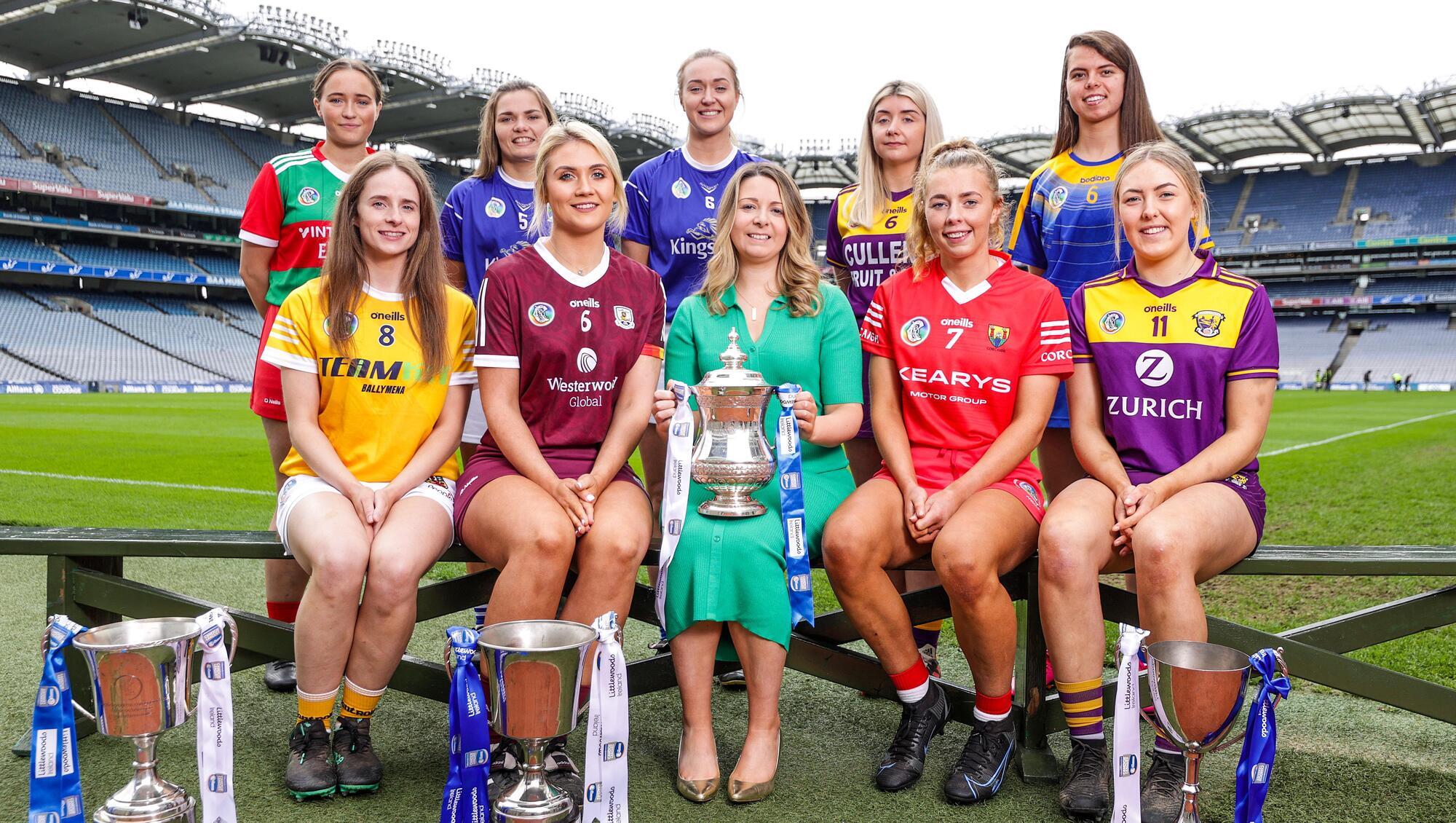
Pictured at the launch Of The Littlewoods Ireland Camogie League finals. (Front row L-R) Antrim’s Lucia McNaughton, Galway’s Emma Helebert, Littlewoods Ireland Head of Marketing Catherine O’Toole, Cork’s Laura Hayes, Wexford’s Ciara O’Connor (Back row L-R) Mayo’s Meabh Delaney, Cavan’s Aideen Coyle and Josephine Maguire, Wexford’s Aideen Brennan, Wicklow’s Ciara Kelly
Camogie has been surfing a wave of good news over the last month. The positive press releases keep coming: a lucrative new seven-figure championship sponsorship deal from Carmel Naughton and Glen Dimplex, worth €250,000 per year for the next five years; a new agreement with RTÉ, guaranteeing broadcast of at least nine live camogie matches per year until 2027; and an innovative new championship arrangement whereby all of this year’s Munster hurling fixtures will have camogie matches as curtain-raisers. Provincial championships have always taken a bit of a backseat in camogie, with its open-draw All-Ireland system, so it will be interesting to see if this new format raises the stakes.
What’s more, plans for integration with the GAA – long supported by camogie president Hilda Breslin – seem to be moving along nicely. Last weekend, 97% of camogie congress voted in favour of integration, and the GAA’s new five-year strategic plan sets ‘producing a shared vision of One Association with a roadmap to make it happen’ as a priority. This accelerates the timeline for integration considerably when compared to the previous report ‘Towards 2034’, although GAA president Larry McCarthy did sound a few characteristic notes of caution in terms of the time frame.Â
As a brand, camogie is buzzing, and like all advocates for the sport, I’m counting on this Saturday’s league final between Cork and Galway in Croke Park (RTÉ2 from 7pm) to bring us the same kind of freewheeling entertainment and championship teeing-up as the league hurling decider did last weekend.Â
My money’s on Cork. New manager Matthew Twomey, assisted by motivator in chief Davy Fitz, has brought an injection of freshness and hunger to this experienced group. Looking for their first bit of silverware since 2018 and their first league title in almost a decade, they’ll savour the opportunity to strike back at Galway after their defeat in last year’s cracking All-Ireland final.
Over the past ten years in particular, the box office appeal of camogie has gone through the roof. This is due to a multitude of factors: increased coverage, broadcasting and streaming of games has enabled spectators to become more invested; rule changes have loosened up the flow of games; and increased focus in areas like S&C has given players the tools to be the best versions of themselves.
Camogie has one main optics problem compared to hurling: a small pool of potential winners. The recent camogie All-Stars illustrated this. While six counties were represented in the nominations, the usual triumvirate of Cork/Galway/Kilkenny accounted for all the winners. And while the likes of Waterford, Wexford and Dublin are steadily growing in influence, only Tipperary has caused any palpitations to the top three in recent memory.
Tipp have had an unhappy run in the league the last number of years, performing exceptionally well only for games to slip out of their grasp in the dying moments. They qualified for the league final in 2020, only for that fixture to be cancelled due to Covid; they led eventual champions Kilkenny for much of the semi-final last year, only to lose by a late goal. Some adjectives that I’m sure Tipperary players would gladly never see again in headlines related to their performances include heroic, gallant, brave, heartbroken, and crestfallen.
As a Tipp fan, I watched the final minutes of their league semi-final against Galway with white knuckles. Tipp led for much of the game, but Galway hung in there steadily, a Siobhán McGrath goal in the second half bringing them back within touching distance. Three minutes from time, the unerring long-range freetaking of Rebecca Hennelly levelled things up. Then, seven minutes into injury time, Tipp’s Claire Hogan gathered the ball near the halfway line. Seconds later, Sarah Dervan stepped into her path; both players went to ground. The ref immediately called a free for Galway which Hennelly calmly converted the seal the win.
Charging: another vestigial rule in the camogie playbook, one of the last few differentials from hurling and one which, I’m sure, many players would be happy to see the back of. To be clear, Dervan did exactly the right thing, what you would want any back to do, but Hogan – being pursued by two Galway women and having just taken possession – did not have time to avoid her. That’s the crux of the rule: the onus is on the person in possession to avoid a collision, and so if a collision occurs, the person in possession is in the wrong. But this is hurling after all – things happen within seconds, and oftentimes the person with half an eye on the ball is least equipped to alter their path. Sometimes a collision is just a collision: no one’s fault, and not the basis on which a semi-final should be decided. More motivation for Tipp come championship, and – hopefully – yet another rule change for camogie to contemplate.