Tommy Martin: As in politics, Ireland’s mood for change is heavy in the sporting air
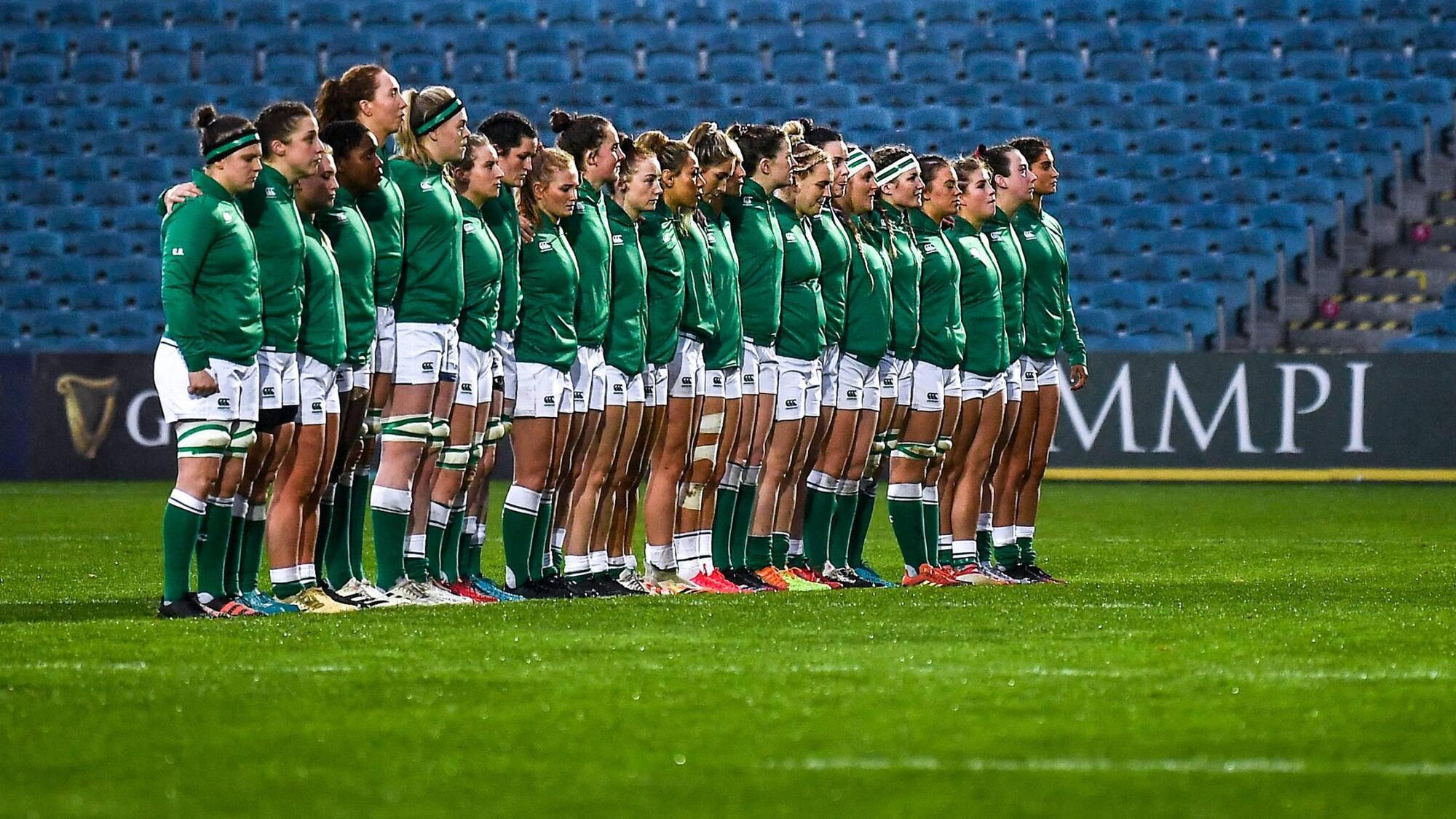
Ireland players stand for the national anthems before the Autumn Test Series match between Ireland and Japan at the RDS Arena in Dublin. Picture: Harry Murphy/Sportsfile

Is Ireland really poised on the brink of radical political change?
After all, this is a country which has never been richer, healthier, or better-educated. The United Nations ranks its quality of life as second best on the planet. It is one of the few developed countries in which income inequality has fallen in recent decades. As the State approaches its centenary, according to Mark Henry, author of In Fact: An Optimist’s Guide to Ireland at 100: “Not only have we taken our place among the nations of the world, but we have taken our place among the leading nations of the world.”
And yet Ireland looks increasingly likely to throw out the prevailing political order which has ruled over it for a century.
According to the most recent IPSOS MRBI poll, Sinn Féin has reached a record level of support at 35%. This is more than 10 percentage points higher than the share the party recorded in the 2020 general election, when a miscalculated candidate strategy cost them a clear electoral victory.
The expressed support for Sinn Féin and other, smaller left-wing parties has been interpreted as a rejection of the ruling centre-right consensus by younger and middle-class voters, primarily over the issues of housing and healthcare. If the current poll numbers play out come the next election, Sinn Féin will romp to victory and the former pariah party will hold the levers of power.
So, if we’ve never had it so good, why do we want change? Did the State’s decade of centenary commemorations provoke widespread contemplation and a desire for something more meaningful than wanton neo-liberalism? Are we in a period of post-revolutionary disillusionment, where the seismic social changes achieved in recent decades have left people unwilling to accept old inequalities and power structures?
Or are we simply spoiled rotten?
If you trace your finger over the contours of Irish sport in 2021, you will find the same ruptures of radicalism and frustration behind the headline-grabbing successes. Women’s sport led the way here as elsewhere, the most prominent example being the very public attack on the IRFU last month by 62 current and former women’s international players in a letter addressed to both sports ministers. The letter was the culmination of long-standing frustration at what they described as “inequitable and untrustworthy leadership”.
Among other issues, the players felt the union had not taken their share of responsibility for the shocking downturn in performance of the international team, who have gone from World Cup semi-finalists in 2013 to failing to qualify for this year’s tournament.
They said their letter came only after the failure of previous attempts to “work constructively with the IRFU to help them to understand how the players have felt over many years”.
Their point was proved by the union’s belligerent response, which amounted to a wish for the women to shut up and let the grown ups get on with things. That the grown ups were mostly men didn’t help. The IRFU’s subsequent climbdown under threat of loss of Government funding was a major result for the players and a vindication of the courage they showed in taking their stand. It is unlikely they will be treated so dismissively in future.
At its core, the women’s rugby issue was about respect and control, or the lack of it to be more precise, issues over which women have long had to fight. It simply wasn’t acceptable for a male-dominated institution to adopt an attitude of patrician disdain in the face of concerns expressed by committed, engaged sportswomen wishing to have a say in how the game they loved was run.
You can’t get away with what the IRFU tried to do anymore, not when equality is the guiding principle of our times and social media allows those with a perceived grievance ready access to public sympathy. Women’s sport is where these issues surface most often, because it is where most inequalities lie, but the refusal to accept things just the way they are goes beyond gender.
The GAA’s great off-field debate in 2021 was over the future structure of the inter-county football championship. That this became a debate at all shows how things have changed. The expectation was the greybeard electorate at October’s Special Congress would mull over the proposed options without much controversy, its conclusions digested by the wider public only when the next ball was thrown in the following spring. Instead, another fundamental schism revealed itself. The Gaelic Players Association (GPA) declared the support of 80% of its membership for the so-called Proposal B, which would establish a league-based championship disconnected from the traditional provincial structure.
Inter-county players publicly supported this proposal because it was felt to have an egalitarian thrust. It would, it was hoped, provide meaningful competition for scores of players from smaller counties whose efforts were being rewarded with frequent, degrading hammerings in the current championship model.
Such radicalism from inter-county GAA players might be the result of a classic case of elite over-production. This is the theory that political instability happens when societies produce more educated and ambitious people than can be accommodated into positions of power and influence. Every inter-county GAA panel is now elite in its commitment, preparation, and ambitions, yet the structures in which they operate are ancient and inequitable. Hence the huge pressure for change.
Opposition came from those eager to protect the traditional structures. Officials from provincial councils argued most strongly in favour of the status quo. When it was put to one of them, Michael Reynolds, secretary of Leinster GAA, that the players were strongly in favour of change, his response was that “in two years those players won’t be there”.
It felt like the moment the erstwhile uppity players’ association took the moral high ground. While Proposal B failed to achieve the necessary two-thirds majority in October, support for the principle of change was such that two new proposals will go before February’s Congress which will attempt to satisfy the players’ demands. As with women’s rugby, those whose voices mattered most will eventually be heard.
If rugby and GAA grappled with lofty matters of power and equality, soccer seemed to console itself with a very traditional debate: whether the manager of the national team was any good or not. And yet within the empirical arguments for and against Stephen Kenny lay another deeper, more fundamental theme.
Despite dreadful results in the early months of his tenure, support for Kenny remained remarkably resolute among that loose conglomerate known as the ‘Irish football public’. While most criticism of Kenny came from established figures within the game, there remained strong support for the aspirational tone of the manager’s grand plan (the promotion of young players and an attractive brand of football being undeniably populist football policies).
Following disappointing home draws with Azerbaijan and Serbia in September, a survey carried out by the research company Ireland Thinks reported that 80% of respondents felt that Kenny should continue in the job. Large attendances and vocal backing at home internationals once crowd restrictions were lifted seemed to back up the sense of a public mood in favour of the previously embattled manager.
The support for Kenny may be part of a deeper desire for an identity for Irish football beyond that of being a de facto dominion of the British game. The long-standing manual for the international team — appoint a gruff figurehead to instruct a spirited but limited squad in functional football — appears to have run out of road.
Beyond that, the Premier League remains king, but perhaps weariness at its excesses has inspired a slight but perceptible nudge in positivity towards the League of Ireland. If there is a wider disillusionment at the alienating forces of the market, then you would imagine local football clubs can only benefit.
Sport keeps showing us how it reflects society and the radical mood in this country backs that up. As with the IRFU and the GAA’s administrative old guard, Government struggles to douse protest movements that can harness public opinion to a righteous cause, like the Mica Redress campaign. Irish football’s soul-searching may well mirror a greater thirst for better communities and a sense of pride in the local. And the concept of elite overproduction is very familiar to those fed up that their education and work ethic cannot get them a house to live in.
In a society that champions equality, everyone has a sense of entitlement, everyone must be listened to. One man’s freedom fighter is another’s opportunistic populist, but when you watch the big debates in Irish sport play out in 2022, look out for the marginalised voices and those who feel they are not getting a fair crack of the whip.
Despite our relative historic wealth and comfort, political change seems likely precisely because our expectations have never been so high and our ability to speak up never so potent — Irish sport, increasingly radicalised, is no different.