Positive approach pays dividends for Guardiola
Speaking at a conference in the Stollenbosch Academy of Sport a fortnight ago, an experienced, romantic yet ultimately pragmatic coach called Alan Zondagh challenged the mindset of the attending coaches by explaining a concept he has termed the Rugby Speedometer. To the left of his speedometer there is the more conservative, slow game. Defensive play and structure is paramount — lineouts, mauls, scrums, kick-offs. Don’t run it or pass it — kick it. Make it a 10-man game.
To the right then there’s the positive, creative, fast game. It’s all about rapid movement of the ball and off the ball. You throw the ball around, not just kick it away. Of course, you still put a value on structure and defensive play but you expand on those non-negotiable fundamentals.
The fast game is the preference of Zondagh’s son, AB, a skills coach with the Super Rugby Cell C Sharks, and which Alan himself has been advocating for years, but in the knowledge that it’s not as pervasive as the conservative, slow game.
Because here’s the thing: the creative, faster game is harder to coach. It takes more time to coach. It means making mistakes, turning the ball over. Not only will you risk losing the ball, you’ll risk losing games, and with it, your job if the boardroom doesn’t have the time or inclination to go with what you’re trying to do.
With the conservative, slow game, you’re much more likely to get results much quicker. By being hard to beat, you’ll win games. You’ll keep your job.
But here’s the other thing that the Zondaghs and All Blacks and Jim Gavins have noticed: the slow, conservative game will only bring you so far. You might win games, but you won’t championships — not the truly big ones anyway. The challenge as a coach is to bring your team from being a competitive team to a dangerous one, like Pat Gilroy did in 2011 and Jim McGuinness did a year later with Donegal.
For too many coaches, that transition is too dangerous in itself. And so, with so many risk-adverse coaches, we get risk-adverse rugby.
“In order for less robot-like play, there needs to be a mind shift in rugby,” Zondagh Snr has written. “The trick is to find a balance between conservatism and creativity, but as long as coaches remain steadfast in the former approach, there won’t be an improvement in play.” Coaches and followers of other sports can relate to his concern.
At the weekend his son AB elaborated further on the characteristics and perils of the conservative game. “When teams are playing for penalties and not really trying to play rugby. Slowing the game down, faking injuries, one-up rugby, dropping the scrum, senseless kicking. Not enjoyable. Rugby should be a fast, explosive game played intelligently by highly-skilled players.”
In a sense, Zondagh’s observation was just a more eloquent and rugby-oriented as well as less profane translation of the rant a Manchester United supporter went on in a vox pop after his team’s derby defeat at the weekend. With a face and voice remarkably like Ricky Hatton and the venom and discernment resembling of a 2002-2005 Roy Keane, the infuriated fan rattled off in the space of a minute to The United Stand a litany of grievances as well as 19 F-bombs. “What were his [Jose Mourinho’s] tactics?” he’d rhetorically ask in one of the few sentences he offered without a curse word. “’As soon as you get it, Rojo, just f***n’ boot it?!’ That was diabolical out there! Hoof, hoof, hoof!” Suffice to say, Ricky-Roy, being a fan of United and “not f***n Stoke”, has a preference for the faster side of the football speedometer.
Jose Mourinho doesn’t though, at least not when his side are up against a fellow top-six team. As Ken Early has recently noted, not once in any of United’s matches this season against City, Chelsea, Liverpool, Spurs or Arsenal have they have had more of the ball or more shots on goal.
The Republic of Ireland under Martin O’Neill also favour the conservative, competitive side of the scale. The journalist and coach Stephen Finn recently illustrated how on average during the last World Cup qualifying campaign, Irish players attempted a pass to a teammate 21 times per game, 10 passes less than each of those players would average with their clubs.
The same mindset has been rampant in Gaelic football. Coaches favour playing 14 men behind the ball. They tell certain players not to even think about kicking the ball. And they get results from it. They even might win a few trophies that way.
But, as Tony McEntee said to this paper five years ago when he was guiding Crossmaglen to another All Ireland, a team and a player can only develop so much if they can’t kick the ball. They’ll only go so far playing in the competitive side of the speedometer. Last summer showed once and for all that while Tyrone and Monaghan might win Ulsters being set up the way they have been, they won’t rattle Dublin the way a Mayo do, playing a more creative, uptempo game like McEntee has them playing.
When Guardiola was appointed Barcelona manager in the summer of 2008 – ahead of Mourinho whose diversionary tactics were as big a turn-off to the Barca board as they still are to so many fans and observers of the game — he was fiercely committed to the club’s tradition established by Cruyff. “The idea of playing in a way that no team has before in Spain seduces me. It is a sign of distinction, a different way of experiencing football, a way of life, a culture.”
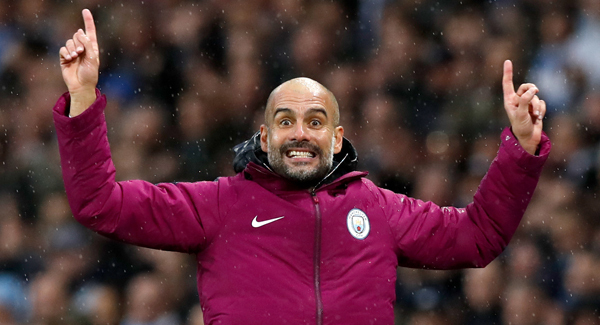
Two games into his tenure and Barca had picked up only a point. Yet he implored his players: Don’t lose sight of the target. “And the target,” as his biographer Guillem Balogue would write in Pep: Another Way of Winning, “wasn’t to win titles but to achieve a certain way of playing. If they stuck to their principles, titles would be the most logical consequence.” A similar story appears to be playing out in Manchester. After last Sunday’s derby he spoke about wanting to show that you could win playing the creative game in England. It took time, there were setbacks and mistakes made last season, but now his side are arguably the most dangerous in Europe.
Meanwhile, over on the red side of the city and speedometer, Mourinho has United set up to continue to win games, Cups, Ulster championships, if you will. But not Premier Leagues or All Irelands. As the title of Guardiola’s biography says, and which the Zondaghs will vouch, there’s another way of winning.