Kerry clinging to Dublin’s coat-tails
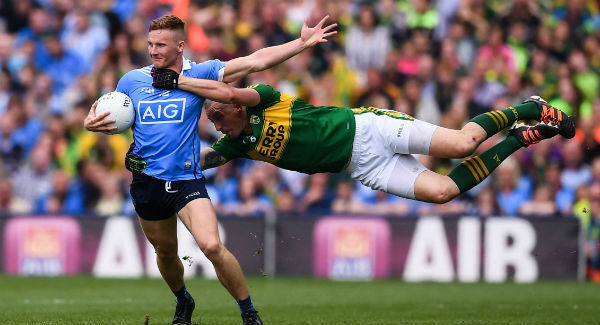

There’s something delicious about the fact Dublin are heading to Kerry this weekend as they bid to extend their epic winning streak. The fact the game has long been a sellout tells you all you need to know about how the game is being viewed.
A huge Dublin crowd is making the trip south. The fact the game was scheduled on St Patrick’s weekend has induced a sort of Gaelic tourism to break the spring.
It is to state the obvious the Dubs are travelling in full confidence of victory. How could it be otherwise? They have earned the right to that confidence. It is a wonderful thing to be able to play without fear. And it’s an even better thing to know when you take the field that if you play up to form, you will almost certainly win.
Dublin are better than Kerry at the moment. That this is the case is made obvious by the recent matches between the teams. Kerry have given Dublin some almighty shocks in the past two years, but they haven’t been good enough to win.
It was very interesting to be in Kerry in the days before last year’s semi-final. There was a simple question asked time and again: ‘Will you beat Dublin?’
And almost every single person answered with a ‘Yes’.
There was a tone to the ‘Yes’ that was strident.
And it was the tone that did not ring true. Coupled with the emotional newspaper columns written by former stars — some of whom painted potential loss almost as the death of a civilisation — there was a lot of emotion clouding the mind.
It was as if Kerry people were trying to convince themselves that they were good enough to win. And that’s never a good place to be in before a match.
And it’s certainly not a place that Kerry people wish to be in before they play Dublin.
It is precisely because they understand this is a brilliant Dublin team Kerry people are so exercised. Win or lose in the league match on Sunday, Dublin will be the team to beat in the championship. It would not be a wise move to bet heavily against them winning the All-Ireland again.
All told, it seems appropriate to ask just how good are the current Dublin team? It is to state the obvious they are an exceptional group of players — their achievements allow only for that interpretation. The way they play the game, their spirit, their willingness to fight, and the presence of a handful of players who stand comparison with the greats of any era mark them out as a special team. But where do they rank in the list of the greatest teams of all time?
A little perspective is usually fairly handy when it comes to judging teams and the players in them. Anyone who doubts that should look at the Punch-and-Judy style soccer analysts whose capacity to shift their opinions across the extremes in the blink of an eye is laughable.
Even the reaction to the Irish rugby team over the last six months makes plain the merit of a longer-term view. In the wake of the autumn internationals, all the talk was of unprecedented squad depth, Grand Slams, and even the prospects of arriving at a World Cup as genuine contenders.
Defeat to Scotland in the first match of the Six Nations then shifted the debate to who needed to be discarded from the team in order to allow it prosper.
Inevitably, the result (more than any performance) will see further overblown judgment passed on the merit of this or that player. And so on through the tournament, calm reason was left to one side as players were evaluated in the whim of the moment.
Part of the beauty of sport is the way in which it can grab the emotions and smother all reason. It makes sensible people say ridiculous things and present wild opinion as some sort of reasoned argument.
Now, all of this is only a bit of fun — maybe — and shouldn’t really be taken too seriously. People who are getting paid to talk on TV, radio and podcasts, and to write in the newspapers and on websites, are not being paid simply to deal in facts.
These facts are woven into opinions and wrapped up in boxes to be presented as truth. But context tends to get squeezed in this process — it’s too boring, perhaps.
In this instance, the context relevant to judging the current Dublin team is largely historical. This is because there is a clear benchmark: the history of the GAA provides a clear standard by which the greatness of the current Dublin team can be judged — the four-in- a-row. This matters in a way that no extended winning streak can match.
he very greatest teams in Gaelic football and hurling have cleared the bar of winning four All-Irelands, one after the next.
In football, Wexford were the first to do it. The Great War was raging and one of Wexford’s best footballers — James Rossiter — died fighting in France in the weeks before his county won the All-Ireland in 1915, and went on and won it on three more occasions before 1918. The transience of success is underlined by the fact that Wexford football then began a long retreat to the margins.
The next team to do the four in a row was Kerry, who managed the feat twice.
The first was in the years 1929-32 and the second was the years 1978 to 1981. No other county has won four All- Ireland football titles in consecutive years.
In hurling, the four in a row has been achieved twice. Cork did it in the years, 1941-44. And, of course, Kilkenny managed it between 2006 and 2009. Is it a moot point why nobody has managed to win five in a row. Some have come extremely close: For example, Kerry almost managed it in 1982 before being defeated in ‘The Greatest Match of All Time, Ever’ by Offaly.
Then Kilkenny hurlers were denied only by an epic effort from Tipperary in 2010. But, the fact remains their star-studded team — comprising some of the greatest players ever to play the game — could not manage to raise the bar of greatness to a new level.
It is a discussion for another day as to why no team has managed to make it to five in a row. It remains the Holy Grail for any who wish to be considered the greatest team of all time. (although of course, Jim Gavin won’t be entering into discussions around it before reaching for the four in a row, of course, Dublin need to win a third consecutive title.
In this pursuit they will be following various counties in football and hurling, including some previous wearers of the Dublin jersey.
Dublin’s footballers have won three in a row on three occasions: 1921-3, 1906-08 and 1897-9. Nonetheless, there is a level at which the Dublin team can fairly be said to stand — for now. Having won four titles in six years, they have equally the achievements of the Kerry team between 2004 and 2006. That team, too, was markedly similar to the current Dublin team for their style and sheer tenacity — as well as for their desire to keep coming back to the well. (And it doesn’t take a genius to understand that the Kerry lads are more than a small bit exercised by the prospect of Dublin adding further titles to their lustre this September and beyond).
In the meantime, they have a lot to be thankful for to Donegal. Not alone did they engineer a shock in the 2014 All-Ireland semi-final, but they were also obliging enough to come up short in the final. In the process they allowed Kerry to win an All-Ireland with a team that was full of heart and drive and no little ability — but could never be considered one of the great Kerry teams.
There are those who will argue that it is much more difficult now to win an All-Ireland than it was in the past. In particular, they argue that it is much more difficult to win consecutive All-Irelands and that comparisons between the different eras are unfair because of this differentiation.
When it comes down to it, such arguments don’t hold water. Dublin canter through Leinster without breaking sweat, have got relatively straightforward draws at quarter-final stage and are left then with two big games to hang onto Sam. It has ever been thus for the very best teams in All-Ireland competition.
Equally, sports medicine and the supports offered to GAA players at inter-county level are now of such quality that careers are being extended. It should be possible to ensure that the very best play longer and play harder. This should, in turn, bring still more success.
This, of course, is a story still in the writing. Every Empire eventually crumbles into dust — and no team dominates indefinitely.
The question is though: At what point will this Empire crumble and when it does where will Dublin stand on the scales of GAA greatness?
And will Kerry be the team to tip those scales?