The Andy Farrell factor can now be of benefit to Ireland
After two years at the top of the European rugby pyramid, Ireland have been forced to regroup after a very demanding period when resources were pushed to the limit. In adversity and with the pressure mounting after a winless opening three games, the back-to -back champions regrouped — admittedly against opposition of lesser quality — to deliver a morale-boosting finish to the championship.
Joe Schmidt is extremely good at achieving his goals, even if this was one that he hoped to surpass. Predicting a mid-table finish amid the clamour for a record third consecutive Six Nations on the bounce wasn’t, you sense, put out there as a means of dampening expectations. It was a realistic assessment of where his side stood shorn of some key individuals and, of even more importance, proven leaders.
After that disappointing opening to the championship, Ireland finished the campaign on a high and a scoring spree that belied the difficulties encountered in those early games. With 13 tries and 93 points scored over the final two weekends of action, Schmidt’s men received a timely confidence boost before addressing the next major challenge on the ever-demanding horizon, a three-Test tour of South Africa.
Scotland, on the other hand, arrived in Dublin buoyed by consecutive championship successes for the first time since 2006, chasing a third for the first time in 20 years. All indications were that under the astute guidance of Vern Cotter, they had finally turned a corner and were ready to step up to the next level.
While it was anticipated that their morale-boosting win over France could act as a springboard for another big win on the road in Dublin, the opening quarter suggested that, if anything, Scotland were left flat and lacking energy after clearing the psychological hurdle of a first win over the French in a decade.
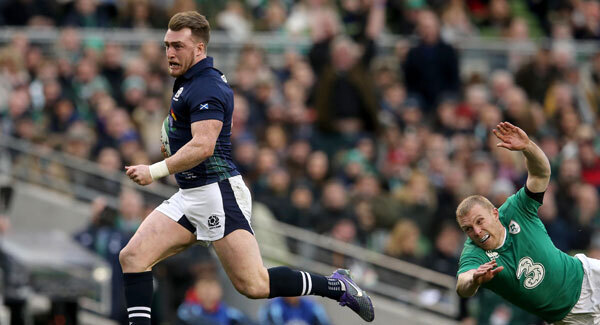
Ireland always looked the superior side even if Scotland, to their credit, refused to roll over.
Overall Schmidt won the tactical battle against Cotter, his former coaching comrade in arms, by completely dismantling the three key pillars of the Scottish game: The scrum, their breakdown efficiency, and their discipline.
Since the emergence of Willem Nel as a tighthead prop of real international quality, Scotland have used their scrum not only as a weapon of mass destruction but also, as Italy found out when conceding seven in Rome, as a penalty-generating machine.
Ireland’s control of possession and minimal error count in the first half was such that there were only three scrums in that crucial period, all of which resulted in Irish put-ins.
By the final whistle there were only eight in total, one of which saw Scottish scrum-half and captain Greig Laidlaw feed his own front row.
Jack McGrath was rock solid when pitted against Nel and has enjoyed a magnificent championship, while Mike Ross also managed to suppress any hint of scrummaging dominance from Scottish loosehead Alister Dickinson, who had enjoyed a very productive outing against French tighthead Rabah Slimani last weekend.
Of even more significance was the fact that the Irish back row of Jamie Heaslip, CJ Stander, and Tommy O’Donnell completely outplayed their highly rated Scottish counterparts, with John Hardie and Johnny Barclay rendered ineffective in generating their usual quota of turnovers.
Of equal importance was the fact that the Irish clean out at the breakdown was so clinical and effective that Hardie and Barclay were completely deprived of any opportunity to slow down the Irish recycle. As a consequence they got frustrated and were suckered into conceding a number of senseless penalties.
oming into this contest, Scotland enjoyed the best disciplinary record in the tournament, conceding an average of just under nine penalties per game. That went out the window, however, when the pressure exerted by Ireland forced the Scots to get on the wrong side of French referee Pascal Gauzere, especially at the breakdown. By half-time the penalty count was 8-1 in Ireland’s favour.
When Barclay pushed his luck too far after Gauzere had issued a final warning to captain Laidlaw, Ireland took full advantage and responded with tries from Stander and Keith Earls for a punishing 12-point return after he was dispatched to the bin. That tore the heart out of the visitors’ challenge, with Scotland emerging a clear second-best in key areas they had fancied themselves in advance to dominate.
The fact Ireland enjoyed a massive advantage in possession forced Scotland into making a whopping 92 tackles — Ireland were only required to make 24 — in that opening half and on the back of a six-day turnaround after that French win, that was sure to take a big physical toll.
Ireland have made an art form of sprinting out of the blocks in those key championship minutes after the break and, right on cue, Conor Murray delivered his third try of the tournament with what is fast becoming a trademark punishing lunge from close in.
Heaslip’s superb offload opened the door for a fourth from Devin Toner, sparking a melee that betrayed Scottish frustrations.
Once again Johnny Sexton was the victim of some bruising punishment but stood unbowed to deliver another impressive display in tandem with Murray in steering the direction of this contest with another varied and intelligent performance.
What will please Schmidt most is the clinical edge that always appeared to deliver points on sustained visits to the opposition 22 over previous seasons was restored in dramatic fashion in this contest.
Tries from Stander, Murray, and Toner bore the hallmark of Ireland at their best under the New Zealander, but one suspects that when facing the best of fringe defences delivered consistently by South Africa, Australia, and New Zealand over the next eight months, those five-pointers might not be so forthcoming. We will find out soon enough.
The most pressing area of concern that hasn’t been addressed satisfactorily throughout the championship is how narrow Ireland defend. One of the reasons England wrestled championship honours from Ireland this time out was their concession of just four tries — the lowest in the tournament. When Ireland topped the table in 2014 and 2015, they conceded only four and three tries, respectively.
This time out Ireland leaked nine. One suspects that with Andy Farrell’s gardening leave from the international arena expiring this morning, Ireland’s newly appointed defence coach can’t get to work too soon. It will be fascinating to see what impact he will make over the course of that three-Test series against the Springboks in June. Time to move forward.