Obligation to find hope in football
Crystal Palace coach John Salako was telling of his defender Martin Kelly’s brush with death in Paris, eating in a restaurant just off Rue Alibert, which terror was invading.
“It shows football isn’t so important, when you lose loved ones…” Salako told us, as the Sky man cut across him.
“But Kelly will be okay for Monday?”
He probably will, agreed Salako.
We have been told many times this week that events such as the Paris massacre put sport into perspective. Certainly, the bereaved and the survivors whose normality was butchered may find it hard to ever find perspective on anything again.
For most of us, the horror triggered a surge of appreciation and cold fear for the well-being of the people close to us. And maybe a renewed sense of how fragile it all is.
But these reboots of perspective also allow us prize more dearly sport, music, art, love — whatever the passions that enrich our short time.
We might, for a few days, find it harder to get worked up by ‘controvassy’, to be as enraged as usual by entrenched rivalries, to be quite so intrigued with who has slammed what.
But we can still look to Monday, or Saturday afternoon. To injury updates, to kick-off, to the prospect of three precious points.
And controvassy will rise again too, in time. We have a duty to embrace it all.
There is a reason why war has been declared on football. Why stadiums are being targeted. A sport seen to bridge belief systems and cultures is an enemy of a cause that thrives on suspicion and misunderstanding.
Every Barcelona or Real Madrid or Manchester United shirt we see in a Syrian refugee camp represents a dream that confronts a nihilism that values nothing of this life.
Football’s universal language is a dialect alien to forces for division.
Just as the French footballers felt a duty to muster a show of defiance at Wembley on Tuesday night, we have our obligations too.
To the people who huddled terrified from the Stade de France, singing La Marseillaise as they ventured into unknown depravity.
To the young Kurds threatened by ISIS with 80 lashes if they are caught watching El Clasico.
To the teenage Iraqis reportedly executed for watching an Asian Cup tie on TV between their homeland and Jordan.
The haunting minute’s silence at Wembley was a touching show of unity between two old foes. The communal singing was another.
But so too was the eruption of joy at Dele Alli’s screamer. A signal that perspective won’t rob us of our passions.
WONDER GOAL: A cracking first @england goal from @dele_alli36 in the 2-0 win against @equipedefrancehttps://t.co/1ByS2pUD6Q
— England (@England) November 18, 2015
There was an obligation to find joy this week. And it wasn’t hard at Lansdowne Road on Monday.
It had been more difficult enough during that bizarre first leg in Zenica, through the fog and the breaking news.
And yet a friend, who was losing someone very close, far away from Paris, put into perspective the joyous power of sport.
“I couldn’t help roaring and laughing at Robbie Brady’s wonderful, mysterious, ghostly goal.”
With no inkling of the unfolding nightmare elsewhere, George Hamilton, as he invariably manages, delivered a line we could cling to: “Out of the gloom, the brightness shines.”

It was easier to see clearly on Monday, a night when cynicism was impossible and would have felt jarringly out of place.
At another time, you might marvel at the generosity of the handball decision against Ervin Zukanovic and wonder if €5m should soon rest in a Bosnian account.
On another day, you might reflect on Ervin’s sanguinity afterwards, telling his home media that Ireland deserved to win because they showed the desire his team hadn’t, and you could recall darkly the fuss we once made when we considered ourselves victims in Saint Denis.
On another day, you might dwell a little longer on the need to keep the ball.
But on this day, it was easy to fulfil the obligation to find beauty and joy.
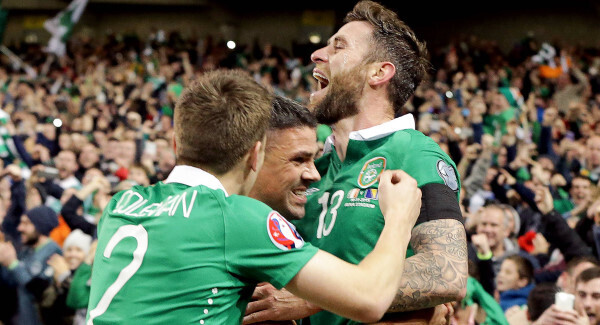
There was the great release of relief and exuberance after Jon Walters’ second goal.
Anyone in the ground will tell of their vow to treasure it, one of those visceral moments when a collection of spectators lose themselves and transcend into one heaving organism and are carried in that state to the finish.

But there were also the vignettes, some of them captured in the match photography, or in the TV coverage, or across the social media reaction.
Little stitches in the tapestry that draw in our past and lend little meanings to our passion.
Roy Keane, age creeping into his face and perhaps a little serenity with it. The joke about Saipan, a sense of old enmities finally put to bed. And maybe dues paid.
John O’Shea high-fiving Shane Long’s little daughter on the pitch afterwards, a lovely portrait of the culchie revolution given momentum by that first intoxicating wave of success under Jack.
Robbie Brady, talking of the dreams of wearing the green he and Jeff Hendrick shared since they were six years old. Now, together with Wes, responsible for the odd thrilling triangle of enterprise down our left, and emblems of the audacious, streetwise genius Dublin schoolboy football can provide.

Back in studio, the quiet pride in Gilesy, the grandfather of Dublin schoolboy football’s streetwise genius. The little melt of good humour in Chippy, it’s uncle. In Eamo, its imperfect cousin.
You could hardly look at James McClean’s harum scarum effort and think of politics or division, only a man driven near distracted by his passion.
And it was somehow appropriate too that the hero represented the second generation. Jon Walters could only think of his Irish-born mother, who died when he was 11, smiling down on him. An unspoken rebuke to anyone who has muttered of plastic paddies, and a nod to the succour faith can provide, on its better days.
It felt equally important to note that many of the players used in qualification began their careers in the League of Ireland. Invariably, that meant they had to be patient and chase their dreams, rather than see their dreams come chasing.
Lads who wouldn’t let hope die. Which is all we can do, whatever our perspective.
Heroes & Villains
He knew little of the unfolding horrors during the first leg in Zenica, with no screens in the press box and no WIFI.
He knew little of events on the field either, with the fog, forcing the intrepid Mackey to seek text updates from base, where we could see nothing either. We tried, but the texts all arrived in bulk, long after the end. A trojan effort, then, to file a 1000-word match report, with no clue what happened in the second-half.
Discussing ticket prices on Newsnight, the Premier League chief distilled his betrayal and misunderstanding of football supporters into one neat soundbite: “Most people can afford to see the occasional game.”