Reality bites but Paulie’s influence can still be ‘unreal’
For those who know and have soldiered alongside Paul O’Connell, there’s a word they’ve noticed that the man is especially fond of using.
While there’s no better man to challenge you, there’s no better man to encourage you either and salute your effort and performance as “unreal”.
Peter Stringer picked up on it before O’Connell ever wore the Irish jersey. The week before his debut in the opening game of the 2002 Six Nations against Wales, O’Connell was deemed the RTÉ Man of the Match in Munster’s stirring Heineken Cup away win over Stade Francais in Paris. In his post-match interview his delight and passion for Munster was evident, if not quite as public or as emotive as Ian Madigan last Sunday.
Everything and everyone was “unreal”. The game. Rob Henderson. Stringer. “The lads” in general.
Stringer would play the interview in the team room the following Monday and still has it on his phone. And as he tells in his new autobiography, every now and then through the years he sends it on to O’Connell, as a reminder of where he came from.
More than a hundred caps later, if ever there was an Irish performance that O’Connell’s favourite term of endorsement was fitting for his teammates, then it was against more French opposition last Sunday.
The intensity, application and execution of his teammates; the manner in which a new wave of leaders and players like Rory Best and Devin Toner stepped up; the way the Ian Madigan and Iain Henderson and the rest of the bench stepped up and seamlessly slotted in when leaders like him had to cry off. Unreal.
But the same could be said of the loss he’d be to this group. Unreal.
O’Gara alluded to it in that passage from his first book, recounting a narrow defeat to Wasps in the opening round of the 2007-8 Heineken Cup campaign. Five years later in his second book, Unguarded, O’Gara would observe, “Presence in sport is huge and you either have it or you don’t. No one in Irish rugby has presence like Brian [O’Driscoll] and Paulie.”

The key here though is that O’Connell’s presence isn’t lost.
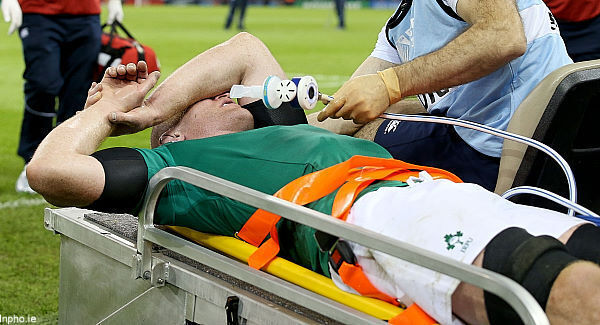
Contrary to what has been widely reported, Paul O’Connell’s Ireland career is not over. His Ireland playing career may be over but his time as captain and leader of this side is not over. His leadership and presence will still be necessary and critical for the rest of this tournament. As much as he’ll be missed out on that field, his contribution in the team room and dressing room can still be “unreal”.
A certain dynamic can kick in when your leader goes down. In 2012, I saw it first-hand as part of the Mayo backroom team when captain Andy Moran collapsed in agony upon severing his cruciate ligament in an All-Ireland quarter-final against Down. He’d been on fire that day, and a reigning All Star, yet right after the game as everyone clasped Andy’s hand while passing him as he lay on the treatment table, team manager James Horan reminded everyone that Andy would be the very first one to say it: his misfortune was now someone else’s opportunity. Next Man Up. Who was it going to be? Who was stepping up?
Over the next few weeks nearly every forward in the panel did, helping the team to what outsiders considered a surprise All-Ireland semi-final win over Dublin. A few starters became more vocal than usual; a few others showed for more ball; a few subs put up their hands. Yet in the lead-up to that game, Andy himself was invaluable. Even the morning right after his injury he’d got out of himself and into the team, being one of the first down for breakfast and his usual chirpy self around the group before heading to the Santry Clinic to start planning his operation and recovery.
Over the following weeks he’d continue to chip in with a word here and insight there to a few individuals or to the group in general, especially the night before the game. Just his very presence and bubbly personality brought an energy and positivity to the team that was contagious.
O’Connell is a different sort of leader and personality. With his entire playing career, not just his tournament, now doubtful, his mood could understandably be quite dark, to the point he could remove himself from the group for a period of time. His former Munster clubmate BJ Botha did just that in the 2007 World Cup, skipping the quarter-final stage, before rejoining the Springboks family.
The group could probably survive for a week without O’Connell. Part of being a leader is to create more leaders and that is something O’Connell has done, just like Keith Wood and O’Gara and O’Driscoll before him. But to reach or even win a World Cup final, just think of the asset O’Connell would be around that group, identifying an opposition line-out, supplying the right word or even look to a teammate or the team.
How the likes of Henderson stepped up last Sunday suggested this group has the I Am Spartacus squad mentality any champion team requires. But there should be no mistaking the identity or the future value of their original Spartacus. He can still win this and his World Cup.