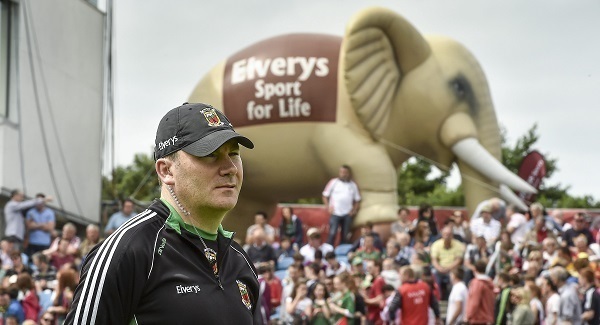
Mayo know change needed to reach final destination
All those hours spent on the M2 motorway, and all those hours spent running round a pitch, for what?
They say it’s the taking part that counts. For some people it is. I’m not one of those people.
I don’t regret playing club football. I have great memories. But again, what saddens me slightly is that most of my favourite memories didn’t actually take place on the field of play.
Take the night in 1999 when Ryan Giggs scored that famous goal against Arsenal in the FA Cup semi-final replay. A lot of people will have watched that game on television. Not me. I was one of four six-footers crammed into a Citroen Saxo. We were returning to Belfast after a midweek training session. The game was on the radio.
All four occupants of the Saxo were Man United fans. Big Gregory McCloskey, our driver, was the most rabid of all. Big Greg was shouting and swearing profusely. He was also driving about 90mph.
Tension was high. When Giggs scored, I’d swear the wee Citroen nearly lifted off the road. It was one of those moments you never forget. To this day, that FA Cup semi-final is the best game of soccer I never saw.
When you spend so much time travelling with team-mates, you soon get to know their idiosyncrasies. As a passenger, Fergal P McCusker was like a baby. The car sent him to sleep. Within about 10 minutes of every journey, he was out for the count. Head back. Nose up. It was like he was drugged.
As a driver, Benny McKeefry had the rather disconcerting habit of seeking eye contact with whomever he was talking to.
Even Benny’s back seat passengers weren’t immune. Benny used the rear view mirror. I often suspected Benny thought the rear view mirror was actually designed for that purpose.
Consequently, while Benny held eye contact, everyone else in the car had to watch the road. We lost more sweat in some of those car journeys than we did in some of the training sessions.
The highlight of every return journey was the game we played on the drive through Belfast. The challenge was to get through as many traffic lights as possible without stopping. The only stipulation was that the car couldn’t come to a complete standstill. Like Gaelic football, the rules were grey.
Breaking the lights wasn’t banned, but it wasn’t encouraged.
Being competitive animals, this nightly gauntlet run was taken extremely seriously. If the lights were red, the favoured method was to crawl towards them at about three miles per hour. Sound easy? Try doing it for 200m with a queue of crazed Belfast taxi-drivers on your tail, flashing their lights and blaring their horns as if they’d just won a championship.
To win, it was the price you had to pay. As a footballer, there were times when I was prepared to do whatever it took. But even then, I knew there were years when it was a complete waste of time.
But when you play for your club, once you have signed up, you don’t really have any other choice.
There is an unwritten obligation.

Sambo McNaughton told me a yarn a few years ago which summed this up perfectly. Cushendall had lost a big game. Sambo and a few of his friends were poking through the embers. Morale was low.
There had been extensive preparations. A huge effort had been made. But it seemed like the senior team hadn’t made one iota of progress. Sensing the mood of abject despondency, Sambo rallied the troops. “At the end of the day,” he said, “we can curse and moan and whine all we want, but what are we going to do, start playing soccer?” And everyone laughed at the sheer absurdity of the notion.
Sambo understands. Within most clubs, and most counties, there is no choice. The expectation to play is more binding than any contract. And that’s why the Mayo players did the right thing. Unconvinced that Pat Holmes and Noel Connelly would lead them to the Sam Maguire Cup, they asked the two men to move aside.
When you are committing your entire life to a goal, you must have total belief in your leader. If that belief doesn’t exist, then it’s pointless. And these Mayo players know the clock is running out on them.
The accusation that they have lost the run of themselves doesn’t withstand much scrutiny.

Consider their conduct under James Horan. Despite the fact that Horan’s tactical lapses were often highlighted by pundits, the Mayo players were unflinchingly loyal to him. For four years, there wasn’t a murmur of discontent let alone rebellion.
It’s often said that the game reveals character. The reason this particular group of Mayo players has won the affection of so many neutrals is because they have shown themselves to be an exceptionally brave and honest group of footballers. They are also ambitious and they want to win an All-Ireland title. When the players don’t want to leave, it makes more sense for the management to stand down.
The players have brooked a lot of criticism for their coup d’état. Yes, they’ve uprooted two fine, upstanding individuals who have served Mayo with honour. And yes, this upheaval will cause division and wounds that will fester for years.
Such is life. Holmes and Connelly must realise that it’s nothing personal. It’s football. And that’s even more important than business. These Mayo footballers want to win an All-Ireland title. To achieve that goal, they want a management team they believe in.
Contrary to the common consensus, their behaviour over the past week should be interpreted as a very encouraging omen for the future.
At long last they are starting to apply the type of single-minded ruthlessness which has been absent from their performances.
When these Mayo men look back on their careers, they want to have more than memories of car journeys. They want medals too. To those of us who have travelled down similar roads, it makes perfect sense.