United take the role of giantkillers
Chelsea, already with a ferociously relentless look about them this season, are certainly fit for purpose. But United? Even with the fresh application of glittering stardust in the form of Di Maria and Falcao, there’s still an unsettling sense that Louis van Gaal’s side are raw understudies who will struggle to live up to such a leading role. And not for some time has Old Trafford been a place to inspire fear in even the mildest hearts.
One of the blackest of the many black marks laid against David Moyes was that his brief, tortured time in charge ended with Manchester United out of European competition for the first time since 1990. But as Louis van Gaal surveyed the Champions League landscape this week, he must privately have been counting his blessings that having to cope with a European challenge was not also on his lengthy to-do list at Old Trafford.

Of the four teams who’d left United trailing in their wake domestically last season, only one looked a side which could claim to be worthy representative of the self-styled ‘greatest league in the world’.
Manchester City’s hopes of progressing from the group stage were left hanging by a thread after a 2-2 draw away to CSKA Moscow. Liverpool, all geared up for one of those great European nights at Anfield, were instead given a bitter dose of the reality at this level as Real Madrid eased to a comfortable 3-0 win.
And having already lost to Borussia Dortmund only a late smash and grab job in Belgium gave Arsenal the points after they’d found the going exceedingly tough against Anderlecht.
The one exception to a night of mainly toil and trouble for the English clubs were, of course, Chelsea, who now go to Old Trafford on the back of 6-0 crushing of Maribor. That made it 10 wins and two draws in all competitions for Jose Mourihno’s team so far this season, an unbeaten record which has already had some, even at this early stage, suggesting they’re a side which could emulate Arsenal’s famed ‘Invincibles’ in the league.
While Chelsea’s present is formidably impressive and their future potentially brighter still, United are still palpably struggling to escape the dark shadows which gathered with the departure of Alex Ferguson.
Or, as many astute observers pointed out at the time, were already being formed even as his players lifted the Premier League trophy at the end of his last season in charge.
Winning that title by 11 points two years ago — in large part thanks to the goals of Robin van Persie and the collapse of United’s rivals, but on the back of football which rarely came close to emulating the swashbuckling style of Ferguson’s best sides — was, more than anything else, a remarkable testament to the managerial glue which held United together during the Scot’s unparalleled reign at Old Trafford.
Once that was removed, and personnel were reshuffled, things quickly came apart at the seams under the unfortunate Moyes. But who was ultimately responsible for that?
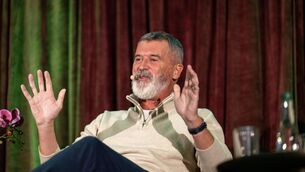
Just as Roy Keane has been insisting that publication of his latest book is, in part, about defending himself against lies and accusations, so Ferguson’s updated autobiography seems intent on portraying himself as a man wronged in the context of United’s sudden demise.
He did not leave behind an antiquated club or an ageing team, he insists. He wasn’t solely responsible for choosing ‘The Chosen One’. The job simply proved too big for Moyes. And the latter’s team didn’t play at the tempo required to help get him out of the hole he’d dug for himself. And so on.
If that all seems a bit self-serving, it’s only fair to point out that Ferguson had to endure some ferocious flak himself in his difficult early days at Old Trafford, coming through a professional near-death experience to shape them over time — again and again — into one of the great forces in English and European football. With all that he achieved at the club, it’s perhaps a bit much to continue to hold him responsible for its decline after he had departed the dugout and the training pitch for the last time.
Yet, the implication of his insistence that the handover should still have been more of a seamless transition than a catastrophic rupture is that, had he himself remained on for another season, all would or should have been hunky dory. We will never know, of course, but while it’s highly unlikely that the dressing room would have failed him in the way that it failed Moyes, the difficulties that a coach as experienced as Louis van Gaal has encountered in getting United back up to speed — as Fergie might want it — suggests that the structural faults, on and off the pitch, were indeed deep-rooted and extensive.
Still fragile at the back, still lacking a world-class midfielder to recapture the glory days when they could harness the power of a Keane and the panache of a Scholes, United remain a shadow of what they once were.
But, in their new, modest role as underdogs on their own sacred turf, if they are to halt the Chelsea juggernaut tomorrow you suspect they’ll have to plug into another traditional United trait of yesteryear — the resilient spirit of a team that never knew when it was beaten.
Before Manchester United can become giants again, they will first have to learn to be giant-killers.