Sweet dreams are made of Messi magic
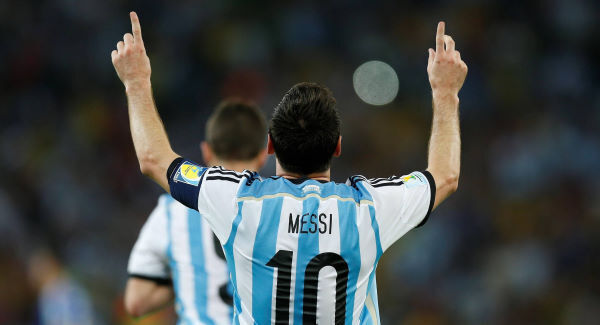

All you need to do — and this is quite simple really — is hop on a plane to Rio De Janeiro, head straight to one of the most famous football grounds on the planet and just sit back and enjoy a moment of Messi magic at the Maracana. After that, trust me, you’ll go to bed happy and enjoy the sweetest of dreams.
Sunday afternoon had found me feeling a bit like the guy in The Band’s great song The Weight: feeling ’bout half past dead and just looking for a place where a man might rest his head.
Twenty-eight sleepless hours after exiting my hotel room in steaming Manaus, the best I could do was find a relatively quiet corner of the airport in Brasilia, stretch out on the floor — keeping a vicelike grip on my laptop bag, naturally – and try to steal 40 winks before the onward flight to Rio.
By the time I arrived at the Maracana many hours later, I was closer to being about 90% past dead but still just about sufficiently compos mentis to do an astonished double-take as, threading my way through throngs of Argentinian fans outside the ground, I almost literally bumped into Diego Maradona, kitted out in full national strip and happily posing for photographs.
I was just about to whip out the tape recorder for an exclusive one-on-one – “Well Diego, my old son, what have you got to say for yourself to the readers of the Irish Examiner?” — when closer inspection revealed that it was not, of course, the great man himself but, rather, an extremely convincing lookalike. Twenty paces further on, there was another one, and then another after that — proof that Diego ballooning in middle age has been a godsend for small, fat men with curly hair from Buenos Aires.
The big question on Sunday night, of course, was whether Lionel Messi would be able to do his own winning impersonation of one the greatest players of all time and, in so doing, take a big step here in Brazil towards definitively securing his place as Maradona’s rightful heir.
But first, there were the preliminaries to endure and enjoy at this must hallowed of grounds. On the streets outside, the city’s formidably attired Robocops responded with tear gas to an anti-Fifa protest numbering no more than 250 demonstrators. ‘Heavy-handed’, is, I think, the conventional phrase, if one which I find almost always errs on the side of understatement.
Inside the stadium, we might as well have been, not so much in a different part of the city as in a whole other universe. This was Planet Football, a raucously joyous world unto itself. Argentinians must have accounted for at least 50,000 of the crowd of 74,738, and they proceeded to turn the place into an adrenaline-charged home from home, rising to their feet every few minutes to rock the stadium with their deafening repertoire of battle hymns while they bounced up and down and twirled their scarves above their heads.
But though Bosnia had a comparatively tiny number of their supporters present for what, lest we forget, was the country’s equivalent of Ireland’s Italia 90 World Cup debut, Edin Dzeko and company were not, as it turned out, lacking in thunderous backing. Thousands of yellow-shirted cariocas had adopted them as their team, less out of sympathy for the underdog than as a handy opportunity to bait their noisy South American neighbours.
And so the rival chants and songs collided thrillingly in the hot Rio night. “Maradona is the greatest, better than Pele”, roared one side. “But Pele makes more money from commercial endorsements,” roared back the other. (Well, okay, they didn’t — but, if they’d spent any time watching TV ad breaks here in Brazil, they would have). But the one that really brought the blue and white hordes to their feet was a popular chant which roughly translates as, “He who doesn’t jump is an Englishman”. Up in the press box, let me tell you, we could feel the stadium vibrate.
In truth, for all of a desperately disappointing first half, the contest in the stands proved far more compelling than the one on the pitch. Even after having had the perfect start handed to them by Bosnia’s ugly own goal, Argentina struggled to break down well-organised and hard-working opponents who also carried a significant goal threat.
More alarming still, the Lionel Messi we know and love had simply failed to turn up, the little man repeatedly running down cul de sacs and over-hitting passes, his face a worrying mask of, it seemed, deep-rooted disenchantment. The horrible thought struck that we were bearing witness to a World Cup anti-climax of epic proportions, the dream about to curdle into a nightmare. And, then, in a second-half instant, the scene flipped from monochrome to technicolour and, suddenly, joyously, all was right in our World Cup world.
It began with Alejandro Sabella’s belated decision to throw Gonzalo Higuain in at the break, his additional presence up front with Sergio Aguero not only giving the Bosnian defence one more body to worry about but, crucially, freeing up the space behind which had been so comprehensively denied Messi in the first half.
And, as the world now knows, the little wizard used it rather well. It seemed to happen in the blink of an eye: a sudden trademark acceleration of pace, a precision one-two with Higuain, a mesmeric high-speed dribble across the face of the penalty area which left Bosnian players colliding slapstick-style in its wake, and then the coup de grace, a low, powerful side-footed shot which curved in off the foot of the post.
And thus, despite Vedad Ibiseic pulling a goal back for Bosnia, the rest was all history and hysteria, one of the great World Cup goals celebrated late into the night and all the way through to the front pages of yesterday’s morning papers in Rio. “Messi Arrives’, ‘The Touch Of Messi’ and ‘The Giant Awoke In The Maracana’ told the tale over numerous pictures of the wonder goal and the No 10’s fist-pumping celebration.
The night before, the game had ended with his besotted countrymen in the stadium bowing en masse and chanting ‘Messi, Messi, Messi’. By the warm light of dawn, even Brazil couldn’t help but acknowledge his genius.
Yet, amazingly, on a night when Argentina might have won but scarcely burnished their credentials as tournament favourites, the crucial difference in a tight game was made by what the record books will show was only Lionel Messi’s second World Cup goal in eight years.
Which leaves the rest of us with just one thing to ask: can we have some more, please?