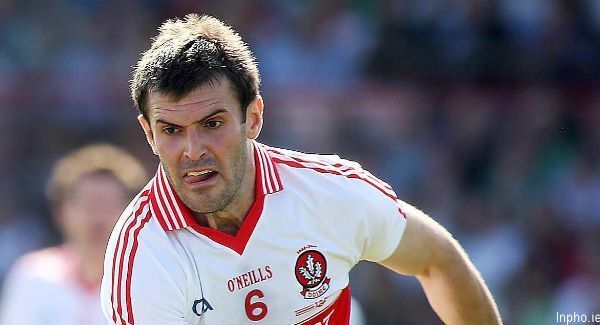
A long journey but Lynch now fulfilling promise with Derry
Before coaching became such an integral part of football, the best managers were essentially natural-born sports psychologists.

A long journey but Lynch now fulfilling promise with Derry

Adrian McGuckin is a prime example. Like Eamon Fitzmaurice is currently doing with Pobalscoil Chorca Dhuibhne in Kerry, McGuckin took a new school and put it on the map. From his first MacRory Cup title in 1977 until his retirement in 2006, McGuckin established St Patrick’s Maghera as one of the most successful academies in the country.

An anecdote that emerged from the 1994 MacRory Cup final illustrates McGuckin’s man-management skills.


The performances of Sean Marty Lockhart, Mark Diamond and Michael McCormick was going to have a vital bearing on the game.

In the dressing room before the game, McGuckin told Sean Marty Lockhart he was marking the opposition’s best player and the result hinged on his performance. Mark Diamond was informed he was the best midfielder in Ulster and simply had to go out and play his normal game. Michael McCormick, my cousin, and three-time Ulster Colleges All Star, was told he had under-performed the entire year and it was about time he did something.

Three contrasting characters. Three different messages. One result. Maghera won. McGuckin’s intuitive understanding of what his players needed to hear was particularly evident in his handling of Mark Lynch.

Lynch was a boy star. At 16, he played at centre half-back on the Derry minor team which won the All-Ireland title in 2002. A year later, he was the class act on the St Patrick’s Maghera side which lifted the Hogan Cup. A glittering career beckoned.

But that huge promise remained largely unfulfilled. After making his senior debut for Derry in 2004, Lynch would show only tantalising glimpses of his staggering potential. A huge man, with an astonishing burst of speed, there would be the occasional mesmerising run, the odd spectacular score. But it was never sustained. The 70-minute master class never materialised.

2004 quickly turned into 2005. Lynch was still young. There was time. But 2006, 2007 and 2008 were much the same. And on it went.

However, while Lynch’s county career seemed to stagnate, there was an arena where he excelled — the Sigerson Cup. At Jordanstown, he came back under the management of McGuckin. Once again, his performance levels soared.

In 2007 and 2008, Jordanstown reached back-to-back Sigerson Cup finals, losing the first, and winning the second. Watching that team was a slightly mystifying experience. Jordanstown’s two best players were Lynch and Raymond Mulgrew, the outstanding player on the Tyrone minor team which won the 2004 All-Ireland title.

While neither was setting the world alight at county level, they were ripping it up in the Sigerson Cup.

I made enquiries. I asked McGuckin to reveal the secret to his success. How was he getting these players to deliver routinely excellent performances? I was treated to a full debriefing. Some players, McGuckin said, are their sternest critics. They dwell on every mistake.

By McGuckin’s own estimation, both Lynch and Mulgrew fitted that profile.

When working with such players, McGuckin said the manager’s job was easy. He just had to keep encouraging them.

The success of McGuckin’s approach was astonishing. The Mark Lynch and Raymond Mulgrew who played for Jordanstown were like two different players to the men who turned out for Derry and Tyrone.

There was perhaps another reason why McGuckin was able to get the best out of Mark Lynch. At county level, Lynch was deployed at wing half-forward. McGuckin played him at full-forward.

Primarily, McGuckin didn’t believe Lynch had the necessary fitness and stamina for half-forward and stationed on the edge of the square. Occasionally, Lynch was sent out the field to run at the opposition. The tactic worked a treat.

Lynch’s displays with Jordanstown suggested he was capable of producing significantly better performances for Derry. It was just a question of getting a manager who could unlock the magnificent footballer that lay within that massive frame.

Enter Brian McIver. Evidently, McIver’s shared McGuckin’s belief that he needed to demonstrate his belief in Mark Lynch.

Last year, his first season as Derry boss, McIver appointed Lynch as captain. Prior to McIver’s involvement, Lynch was regarded as a cog in the wheel. But McIver put Lynch at the centre of his team and built Derry’s game-plan around him.

Although Lynch was named at centre half-back, he never fulfilled that role. Instead, a player who was named in the half-forward line would drop back into the defence. This allowed Lynch to play as an attacking sweeper. It worked to perfection when Lynch came from 80 yards to score a goal against Down in last year’s Ulster Championship.

With the introduction of the black card, Lynch no longer has to make his runs from behind enemy lines. Now that third-man tackling is no longer granted the same latitude, McIver has been able to position his captain further up the field.

The Derry manager has also taken care of Lynch’s physical conditioning. A few weeks ago, I met Lynch in a Belfast café. I tested him. Prone to weight gain in the past, I wanted to see if he would eat a bun. Despite repeated attempts he rejected all offers. He wouldn’t even eat a scone. When pressed, he revealed Derry’s dietician would be measuring his body fat in three days. Targets to meet.

Although the 6ft 2inch centre half-forward tips the scales at 15 stones, it is 15 stones of skin, bone and muscle. Lynch’s shortcomings in the stamina department no longer apply. In Sunday’s league semi-final, he ran and ran. Mayo much-vaunted half-back line couldn’t cope. His man-of-the-match display against Mayo follows his man-of-the-match display against Dublin in Celtic Park.

Brendan O’Brien, from this church, said Lynch was “sensational”. O’Brien described how the Derry skipper “made a succession of lung-bursting runs from deep that Mayo failed to combat”.

In the other semi-final, Michael Darragh Macauley was the unanimous selection for man of the match. At present, Lynch and Macauley are arguably the two best footballers in the country. But Macauley’s status as a Dublin footballer assures him of more big days in Croke Park.

When the All Stars are selected, if Derry fail to make the last four, there is a distinct possibility that Lynch’s heroics will be overlooked.

That’s just one of the failings of the system. Fortunately, 12 years after starring for the Derry minors, the 28-year-old Mark Lynch has finally blossomed into the brilliant footballer we always knew was there.

The prodigy has finally fulfilled his promise. It’s been a long journey. But it’s been well worth the wait.

More in this section

Sport

Newsletter

Sign up to our daily sports bulletin, delivered straight to your inbox at 5pm. Subscribers also receive an exclusive email from our sports desk editors every Friday evening looking forward to the weekend's sporting action.

Cookie Policy Privacy Policy Brand Safety FAQ Help Contact Us Terms and Conditions

© Examiner Echo Group Limited