Economic hell means Greeks must finish the job
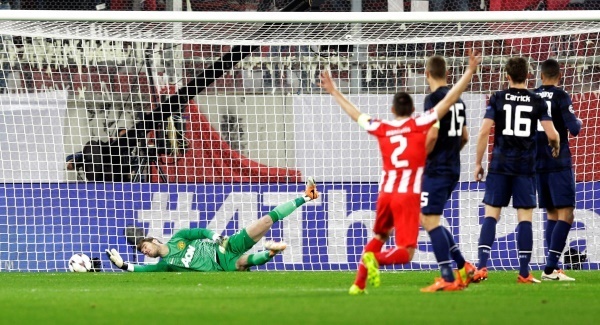

This time you sense it could be different. For one thing, defeat does not equal disaster. And while they have only scored three times in their 11 visits, an away goal this time would leave Manchester United needing to score four.
Olympiakos also arrive buoyed by a victory on Saturday which sealed their title defence with five matches to go. It was a strange match, played in an empty stadium as their fans were banned following crowd violence. But they duly secured their 41st league title with a 2-0 win, the second a penalty by David Fuster, who scored a couple when Olympiakos met Arsenal three years ago.
Pressure off then, although that can rebound psychologically and Greek sides usually do not travel well. Their challenge is to perform as they did in Paris last November, when they lost 2-1. Zlatan Ibrahimovic banged in a cross from four yards early on, yet PSG only won in the final minute when Edinson Cavani broke on the left and beat Roberto at his near post.
Olympiakos resisted stubbornly that night — even if they had an extra man for almost the whole of the second half — and they made chances. Eventually PSG were caught flat-footed at a corner. But their main attacking threat was from Konstantinos Mitroglou, the striker they sold to Fulham in January for a record Greek transfer fee of €15.2 million.
Selling your main goalscorer in January is not the mark of champions and it shows how much the undermining of the Greek economy has affected football, even its most prosperous club.
Olympiakos are owned by a group of successful businessmen, led by Evangelos Marinakis, the boss of Capital Ship Management, whose impressive fleet includes 39 oil tankers. Still on the board is former owner Socrates Kokkalis, whose political contacts enabled him to liquidate and reschedule debt and finance a stadium rebuild for the 2004 Olympics.
But those resources cannot insulate a club from the impact of the debt crisis on the ordinary citizen.
The official unemployment rate has just risen to 27.5%, for young people it is close to 60%. It’s far worse around the port of Piraeus, the home of Olympiakos.
Almost half the population are out of work and the last 18 months have been catastrophic. In the Perama district, the heart of the shipbuilding and repair industry, around 70% of the work has gone and owners have switched business to countries such as Turkey and China, where wages are low and there are bigger state subsidies. Former seamen and yard workers have been reduced to collecting scrap metal and eating at soup kitchens.
The cheapest season ticket at Olympiakos works out at €10 a match, most are priced at €20 or more. In such circumstances many people just can’t afford it. Surprisingly, attendances at Champions League games have held up, at around the 30,000 mark. There were 32,000 for the derby against Panathinaikos when the team collapsed after their win against United and went down 3-0.
But these are the glamour games that attract those with money. Crowds for some league games have been as low as 11,500 and the average attendance at league games is down to 17,290, compared to nearly 21,000 last season and to 25,370 five years ago.
That’s good compared to Panathinaikos, though. They were pulling in over 19,000 in 2009. This season their average crowd is less than 9,000. Most sides in the Super League are now averaging 2,000 or less.
For Olympiakos as for Greek football tomorrow night at Old Trafford is about pride and prestige. It is the biggest club match since they went out to Juventus in 1999 — the year that United overcame the Italians and went on to beat Bayern Munich in an unforgettable final.
But is also a matter of cash. Last year Olympiakos made €23.2 million out of the Champions League. If they go through to the quarter-finals their take this year will top the €30 million mark.
Travelling hopefully is all very well. In this case it is better to arrive.