A warning from history
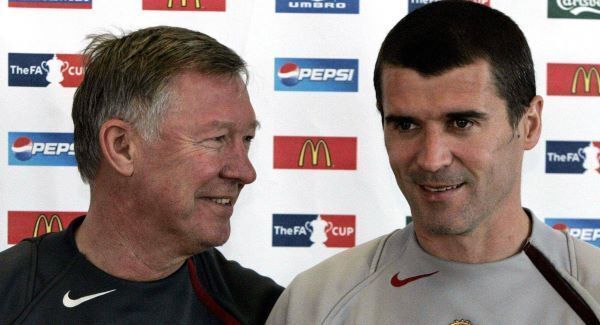

For those already inclined to take a jaundiced view of the concept of Roy Keane as manager of Ireland, Alex Ferguson’s book will resound like a warning from history.
The quotes above, with a snatch of Carlos Quieroz thrown in, form the bloody guts of Fergie’s account of the player’s infamous 2005 gloves-off critique of some of his Manchester United team-mates and the manager himself, a flashpoint incident which, we’re told, made up Fergie’s mind that he was “finished with” Keane at Old Trafford.
With the FAI in the process of deciding who will succeed Giovanni Trapattoni as manager of Ireland, it’s easy to see how Ferguson’s testimony could be deployed in a bid to demolish whatever case might have been made for the Corkman.
With Keano, it always seems to be a stark choice of for or agin – and the timing of the publication of Ferguson’s autobiography clearly favours those who would regard his appointment as falling somewhere on the condition red spectrum between ‘high-risk’ and ‘flat-out crazy’.
The echoes of Saipan are, of course, unmissable in Ferguson’s account of that 2005 eruption while, if they needed any further ammunition, the anti-Keane camp will point to the claim the player once expressed grievances about the accommodation for a United training camp in Portugal as conclusive proof that there’s just no pleasing Yer Man. “See? It was never just about the bad old FAI — he was still complaining at the best club in the world with the best manager in the world.”
To some extent, we actually learn nothing startlingly new about Keane from Ferguson’s book, beyond the addition of the kind of juicy detail that will always bag headlines once it escapes the dressing room walls.
The broad picture is one we all already know and love/hate – dilute according to taste – not least from the pages of his own no-punches-pulled autobiography. (Although I have to confess that, after flicking through that book again this week, I’m still inclined to believe its often strident, high octane tone owes as much if not more to ghostwriter Eamon Dunphy as it does to its nominal author).
Revisiting that book also reinforced the view that when Sir and His Corkness go head to head, there’s more than a touch of ‘Mr Kettle meet Mr Pot’ about the standoff. Maybe, that awareness is why Keane was measured in his response on ITV the other night, outside of that headline-grabbing barb about Fergie not knowing the meaning of the word loyalty. If nothing else, his brief exchange with Adrian Chiles was worth it for the spectacle of Ian Wright apparently cracking up at Keane’s determined show of sang froid which, in turn, caused the latter’s poker face to crease into a grin.
As for Ferguson’s opinion of Keane’s limitations as a manager – well, it’s just that, an opinion. Fergie may have been one of the greatest managers in the history of football but – as some of his dealings in the transfer market confirmed – that doesn’t mean he is God-like in the infallibility of his judgement. Kevin Kilbane’s astonished response this week to Ferguson’s remarks about Keane as gaffer – the former Irish international making a point of highlighting the latter’s transformative first season at Sunderland – was a useful corrective, if hardly one that was ever going to merit a proportionate number of column inches.
We know Roy Keane can manage. But we also know that, as a manager, he doesn’t possess the Midas touch. Which means, in purely footballing terms, it would indeed be a gamble to appoint him manager of Ireland, but only in the same way, and for the same reason, that there is an element of risk involved whenever any new manager is appointed anywhere in the game. Even the serial winners – the likes of Mourinho and Fergie himself – can’t offer a money-back guarantee. I recently asked John Giles who he would want as the next Ireland manager, given an unlimited choice. His reply was he genuinely couldn’t say because, he explained, you simply couldn’t be sure that even a World Cup and European Championship winner like Vincente Del Bosque would enjoy success with this Irish team.
Where Keane would be deemed riskier than most has to do with that driven, demanding, domineering part of his character which Fergie’s book has once again brought to the fore. Whatever about its potentially galvanising and/or intimidating effect on his players, you can be sure that there would be some in the FAI who would be distinctly uncomfortable at the prospect of having a perceived human time-bomb ticking away under their nose, however much of a commercial boon the sight of Keano in the dugout would be for an association which needs all the financial help it can get.
In the end it boils down to this: would Roy Keane drive the national team to new and greater heights? Or would he drive everybody and himself up the walls? Or perhaps both? Keane might always have been a long shot to succeed Trap but, after Ferguson’s late, late studs up tackle, chances are we’re going to have to wait a whole lot longer — if not, indeed, forever — to get the answer.