One pint and a donor
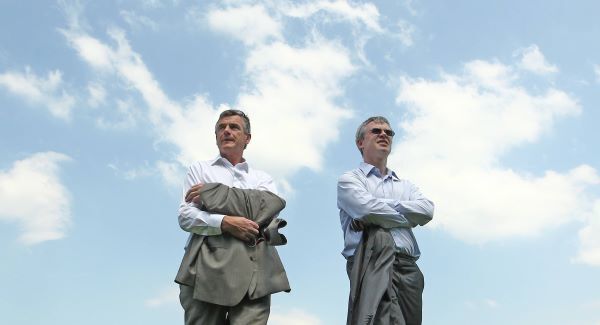
Having often stirred up controversy as a fast-talking analyst on The Sunday Game, people thought they knew who Joe Brolly was.

One pint and a donor

But after giving up a kidney in an effort to save the life of a fellow St Bridget’s coach, the Derry man has started to change minds. Now he wants to change the law, too.

When he sits down to talk, Joe Brolly is carrying a creamy pint of stout.

“My first,” he says. “First pint since the operation.”

And we’re off.

Last year Brolly made a rare leap. Up to November his name usually carried a prefix or two when it popped up in conversation, prefixes of the unflattering kind.

Then news broke of his kidney.

Shane Finnegan, one of Brolly’s fellow coaches with the St Bridget’s U10 footballers, needed a kidney transplant. Brolly volunteered one of his. The transplant didn’t succeed, but it made people revisit their perceptions of the Derry man.

Scathing pundit? Yes. Extraordinary person? Yes.

Now you can add campaigner to the list.

“I’m working to change the law North and south so that everyone is automatically an organ donor, unless they go online to opt out,” he says.

“We want the same system as Spain, Croatia and Portugal, countries with the highest rate of organ donation, where there are no waiting lists. Their system works along the lines of, ‘you’re automatically a donor unless you opt out — but your family still has the final say as to whether your organs are transplanted’.

“So it retains the principle that organ donation is a sacred gift from one family to another at a very difficult time.”

A barrister by profession, Brolly is used to making a convincing case; in this case it’s not a matter of Donegal’s defensive superiority, but he’s no less persuasive: “When that system came into the countries I’ve mentioned, organ donation just became the norm. People accepted it was just part of being a citizen.

“This campaign reflects the belief that this is a good thing. We’re a very generous people, and the safeguard is still there for the family to have a final say.

“Those other countries have found that in 90-95% of cases the families allow the donation to proceed. In Ireland — North and south — and in the UK there’s a 50-60% refusal rate because it’s not the norm, and people feel, ‘why should we be asked to do this at such a difficult time?’

“In the North the assembly has agreed to this and they’ve begun to move towards this law, and we’re hopeful the Act will be in place towards the middle of 2014.”

We met the evening Brolly appeared at Up Close and Personal, the Glen Rovers/Mercy Hospital fundraiser. Earlier that day Brolly had touched base with Fianna Fáil leader Micheal Martin and Jerry Buttimer of the Dail’s health committee. They were given the full Brolly treatment, in which facts and figures are marshalled alongside the emotional argument.

“There’s no downside to this — 10% of people on the waiting lists die every year, and it’s a miserable end.

“It’s been going on long enough, this silent tragedy. And there’s no need for it. All this needs is 24 specialist nurses embedded in hospitals to make this succeed, a cost of €1.5 million per year.

“Two successful transplants save the exchequer €680,000 over 15 years in dialysis costs. So two additional transplants per year cover the entire cost.”

One man who won’t benefit from a successful campaign is Shane Finnegan, unfortunately.

“We’re both campaigning for this, but he won’t benefit from it. He’s not transplantable anymore so he’s in a very bad situation. He doesn’t know when the end is going to come, but he’s working for this. He’s an inspiration to me.

“There’s no downside to this. It’s not a political thing. It’s a heart and soul thing. It’s allowing another family to get the gift of life in a situation where someone you love is losing their life.

“That’s not far away from the principles of the GAA: helping others, doing your best for them, volunteering and so on. So the two things fit together very well, and the GAA will put messages in match programmes on this, they’ll be involved in social media, men like Darragh Ó Sé , Ger Loughnane, Tomás Mulcahy — they’ll all be ambassadors for this cause.

“The GAA’s response to this has been extraordinary, and it’s formally supporting this campaign North and south. As soon as you say to a politician, North or south, ‘the GAA’s formal position is that it supports this and is going to campaign on this’, then they immediately know they have to move on this.”

The GAA’s support for the cause offers a neat parallel to the way Brolly himself first got involved. “If I weren’t a GAA man, or involved so heavily in the GAA, I wouldn’t have donated a kidney, because I wouldn’t have known Shane.

“It was the fact we were both coaches, and the GAA has that neighbourliness... all my pals are GAA people, and you go the length and breadth of the country meeting GAA people.

“It’s like the Freemasons. There are just no funny handshakes.”

There are other fundraising initiatives in the pipeline but what about a website?

“We had our first meeting a week ago!” said Brolly. “Give us a chance.”

Note: it was at this point in the conversation that the Derry man was seen to take a first sip from that pint.

Since then the Opt For Life campaign has gathered steam, as readers are no doubt aware.

Is there time in that kind of schedule to think about Gaelic football? Maybe, maybe not. It might depend on whether you sleep nights.

“I’m an insomniac,” says Brolly. “I can get a lot done at night, and people are always saying to me, ‘I got an email from you at 4am, what was that about’.

“I usedn’t like it, being an insomniac, but I’m very comfortable with it now. And of course when I had kids it was ideal, because it meant I had company at four in the morning.”

Brolly being Brolly, there’s a nudge at the GPA before he settles down to talk football. (“Well, there are two GAAs, one of which is the elite GAA which really isn’t the GAA at all, though I think the debate about the GPA and professionalism has been good in that everyone — unanimously, I think — feels the GAA must be amateur, and that there is something really sacred here. Donal Óg [Cusack] and the boys have done everyone a favour in that that’s been debated openly and properly.”)

Typically, his Gaelic football focus sweeps the length of the country.

“The inexorable rise of Tyrone interests me, as does the demise of Kerry.”

Tyrone? Inexorable?

“The problem with Tyrone is that Mickey Harte’s approach of high-intensity pressure and holding possession doesn’t have the final component: how to get scores. That’s the problem for them.

“Tyrone’s strengths are their tradition, which they’ve built up in recent years, their defence and their possession game but I don’t think Mickey has ever worked out how to get scores.

“That was okay when he had geniuses like Peter Canavan and Brian McGuigan and others. They just got the scores — they found a way to do it — but the problem now is this: they don’t have a system for scoring.”

What about the All-Ireland champions, then? They can score.

“Donegal, on the other hand, have a brilliant system for scoring, one that’s economical.

“They know what they’re doing all the time. If they turn the ball over at the corner-back slot they know what they’re all doing — 50% of their turnovers result in a score.”

But they’ll hardly retain the title.

“Why not?”

Celebrations. Karl Lacey’s injury. Jim McGuinness being distracted by Celtic. Appetite.

“McGuinness is an obsessive. No stone will be left unturned because Jim can’t help himself, he’s a 24-hour-a-day, seven-day-a-week Jerry Maguire for Donegal.

“But he’s also a totally logical thinker. That’s the difference between him and other coaches.

“Another illustration of the difference came, actually, in the Dublin-Kerry game a few weeks ago: the difference between an organised phalanx and a Kerry team just trying to play football.

“Dublin cut them in two.

“What’s happening to Kerry football is a metaphor for football as a whole. Kerry football has been one of the glories of Irish society for over a hundred years, but that’s changing now because the systems that have to operate nowadays to succeed don’t permit that approach.”

To illustrate his point, Brolly isolates what is, for him, the key statistic in modern Gaelic football.

“Turnovers. The key to modern football is turnovers. The two teams with the highest turnover rates are Dublin and Donegal, and it’s no surprise they’ve won the last two All-Irelands.

“Tyrone invented that in 2003 but Donegal have brought it to its logical end, and it doesn’t matter how much possession you win. The Crossmaglen style of kicking the ball takes quite a while to develop — and takes more imagination than most current strategies — and that might help overcome the turnover game.

“In terms of development in football, we’ve had big moments with the arrival of Tyrone, with Dublin’s transformation under Pat Gilroy from startled earwigs to beating Kerry with 40% possession in an All-Ireland final.

“How did they do that? On turnovers, and fourth-quarter turnovers in particular, when the opposition tires.

“Donegal have made the big breakthrough now but the next big moment will be when Tony McEntee takes the Armagh team in a couple of years.

“Then you’ll see Armagh using the Crossmaglen style, keeper hitting the half-forwards, half-backs hitting the full-forward line. That’ll be interesting, to see if that can survive at the top level, because potentially that sort of system could destroy a team like Donegal.”

Yet Donegal didn’t steamroll their way to the All-Ireland title. They needed a lucky goal against Kerry, were hanging on against Cork and Mayo, despite shipping two early goals, almost caught them as well.

“You have to understand the low base they’ve come from.

“One of the Donegal players said that after 20 minutes against Kerry he realised they were as good as Kerry, and you can’t underestimate that as a psychological breakthrough.

“I think they were distracted in the last few minutes against Kerry because they realised they were going to beat Kerry; in the last few minutes against Cork because they realised they were going to make an All-Ireland final. And a well-organised team could take advantage of that.

“My only regret would have been that Dublin didn’t make the All-Ireland final, that would have been a great game because they do a lot of the same things.

“I still think Donegal would have won because... well, a lot of teams work repetitively on their defending, or winning the ball in midfield but Donegal work repetitively in training on how to get scores.

“I’ve seen them do it. They can have Colm McFadden working against three defenders; they fire the ball to McFadden and he’s so exhausted by the three markers blocking him and tackling him he can barely kick the ball. But he gets used to taking on three men.

“Then, when he’s isolated in games he’s only taking on one or two and it’s easier for him. He has loads of room he doesn’t get at training with Donegal, the same for Michael Murphy.

“So they have a game plan where everything’s been ironed out. That’s why I think it’s illogical to think they can’t retain the All-Ireland. They should have won the quarter-, semi-final and final by more last year; they had more in the tank. The big issue is desire.”

So lengthy celebrations won’t derail the Donegal train?

“McGuinness will drag them out of the pubs if he has to. There’s a reign of terror there, though he’s immensely charismatic as well.

“Dermot McNicholl told me that the principal in St Patrick’s Maghera, where he teaches, asked McGuinness in to give the staff a talk. McNicholl told me going in he was rolling his eyes, but that he came out of the pep talk with the hair standing up on the back of his neck. McGuinness talked for 40 minutes without notes and the teachers left the room walking on air.”

That’s Donegal and Dublin. Go back one more year to assess the 2010 All-Ireland winners.

“Cork have the best collection of footballers in Ireland,” says Brolly, who was speaking, unfortunately, before Colm O’Neill’s terrible injury last weekend.

“They have at least eight players who are better than any other team. If they had a constructive half-back line, a centre-back who could play as a quarter-back, they’d win the All-Ireland.

“In Ciarán Sheehan and Colm O’Neill Cork have two of the three best forwards in Ireland — Michael Murphy’s the other one.

“O’Neill got 1-4 against Donegal; Sheehan got three points from Karl Lacey. All Cork had to do was to hit O’Neill with the ball against Donegal. As it was he got 1-4 playing on a team laboriously handpassing the ball up the field.

“Cork have the team to carry any game plan. You can see the quality of a team in the league — not necessarily what’ll win the championship, but their quality. We saw Cork play Derry a couple of years ago in the league in Celtic Park and we were thinking after a few minutes, ‘how can anyone play against these guys?’ Derry were terrible, but in the end they only beat us by a point.

“They should have destroyed us, with the artillery at their disposal. But they only won by a point.”

Here the conversation ended. Brolly had to go to the Cork Opera House to dazzle the audience: to talk a little more.

Note: to give you the full effect of the full-on Brolly conversation the above chat — as well as some interesting digressions — all took place over the course of that pint.

A second drink the next time and we may have to clear the entire supplement.

More in this section

Sport

Newsletter

Sign up to our daily sports bulletin, delivered straight to your inbox at 5pm. Subscribers also receive an exclusive email from our sports desk editors every Friday evening looking forward to the weekend's sporting action.

Cookie Policy Privacy Policy Brand Safety FAQ Help Contact Us Terms and Conditions

© Examiner Echo Group Limited