Colin Sheridan: A fantasy but Roy Keane the right ringmaster for Man United circus
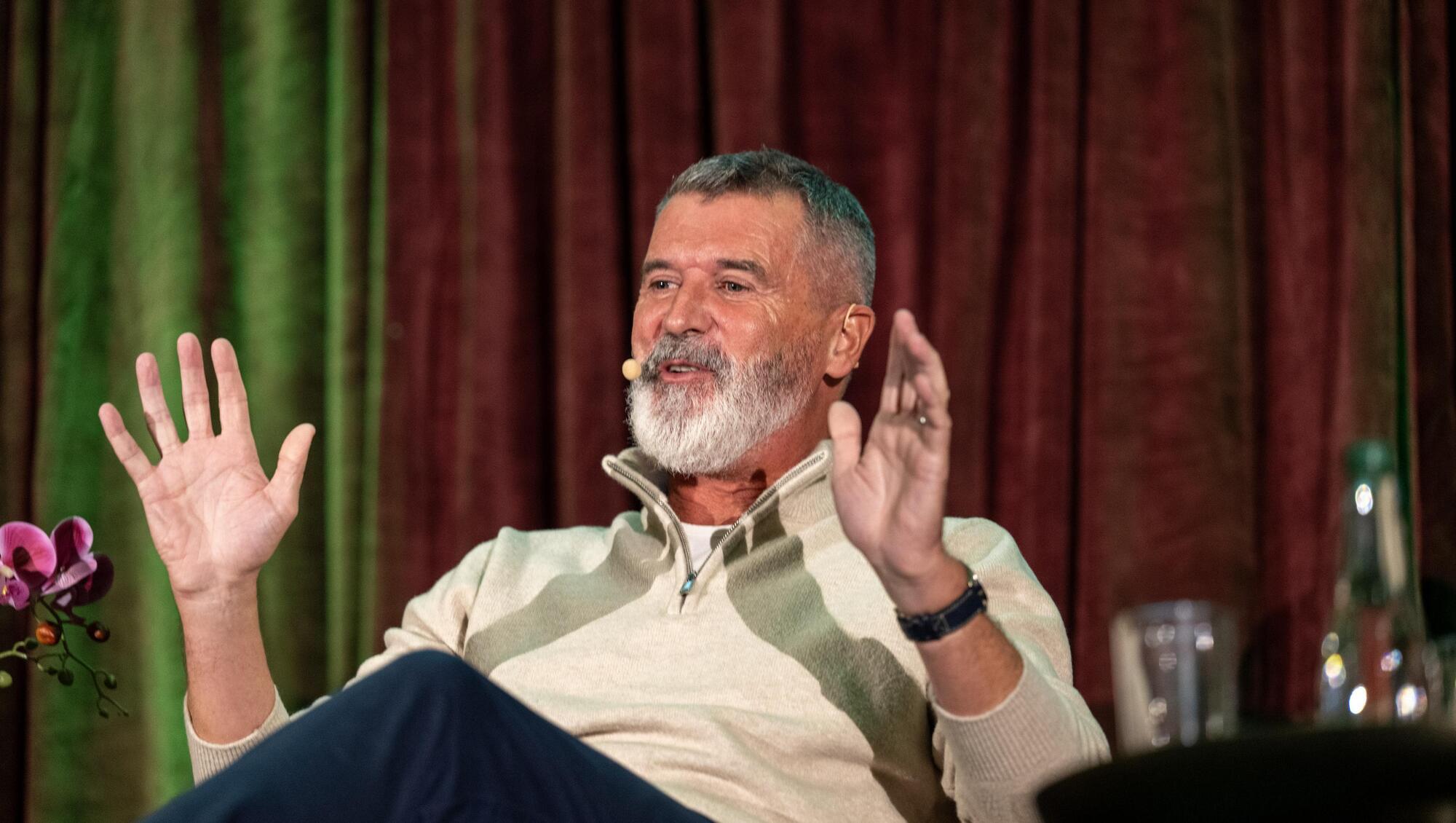
Roy Keane at the recent Irish Guide Dogs for the Blind 50th anniversary event. Pic: Brian Lougheed
Every few months, as Manchester United oscillates between competent and comically bad with the cadence of a circus clown, I get a notification on my phone that is far, far too good to be true. It comes from a source that, if you squint and hold your phone at an angle, seems reputable. The London Evening Express. The Shepherd’s Bush Telegraph. Something with a masthead and a passing acquaintance with punctuation.
It always follows a period of chaos so dramatic it makes the royal family look stable.
“Roy Keane set for dramatic Old Trafford return.” This will not happen. Let’s establish that now, before anyone accuses me of confusing a managerial appointment with a Christmas wish.
But if you’re 12, like my son, or delusional, like his father, you might momentarily believe it. The headline is written by a newspaper, after all, and newspapers never lie. Right, Dad?
Even I allow myself a few seconds, looking wistfully out the window, imagining Keane taking charge of that dressing room. A single-season, no-sack clause in his contract. Every press conference televised live, like presidential addresses during international crises. No transfer window in sight. Nobody’s agent capable of arranging an escape. Players left with the unappealing choice of adapting or professionally dying. Beat-reporting becoming an art form again. An away fixture at Hull acquiring the emotional stakes of a Champions League semi-final.
Jesus.
When my son sought advice about whom he should support some years ago, I considered my answer carefully. The rot was embedded at United by then, and I didn’t want to sell him a pup. His granddad supported Aston Villa, I told him. Following that path would offer trials and tribulations, perhaps even a relegation or two, but also the consolations of inheritance and nonconformity. To his credit, he considered it before choosing Victor Lindelöf over John McGinn.
When I asked what tipped the scales, he simply said he preferred the colour red.
As sound a basis for lifelong allegiance as any. Certainly more defensible than mine, which now seems to depend on whether a retired midfielder from Mayfield might accept a job he almost certainly doesn’t want, and more than likely will never be offered.
I stopped loving United when Keane left. I continued watching, but something in the relationship had gone. I was an adult by then and the “Sir Alex” schtick had worn very thin. Keane embodied what I thought I supported: excellence without ceremony, responsibility without a marketing department. He was pure fire. That probably says as much about me as about Manchester United. Supporting a football club is an elaborate exercise in projecting your own virtues onto strangers.
Still, why is the prospect so outlandish? The club is a circus. Keane is hardly a clown, but he might be a ringmaster worthy of consideration.
The objections are obvious. Sunderland brought a Championship title; Ipswich brought failure. His time away from management cannot be explained away by a gap year in Peru. There is no guarantee that the qualities which made him an exceptional captain would make him an effective manager now.
Nor does shouting, eye-rolling preaching common-sense constitute a footballing philosophy. You cannot organise a press by telling everyone to have some self-respect.
But the fantasy doesn’t require Keane to design every training session. Give him excellent coaches. Give them responsibility for the intricate work. Ask him to establish what is acceptable, what is required, and whether the people wearing the jersey intend to meet those requirements.
That is management too.
We have become comfortable discussing leadership as though it were an accessory to expertise. Yet anyone who has worked in a functioning organisation knows the difference made by someone whose standards are clear, whose example supports them, and whose displeasure cannot be negotiated away with fluent corporate language.
Keane’s bullshit radar would, admittedly, require its own electricity supply at Old Trafford.
The attraction is not simply watching wealthy footballers being frightened. That would become tedious, and fear eventually exhausts itself. It is watching excuses encounter someone who has no professional interest in preserving them.
Including, presumably, the excuses offered upstairs.
Which is where the fantasy becomes especially entertaining, and the appointment especially unlikely. Would Jim Ratcliffe and company really want a manager whose instinct, when confronted with something absurd, is to identify it publicly? Keane might be asked about a missed tackle and end up discussing who runs the place. There would be no neat boundary around his demand for accountability. The players would hear it. So would the people who appointed him. That makes him attractive to supporters and considerably less attractive to employers.
Then again, United’s leadership hardly inspires confidence that improbability is a barrier to anything. A shambolic institution can occasionally stumble into a compelling decision for entirely the wrong reasons.
I know. This is nostalgia wearing a tracksuit. I am asking a man from my past to restore feelings that belong to my past, and calling it a football argument.
My son would probably see through it.
But the next time the Shepherd’s Bush Telegraph lights up my phone, I will still look out the window.
For a moment, I’ll be a United supporter again.
From behind the goal at the 2021 All-Ireland final, I watched Niall Morgan take apart Mayo with a composure I found considerably easier to admire than enjoy. The view revealed the breadth of his influence. The passes he could see, and execute. The patience to wait for an opening while everyone around him seemed in a desperate hurry. A goalkeeper quarterbacking an All-Ireland final, making its frantic geography appear perfectly legible. A supreme footballer, however you felt about the result.
On Friday night, Morgan stood over a different kick, with something he would later describe as the pinnacle of his career depending upon it. Edendork trailed Errigal Ciarán by a point in the Tyrone final replay. Conn Kilpatrick won a free, 45 metres out. Morgan stepped forward and kicked two points, delivering the first senior championship in his club’s history.
“This is as good as it gets,” he said afterwards. “It’s never going to get better than this.” We hear versions of this from players who have won everything. County medals, All-Stars, afternoons when the country knows their name. Then they win something with the people who knew it first, and everything else moves down a place. Perhaps we should believe them. There are teammates you meet through excellence, and teammates you inherit through geography. People whose parents knew yours. People who remember you before anyone had cause to remember you. Winning together reaches into parts of a life that applause from strangers cannot. Friday was one of those unexpected sporting delights: you stumble upon a game and finish feeling grateful you stayed. Morgan has played on grander stages. He has never looked happier leaving one. For all the GAA’s complications, here was its promise fulfilled: a great player, an extraordinary kick, and a whole place sharing ownership of the moment.
Employees at James Dolan’s Madison Square Garden received an email inviting them to choose a Knicks championship ring. Click through, however, and their reward was compulsory cybersecurity training. The offer was a phishing test. Imagine mistaking your employer’s gratitude for something real.
MSG has apologised and says eligible staff will receive rings. Still, what an insight into corporate imagination: even appreciation becomes a trap. Meanwhile, Premier League champions Arsenal plan to cut up to 60 jobs - not from the elite, expensive end, naturally. All that wealth, all that success, and employees remain expendable. Sport’s billionaires love talking about family. Remember which relatives get sacrificed first.
Four months of early alarms, long Sundays and negotiating with your own legs, then Dublin serves up yesterday’s wind. A marathon is hard enough without the weather demanding a role. There will be runners today examining splits, wondering where the minutes went. Some will have achieved what they wanted. Others will need time before the medal feels like compensation. You’re allowed to be disappointed. Finishing is an achievement; wanting a faster time doesn’t diminish it. Put an asterisk beside the result if you need to. The clock recorded yesterday’s run. It didn’t deliver a verdict on what you’re capable of.