David Shonfield: English clubs and English managers — a contrasting tale
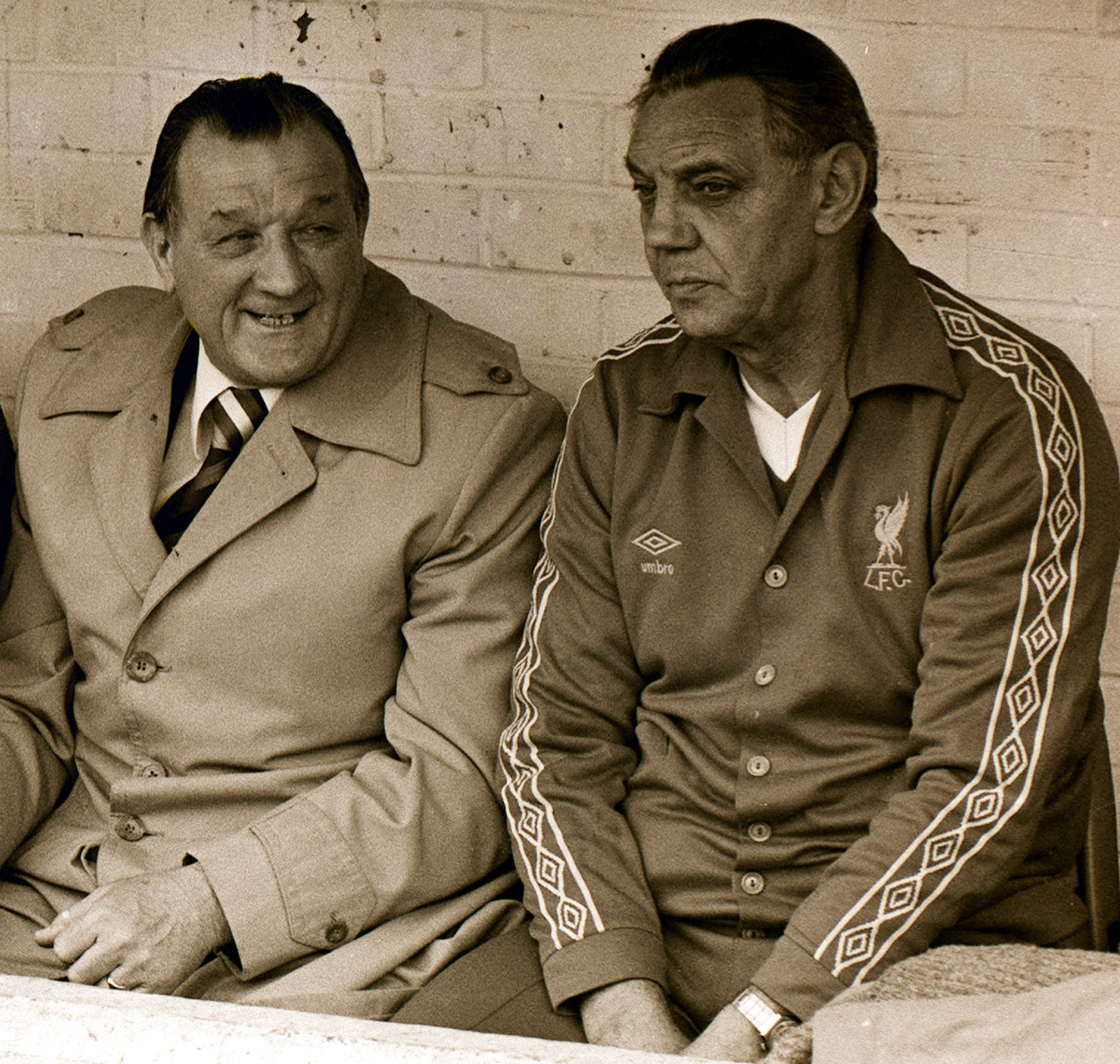
The last Englishman to win the European Cup was Joe Fagan (right, pictured with Bob Paisley) with Liverpool in 1984.
In the modern world almost nothing seems impossible, apart from an English manager winning the Champions League.
In a week where an all-English final is on the cards for the third time, it’s a failure which almost defies belief.
Remote-controlled helicopters on Mars? No problem. A cryptocurrency invented by persons unknown that trades for €50,000? Done that.
Yet the last Englishman to win any major European title was Bobby Robson with Barcelona in the Cup Winners’ Cup in 1997. The last to win the European Cup was Joe Fagan with Liverpool in 1984, when Keith Burkinshaw also guided Tottenham to the Uefa Cup.
The overall record of English managers in Europe’s top competition is even worse. Robson is the top contender, with 30 matches for PSV, Porto, and Newcastle. After him comes Frank Lampard with just 12, although his Uncle Harry achieved better results in his 10 matches for Spurs, beating both the Milan clubs before being thumped by Real Madrid.
English managers have been involved in a total of just 68 Champions League matches. Set against Alex Ferguson’s record of 114 European Cup and Champions League wins that total is simply pitiful.
Of course, Scottish managers have long dominated the top-flight in England. But while you might just about get away with describing Matt Busby and Bill Shankly as products of the English game, Alex Ferguson spent his entire playing career in Scotland and was manager of three Scottish clubs, plus the national team, before moving south.
He had also won his first European trophy at Aberdeen before arriving at Old Trafford.
By general consent, the Premier League is now the most demanding in Europe and the performance of English clubs this season confirms that. But the performance of English managers in that league is ridiculously bad.
Howard Wilkinson remains the last Englishman to win the title, and that was before the Premier League was born. More damning than that, only two English managers have managed to finish in the top three since Kevin Keegan’s infamous collapse a quarter of a century ago.
The stock of English managers fell so far that at one point there were only three of them in the top flight.
This is a big contrast with the other major European leagues, with the partial exception of La Liga.
Spain has had more foreign title winners than the rest in the decades since the Premier League was formed — 15 foreigners compared to 12 locals — and its European roll of honour is led by Zinedine Zidane at Real Madrid as well as Johan Cruyff and Frank Rijkaard at Barcelona.
But La Liga has still produced Pep Guardiola, Luis Enrique, and Vincente del Bosque as well as Rafael Benitez.
In Germany the trophy winners have mostly been local men: The exceptions since 1992 have all been at Bayern Munich, mostly in recent years: Guardiola, Carlo Ancelotti, Niko Kovac, and Louis Van Gaal.
France has tended to be dominated by French managers, at least until recently, when PSG have looked abroad — to Ancelotti, Unai Emery and most recently Thomas Tuchel.
As for Italy, where foreign managers used to play a big part in Serie A, only two foreigners have won the title since 1992, Sven-Goran Eriksson at Lazio, and Jose Mourinho in consecutive years at Inter.
How has this happened?
One argument is that England has an unusually weak coaching tradition and has for years neglected qualifications. The facts seem to bear that out, up to a point. But there have been several successful English assistants, for example Mike Phelan with Alex Ferguson and Paul Clement with Carlo Ancelotti.
One major factor is perhaps the very success of Alex Ferguson and Arsene Wenger. These two dominated the league at a crucial time and ran their clubs for far longer than managers in any other European country. In doing so they must have blocked the chances for some English coaches to progress.
Along with that is the old boys’ network that still persists in English football. It still seems more difficult to break into that circle than it is in other countries. Two of the most promising English coaches to come through in recent years are Eddie Howe and Graham Potter, but both seem to have been overlooked by the bigger clubs.
Other countries, notably Germany and Spain, have more readily promoted young men with positive ideas.
A nice irony that Guardiola and Tuchel could be contending for the biggest prize this seasons.