Peter Jackson: Is there someone up there who doesn't like us?
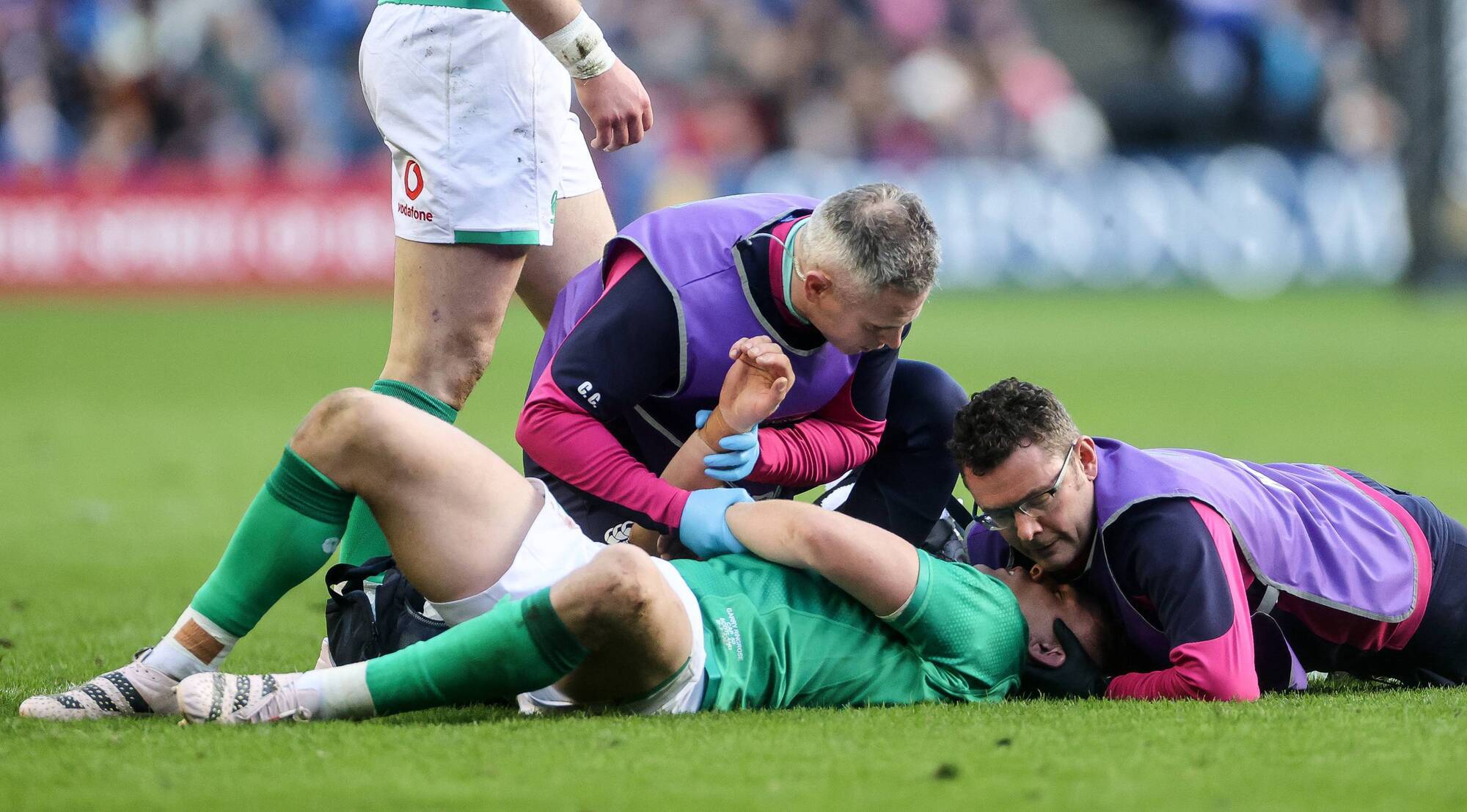
INJURY WOE: Ireland’s Garry Ringrose receives treatment before going off injured Mandatory Credit ©INPHO/James Crombie

The Grand Slam gods have played some dirty tricks in their time but never quite as many as they rained down on Ireland at Murrayfield. It was as if they had gone into conclave and conspired to set the champions-elect a brutally destructive test.
As the accidents began piling up, those on the receiving end would have been less than human had the same rhetorical question not flitted across their minds: ‘Is there Somebody Up There who doesn’t like us?’
The plot to find out how much adversity the world’s No. 1 team could take on the hoof and still keep winning began to emerge almost from the off with the almost immediate removal of Caelan Doris. It was as if someone from on high was saying: ‘See how you manage without the mayhem from Mayo.’
In next to no time, Dan Sheehan and Iain Henderson had joined Doris in the casualty unit. As if the able-bodied hadn’t enough to do with subduing the rampant Scots, their exit forced Ireland to change the first and second rows hot on the heels of Jack Conan fixing the hole at No. 8.
With the Slam, the Triple Crown and the whole bag of chips in the balance, mishap continued to heap on mishap. Ronan Kelleher’s early second half departure demanded immediate solutions to problems which no Irish team can have been confronted with before.
Far from pressing the panic button, Johnny Sexton & co. gritted their collective teeth with the same response. Nothing would be too much of a problem.
We need an emergency hooker? Cian Healy. No problem.
Who’s going to throw into the line-out? Josh van der Flier’s the man because there’s nothing he can’t do. No problem.
Healy rose to the emergency by helping win a scrum penalty. van der Flier threw as if he’d been doing it most of his life, so effectively that Ireland didn’t lose a single line-out on his throw.
Still more disruption followed, most worryingly over the loss Garry Ringrose, carried off with an oxygen mask, the victim of a mistimed tackle which caused his head to smash into Blair Kinghorn’s hip.
Ringrose’s thumbs-up prompted an ovation from the multitude relieved that the stylish Leinster centre was conscious. The sign could also have been taken as an acknowledgement of admiration for how those around him had come through the eye of so many storms.
By then the game had been won. Ireland had passed a severe test of collective character with flying colours in a way which made a mockery of those who dared to doubt whether they had the strength of mind to ensure the winning mentality survived intact.
And a third Six Nations Slam on Saturday would surely be the best of all, if only because winning it means beating France, a victory made to look even better, if that’s possible, after what Les Bleus achieved at Twickenham.
It will be Ireland’s 12th Grand Slam decider, the first in Dublin since the best of all England teams, then at their zenith a few months before lifting the World Cup in Sydney, won at Lansdowne Road twenty years ago.
How different now, with the best of all Irish teams ready to be anointed undisputed champions of Europe.
2018 England at Twickenham 24-15; 2009 Wales at Cardiff, 17-15; 1948 Wales at Ravenhill, 6-3; 1899 Wales at Cardiff, 3-0; 1894 Wales at Swansea, 3-0.
2003 England at Lansdowne Road, 6-42; 1982 France at Parc des Princes, 9-22; 1969 Wales at Cardiff, 11-24; 1951 Wales at Cardiff, 3-3; 1926 Wales at Swansea, 8-11; 1905 Wales at Swansea, 3-10.
Shaun Edwards has been lording it over Twickenham since first setting foot inside the towering bastion of Rugby Union amateurism as a Rugby League professional.
One hundred and one years after The Great Schism of 1895, the RFU reached out across the divide to invite the then supreme exponents of the 13-a-side code to their traditional end-of-season bash, the Middlesex Sevens. For the final against Wasps, Edwards led the most magnificent seven bar none:
Gary Connolly, Great Britain Test centre who finished up on a short-term contract at Munster under Declan Kidney.
Va’aiga ‘Inga’ Tuigamala, the great All Black who died last year at the age of 52.
Jason Robinson, who reinvented himself as England’s World Cup-winning superstar.
Martin ‘Chariots’ Offiah, career League record: 462 matches, 480 tries.
Scott Quinnell, the block-busting Welshman forged in a village called Furnace.
And someone destined to make a bit of a name for himself in Ireland, Andy Farrell.
They cleaned up that day at ‘HQ’ and Edwards has been cleaning up there ever since, including not one, two, three but four English Premiership finals and two Heineken Cup finals, all with Wasps.
The coalminer’s son was only warming up. He marked his Six Nations debut as Wales’ defence coach at Twickenham with an improbable win over England which led to the first of three Grand Slams and now he’s overseen the biggest beating his compatriots have taken on Billy Williams’ old cabbage patch since moving there in 1910.
For good measure, he helped heave England out of their own World Cup and unwittingly did Ireland the biggest of favours as a consequence: paving the way for the sacked defence coach, Farrell, to relocate in Dublin along with the sacked head coach (Stuart Lancaster) and the sacked attack coach (Mike Catt).
A hard man in a hard sport, Edwards at his most intense portrays an image not unlike Mount Vesuvius about to blow its top. At Twickenham on Saturday evening, the sheer majesty of France’s victory prompted him into a rare eruption of pure delight and high fives all round next to the Royal box.
Anyone would think he owns the place…
Sometimes those who are supposed to know most about the internal workings of Test rugby because they have been there and done it turn out to be seriously off-beam.
Clive Woodward, still the only British coach to win the World Cup, declared before Saturday’s match: "’This is going to be a humdinger of a Test match.’ England fans have every reason to be excited about seeing Marcus Smith.’’
Steve Borthwick said: ‘’This team is the right team for the way we need to play. To have Owen (Farrell) coming onto finish the game is a great strength.’’
Farrell, junior, duly came on only to watch France finish the game with four tries in the last 23 minutes and condemn England to their worst beating at Twickenham.
Thomas Ramos (France)
Mack Hansen (Ireland)
Gael Fickou (France)
Jonathan Danty (France)
James Lowe (Ireland)
Johnny Sexton (Ireland)
Antoine Dupont (France)
Andrew Porter (Ireland)
Julian Marchand (France)
Tadhg Furlong (Ireland)
Thibaud Flament (France)
James Ryan (Ireland)
Peter O’Mahony (Ireland)
Charles Ollivon (France)
Gregory Alldritt (France).