Donal Lenihan: Leinster tyros show how bright the future can be
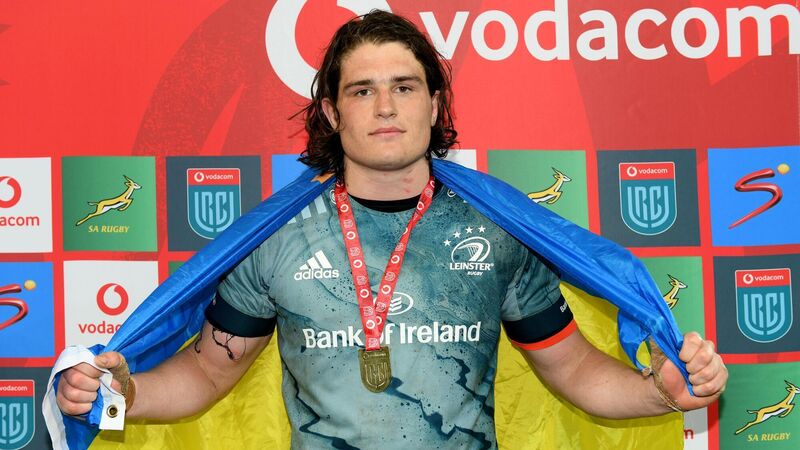
Leinster's Alex Soroka is presented with the URC Player of the Match meda. ©INPHO/Thinus Maritz
If you’re still lacing up the boots in a meaningful way after the May 1st threshold, chances are you’ve made that crucial point of the season which justifies all the hard work that’s been undertaken since the dreaded pre-season training phase last summer.
The weekend’s European action features two mammoth quarter finals involving a quartet of the most decorated teams in the history of Heineken Cup rugby. Between them, Toulouse, Leinster, Munster and Leicester Tigers have a combined haul of 13 Heineken Cups.
Toulouse and Leinster dominate with five and four stars perched proudly over their club badge. With the Grand Slam-winning French and Triple Crown-winning Irish teams from this season’s Six Nations populated by key players from those clubs, both are favoured to emerge from their respective ties against Munster and Leicester on a bumper Saturday to meet at the penultimate stage back at the Aviva Stadium.
The beauty of sport is, once you reach this stage of top level competition, anything can happen. Munster and Leicester are enjoying a rich vein of form at present with the Tigers leading the charge in the Gallagher Premiership and Munster second in the URC.
With the sheer volume of players tied up on a gruelling seven-week stint with their international squads, it became clear to Leo Cullen and Toulouse head coach Ugo Mola that their leading lights needed to be managed carefully in order to reach this stage of Europe refreshed and firing on all cylinders.
With a series of domestic games in the Top 14 on the immediate horizon, that was a bit more straight forward for Mola to negotiate. Not so for Cullen. The big problem for his management team was timing, with Leinster scheduled to travel to South Africa for two pivotal games against their leading sides, the Sharks and Stormers, in Durban and Cape Town on successive weekends.
Where others might have dithered with the business end of the season fast approaching, Cullen sensed an opportunity to road-test an exciting cohort of players and lay the foundations for the next generation of emerging talent to showcase what they are made of.
What Leinster achieved at Cape Town Stadium last Saturday was staggering. Munster were plunged into a similar position last October with 34 players ruled out of their opening Heineken Champions Cup game against Wasps, having come face to face with the emerging Omicron variant of Covid on their trip to South Africa.
What emerged was hugely uplifting when a bunch of academy and sub academy players stood up to be counted in an inspired performance, admittedly against a Wasps side equally ravaged by Covid and injury. Given that six of the starting team and the entire bench were rookies who had featured for their clubs in the AIL in the weeks preceding that game, the feelgood factor throughout the province was massive.
That Munster team, however, was driven by a very experienced backline with six seasoned internationals in Conor Murray, Joey Carbery, Damien De Allende, Chris Farrell, Andrew Conway and Keith Earls. The real heroes that day were up front in a callow Munster pack inspired by the presence of Peter O'Mahony, Tadhg Beirne and Dave Kilcoyne.
But what Leinster achieved in defeat last Saturday was on a different level. To emerge with a losing bonus point against a team that started the day second in the URC table with five Springboks, including three World Cup winners, was staggering given the team they fielded.
Cullen started with just two Irish internationals in Ed Byrne and inspirational captain Rhys Ruddock, supported by seven academy players, with a further three introduced off the bench. These weren’t academy graduates but ten of the 21 players currently negotiating their way through the three-year academy cycle, on a retainer ranging between €8,000 and €10,000 per annum.
As in Durban the previous week, Leinster were eventually undone by the physicality up front of the South Africans. For a second week in a row, Leinster had to absorb two second half yellow cards, conceded out of necessity as their greenhorn pack attempted to suppress the superior power of the opposition maul.
Despite two defeats, the losing bonus points rescued by a vastly understrength squad against top quality opposition has ensured that Leinster will finish top of the pile, regardless of what happens in their final URC outing against Munster at the end of the month. Securing top slot means they will enjoy home advantage throughout the knockout phase and the right to host the URC final should they progress that far.
Entrusting a bunch of youngsters to copperfasten that slot, in hugely demanding circumstances on the road, was a massive leap of faith by Leinster. With Stuart Lancaster left at home to manage the front line troops, Cullen and his coaching team, which included the potentially Munster-bound Denis Leamy, must have sat back on the flight home and reflected on a rewarding experience that offered a glimpse into the future with a host of players emerging with reputations enhanced.
Most impressive behind the scrum were scrum-half Cormac Foley, Jamie Osborne and Rob Russell. It was up front, however, where a number of the forwards earned their stripes in the most challenging of circumstances.
A pair of academy hookers in John McKee and Lee Barron were thrown in at the deep end and did well. A trio of rookie props in Thomas Clarkson, Vakh Abdaladze and Michael Milne faced off against seasoned Springboks and World Cup winners in Stephen Kitshoff, Frans Malherbe, Bongi Mbonambi, Ox Nche and Thomas du Toit and survived to tell the tale.
Clontarf AIL back rower Alex Soroka was deservedly awarded man of the match on Saturday, despite competing against Duane Vermeulin’s likely Springbok successor in Evan Roos.
When Leinster reassembled as a full squad in their UCD headquarters this week, the international contingent will have welcomed their less-heralded colleagues back into the fold with a mixture of pride and admiration. The young guns have placed the pressure back on the internationals to deliver Saturday against Leicester.
They have done their bit which will only add further to the positive environment Cullen has done such a brilliant job to cultivate in challenging circumstances. Managing to keep so many talented players on point is an art in itself. Leinster have mastered that. Next on the list is Welford Road, an arena Cullen knows better than most.
Munster’s preparation for their quarter-final may not have been quite as stressful or challenging but has been equally fruitful. In truth Friday's routine bonus point victory over Cardiff went exactly to plan with a convincing victory in impressive fashion.
There’s been a notable change in the body language and approach surrounding the squad since confirmation of Graham Rowntree’s elevation to head coach leading into the game against Exeter Chiefs.
The quality and ambition of Munster’s attack has gone up a notch since, with three impressive displays on the bounce against Exeter, Ulster and Cardiff. The question now is whether Munster can bring that to another level, which they will have to do, in order to dethrone the current European champions.
Toulouse have been struggling to recapture the form of last season's double-winning side, as evidenced by Ulster’s stunning win against them in the opening Round of 16 game in France. Toulouse found a way to overturn that result in Belfast the following week but still managed to look vulnerable.
Having watched them defeat La Rochelle 23-16 at home last Saturday night in a must-win game, they were pushed all the way by Ronan O'Gara’s charges who continually brought the game to their hosts.
La Rochelle were very positive in their approach, played with a pace and attacking tempo that asked questions of Toulouse throughout. For a team noted for its offloading and attacking prowess, Toulouse kicked a huge amount of ball, content to play kick tennis for long periods.
To win Saturday, Munster must show intent and look to play. They won’t succeed by relying exclusively on their set piece and maul, especially without Dave Kilcoyne, Tadhg Beirne and Gavin Coombes.