Kieran Shannon: Learning to master emotions a key element in Phil Mickelson’s comeback
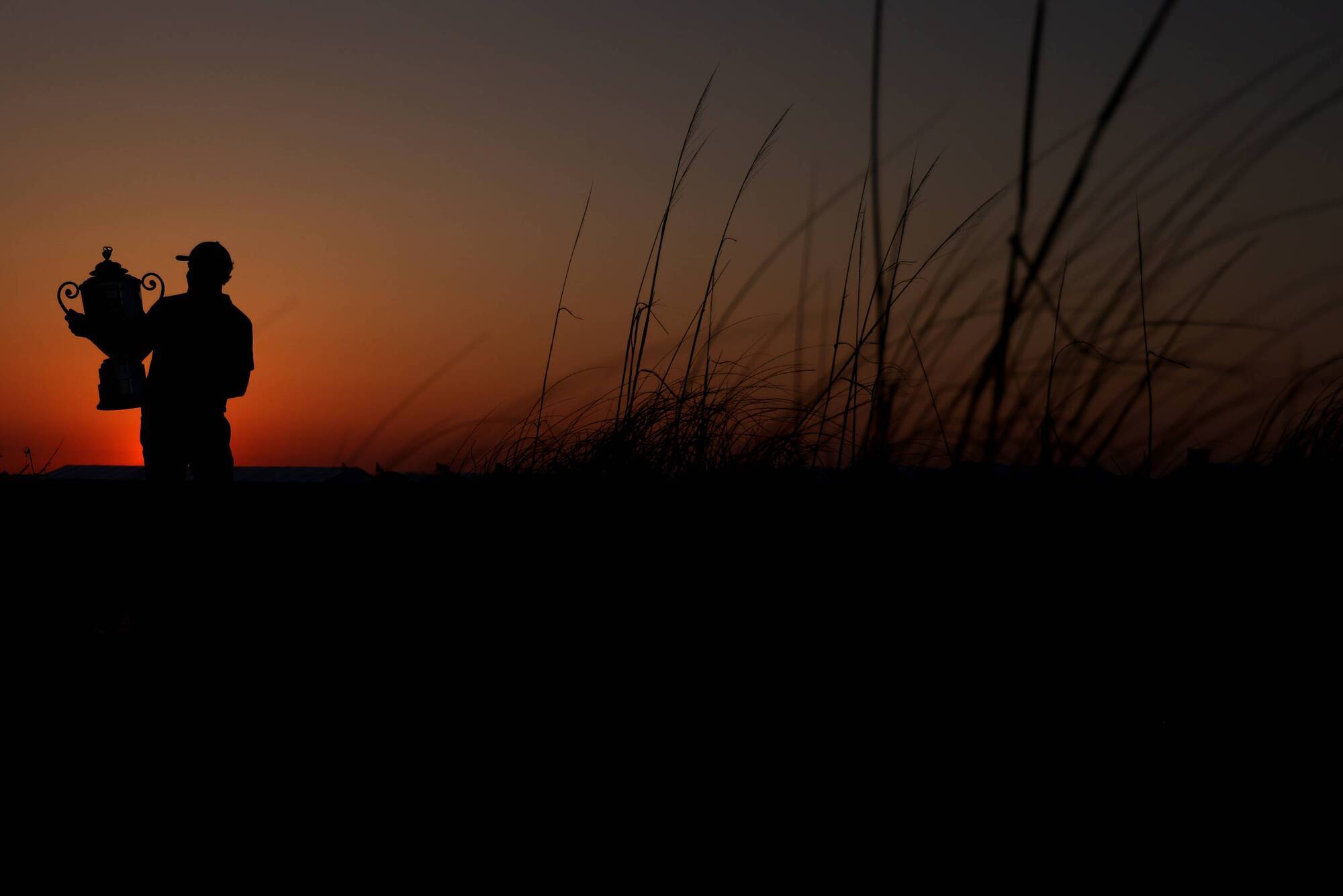
Phil Mickelson raises the Wanamaker Trophy as the sun goes down at Kiawah Island on Sunday. Picture: Patrick Smith/Getty Images
Within minutes of the best performance he’d had in a major in nine years, Pádraig Harrington offered an explanation in a characteristically honest and insightful interview to Sky Sports.
“I will say one thing [about] today and it’s something we always say to every player to try to work on, but I don’t think I enjoyed a round as much as I did playing with Shane [Lowry] today. It’s amazing how relaxed I was. [Okay,] I wasn’t relaxed at the putting but from tee to green, I was relaxed all day.
“I know it’s a cliché but if you get your head in the right place, it’s much easier to play good golf. I can be a bit of a stressball on the golf course, I can really overthink things, so it [his performance] was down to a nice pairing with Shane.”
So engrossed was the interviewer in hearing Harrington reflect on how he could be competitive entering his 50s, for a moment it seemed as if they’d forgotten that there was still a final pairing out there and a major tournament to be decided.
In what he had to say about himself and Mickelson, however, Harrington had hit upon some of the reasons why Lefty was going to leave Kiawah Island with another major — his sixth — to his name.
There was a time when he’d no major to his name, and there was a genuine fear and prospect that it would stay that way. And that was partly because Mickelson, without even being aware of it, could be a bit of a stressball himself on the Sunday of a major.
It was David Peltz, his old short-game coach, that brought it to his attention sometime shortly before his breakthrough win at the 2004 US Masters that he tended to look “too serious” on Sundays.
“When you’re at the top of your game, you’re smiling and laughing,” he’d tell Mickelson. “That allows your mind and body to perform at the top of your game. If you try to be serious it’s like tying one hand behind your back. You need to lighten up on Sundays.”
So, at Augusta that year, that’s what he did, as explained in a book Mickelson did with Donald T Phillips appropriately called One Magical Sunday.
Like Harrington, it helped that he was paired with someone he was comfortable with.
Chris DiMarco and he knew each other well form their college days. But what mattered more was his own outlook and preparation.
“Phil was really tuned in during his morning practice session,” his long-game coach, Rick Smith, would tell Phillips. “There wasn’t anything technical or analytical to discuss. So I tried to just make sure he was relaxed. About half an hour before he was due to tee off, Phil started talking about solar eclipses and spiral galaxies. At that point I figured he was relaxed enough.”
In psychological terms, they call it IZOF — the Individual Zone of Optimal Functioning, based on a theory and study by a Russian researcher called Yuri Hanin.
In short, every person has an optimal level of anxiety that allows them to perform to the upper range of their ability. If they experience too much or too little anxiety it can hinder their performance.
For a while, Paul O’Connell was working under the assumption and illusion that a high level of anxiety worked best for him; “If I throw up before we go out, I know I’m ready,” he’d reflect in 2009. It wasn’t something that he especially set out to trigger and certainly wasn’t a state he enjoyed but it was how he’d won his first Heineken Cup and several Triple Crowns.
Then after a conversation with the performance psychologist Caroline Currid, it brought home how stressful it was. As he told her at the time: “A lot of the time around a big game I’d be happy to get on a plane, leave the country and hide, rather than deal with the stress over us losing or me not performing.”
The process of finding a new way — a new IZOF — would define the second half of his career, even inspiring the title of his autobiography, The Battle. In the end, the new way won. Having to be emotionally high for every game, looking for reasons to resent the opposition, was too draining. His game was less governed by fear. As he’d write in the book: “Being relaxed makes life a bit easier.”
While he wasn’t exactly talking about solar eclipses half an hour before facing England or Toulouse, he’d found a way to bring it down a notch. It didn’t compromise his performance. Instead it had helped prolong his career and make the journey and the battle more enjoyable.
That is the trick for athletes and coaches. Several Munster players have remarked how there wasn’t enough anxiety in their leadup to the watershed that was the 2008 Heineken Cup semi-final against Leinster; as the captain of the victors that day, Leo Cullen, has since observed from bitter experience, in competitive sport, you need a certain level of fear, or at least anxiety to perform.
Or as the famous Cork kitman Jim ‘Kid’ Cronin so brilliantly put it to several countymen ahead of big games in Croke Park, Thurles, and Killarney: “If you don’t have nerves, go home, boy.”
But the danger is sometimes some athletes can drain too much energy before and during competition. And overthink it.

Mickelson once had the same issue. But he’d come to accept and embrace the discomfort.
So stellar and magnificent was his final round at Augusta in 2004, we tend to forget how imperfect it was, at least at the start. He bogeyed three of the first six holes. But he’d learned to regulate his emotions in no small part because of how he talked to himself.
“As I walked off the [fifth] green,” he’d recall in One Magical Sunday, “I’m thinking: ‘Okay, I lost another shot to par. Those things happen. I’m going to make mistakes like that. But it’s much better to make a bogey as opposed to a double bogey. At least I’m still tied for the lead.”
There’d be other magical Sundays in Augusta after that one.
In 2010, after a round that included several drives that ended in the trees, he’d remark: “I feel like I can make mistakes here.”
Kiawah Island was the same. Even in the back nine, he’d have several bogeys but as Harrington observed in that interview on Sky, Mickelson remained absolutely committed and fearless with every shot.
He’d stay in his IZOF, having a bit of banter with the crowd, even when one of them appeared to lift his ball on 11.
A lot of athletes never discover their IZOF, sticking to routines that might not necessarily be the best one for them. Mickelson did, some time ago, as did O’Connell.
As Ryder Cup captain, a challenge for Harrington will be to appreciate and facilitate the various different IZOFs of his European team; a role such as his will demand what GB swimming defined some time ago as “arena skills”.
But you’d hope too that now that he’s come upon his own IZOF, he’ll look to facilitate and trigger it as well.
If someone as reflective as O’Connell could call his story and relationship with the mental game The Battle, then Harrington, as about the only Irish athlete even more cerebral than the Limerick man, could call his The War.
Whatever about winning another major in his 50s like a Mickelson, it’d be something if he were to win that.

Subscribe to access all of the Irish Examiner.
Try unlimited access from only €1.50 a week
Already a subscriber? Sign in