Colin Sheridan: Andy Moran refused to become Mayo's prisoner of tomorrow
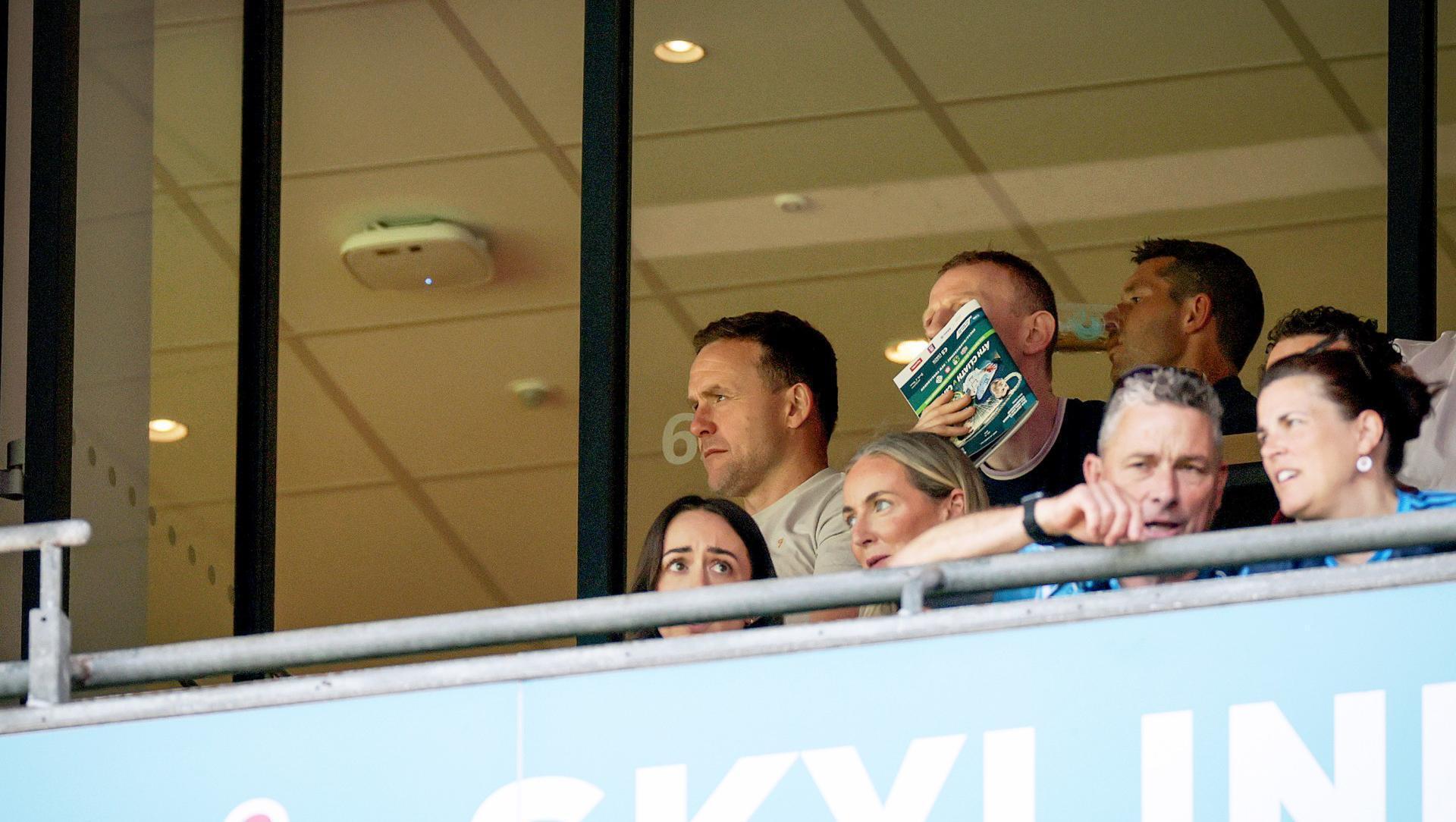
FINAL COUNTDOWN: Mayo Manager Andy Moran attends the Kerry v Dublin game. Pic: ©INPHO/Laszlo Geczo.

-
There was a stage this summer when Andy Moran's first championship as Mayo manager looked as though it would become one of those seasons explained away with a shrug of the shoulders.
A transition. A year full of learnings and work-ons. A necessary pain before better days.
That is usually the language of teams that lose.
After the defeat to Roscommon, and then another against Tyrone when confidence looked to be evaporating almost as quickly as optimism had arrived, there was every chance Moran's debut campaign would be filed away as respectable but flawed.
Read More
Had Mayo fallen the wrong side of the margins against Monaghan - and they very easily could have - the season's postmortem would be very different.
We would be discussing tactical naivety, asking whether he had been too loyal to veterans, questioning whether his attacking philosophy was sustainable, and concluding, with the benefit of hindsight, that perhaps 2026 was always going to be about laying foundations.
Sport is wonderfully cruel like that. The difference between vision and delusion is often one kick of a ball. Instead, Mayo wakes this morning preparing for an All-Ireland final, and what a short while ago looked like a quiet calamity suddenly looks like a masterpiece in opportunism and ability.
This is the curious thing about Moran. Just as it once was as a player, it is difficult to define precisely what he is as a manager. Is he one of those lucky generals history occasionally throws up? Is he blessed with timing more than tactical genius? Or is he simply intelligent enough to recognise his own abilities and limitations, surround himself with good people and allow them to flourish?
Perhaps the answer is none of those things. Perhaps the biggest change has been emotional rather than tactical.
For years Mayo had become weighed down by themselves. The latter years of James Horan's reign carried the burden of familiarity. Kevin McStay inherited a county exhausted by near-misses and expectation, and ultimately that fatigue and confusion seeped into the football.
Moran has arrived with something entirely different. Energy. Enthusiasm, and ever-so-slowly, belief.
Those words can sound painfully clichéd until they become visible. We cannot see behind dressing-room doors. We have no idea what conversations happen on Tuesday nights in Bekan or Castlebar. We can only judge what we see. And what we see is authentic.
Moran looks and acts like somebody who genuinely loves football. More importantly, he looks like somebody who genuinely enjoys the players he is coaching. Enthusiasm in groups is contagious, just as anxiety is.
He has hardly been flawless.
He continues to trust Aidan O'Shea, whose influence extends well beyond birthdays and birth certificates. He has built much of his attacking identity around Kobe McDonald, fully aware that the outstanding young forward is bound for Australia and the AFL when this season finishes.
That feels contradictory if this is supposed to be a long-term rebuild. Yet perhaps that is exactly why this campaign has worked.
Too often managers become prisoners of tomorrow, and had this season gone another way, Moran would have had to revert to that logic. But in the last few weeks, Moran has coached nothing but the present.
He has allowed youth to breathe without discarding experience. He has trusted emerging footballers while recognising that men like O'Shea and Cillian O'Connor still possess something that cannot be coached - perspective.
He has also understood these new rules quicker than many of his contemporaries. Some managers have spent the season complaining about football's evolution. Moran appears to have accepted the changes immediately and asked only one question: how do we make this work for us?
That willingness to adapt has been one of Mayo's great strengths. And then there is McDonald.
Every generation needs a footballer who reminds people why they fell in love with the game in the first place, and McDonald has embraced that with carefree gusto.
A certainty for an All-Star and Young Footballer of the Year. A footballer who attacks defenders instead of systems, and creates rather than destroys. Who plays with an abandon that feels almost rebellious after years in which Gaelic football became consumed by structure, caution and suffocation.
He has become the symbol of this Mayo team because, in many ways, he reflects the personality of his manager.
Play, attack, believe.
Now comes the easy part. Not winning the All-Ireland, obviously. That may prove impossible. The easy part is the next fortnight, and the next fortnight is the part that Mayo have usually found the hardest.
But once again, Moran has somehow managed to flip the familiar script of Mayo as over-excited bottlers into fuel to burn.
“Let them enjoy it,” Angry Andy said in response to a press question he found patronising in its presupposition.
You have to admire his unwillingness to conform. Why shouldn't supporters dream? What exactly is the alternative? To stay quiet? To prepare emotionally for disappointment? To convince yourself defeat is inevitable because history says so? Sport does not reward emotional caution.
This feels like as close to a free shot as Mayo have ever been given.
The burden belongs elsewhere.
Across no-man's-land stand a machine that has spent the last decades collecting medals almost routinely. A county so relentlessly successful that even neutrals have grown weary of counting Celtic crosses. Mayo arrive carrying something entirely different; Hope. Not optimism. Hope. Those are not the same thing.
Perhaps Andy Moran is a lucky general after all. History has always had room for those. But reducing this remarkable season to luck alone would miss something important. He has embraced change. Trusted youth. Respected experience. Understood the new game. Rolled the dice when others might have played safe.
And now, improbably, wonderfully, Mayo get to roll them one more time.
If somebody had sat down in a FIFA boardroom 12 months ago and sketched the perfect World Cup semi-final line-up, it is difficult to imagine they would have come up with anything more commercially irresistible than what we’ve landed on. Argentina versus England. Spain versus France. All the history and the rivalry and the superstars. Television audiences measured in the hundreds of millions. Lots more awkward silences as Irish commentators linger in a vortex while cameras linger on celebrities we wouldn't know if we met them in a tent at the Galway races. It is, in every sense, the poster. It is also enough to make even the most rational football supporter glance sideways and wonder, however fleetingly: “Jesus... maybe the fix is on.”
Maybe. Football is gloriously chaotic precisely because it refuses to follow scripts. But this script? This script is almost too perfect. Every World Cup seems to produce its wonderful gatecrasher. Morocco in Qatar. Croatia before that. Uruguay, Ghana, South Korea - teams that upset the commercial order and remind us that football remains stubbornly democratic. This one hasn't. Instead, the tournament has unfolded almost exactly as the bookmakers might have hoped, against a backdrop of political and commerical intervention unlike anything in the game's history.
Argentina survived Switzerland courtesy of Julián Álvarez's genius. England edged past Norway in a match that felt like a prolonged anxiety attack. Spain and France have arrived exactly where everyone expected them to. It is, objectively, brilliant for the tournament. Four magnificent football nations, four genuine contenders. Four semi-finals that could each have been finals. Perhaps that's all it is.
Or perhaps somewhere, in a smoke-filled room that probably exists only in hyperactive' imaginations, a group of puppet masters are quietly raising a glass to another job well done.
Denise O'Sullivan's proposed departure from Liverpool after just six months feels surprising, if not entirely inexplicable. The midfielder has been one of the club's standout performers since arriving in a record transfer from North Carolina Courage in January, helping steady Liverpool's season. Reports in the US now suggest Gotham FC are close to agreeing a loan deal. On the surface, it raises obvious questions. Liverpool invested heavily in O'Sullivan and she quickly repaid that faith. Players of her experience and influence are not usually allowed to leave so soon unless there is more to the story than football. The indications are that there are. Personal reasons, rather than sporting ones, are understood to be behind the move, with a return to the United States offering greater stability off the pitch. If that proves to be the case, Liverpool can have few complaints. O'Sullivan has done her part. Sometimes life simply has a habit of dictating the next transfer.
An all-Czech Wimbledon final between Linda Nosková and Karolína Muchová was more than a curiosity; it was the latest chapter in one of sport's most remarkable production lines. For a country of fewer than 11 million people, the Czechia continues to churn out elite tennis players with astonishing regularity. From Ivan Lendl, Martina Navratilova and Petra Kvitová to Barbora Krejčíková, Markéta Vondroušová, Muchová and now Nosková, excellence has become a national habit. While larger nations obsess over finding the next superstar, Czech tennis simply keeps producing them, generation after generation, through a culture where coaching, competition and expectation reinforce one another.