Christy O'Connor: Limerick hoping to reignite their love-affair with Croke Park
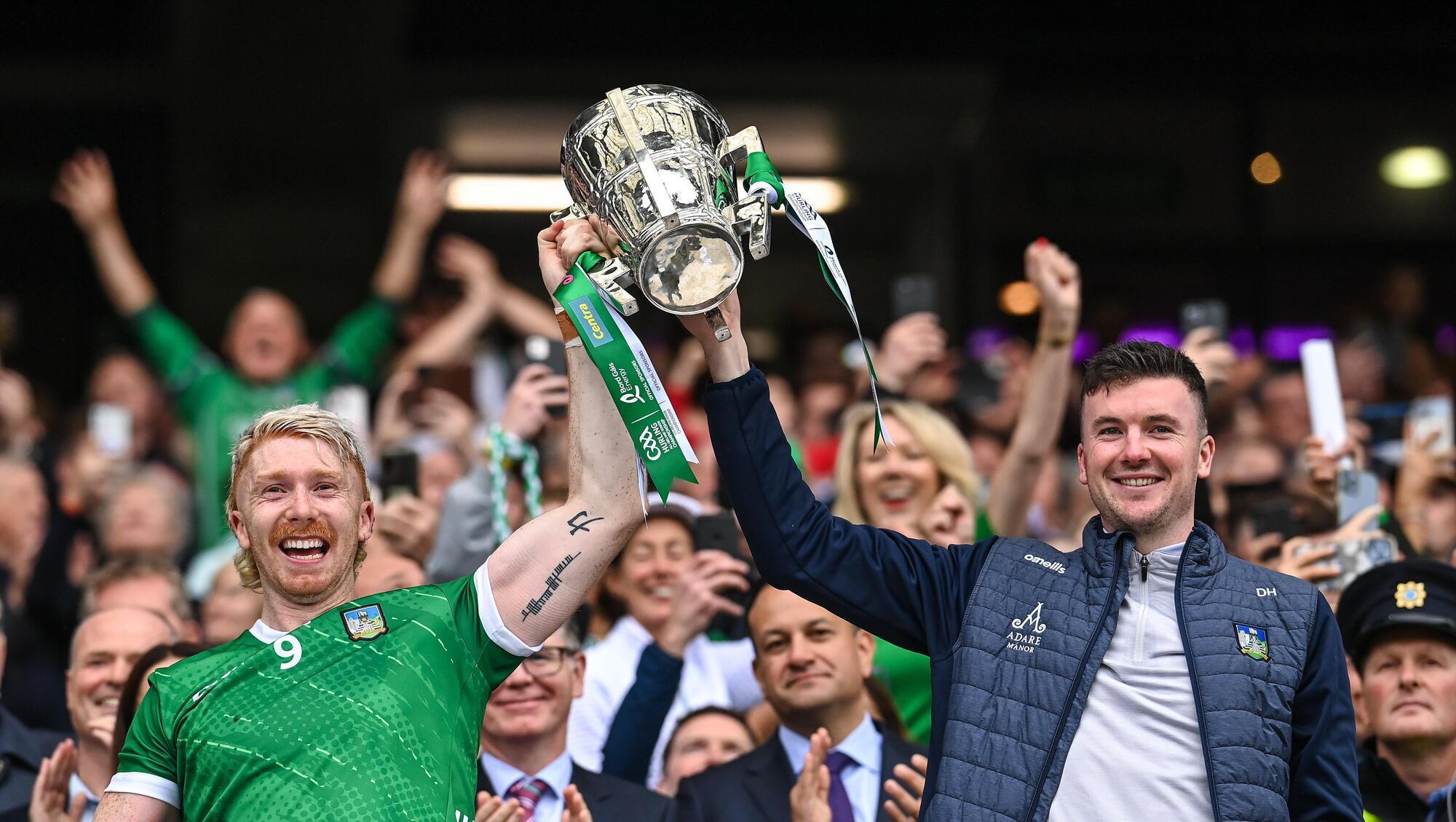
GOOD TIMES: Limerick players Cian Lynch and Declan Hannon lift the Liam MacCarthy Cup at Croke Park. Pic: Piaras Ó Mídheach/Sportsfile.
At the end of the 2024 Cork-Limerick All-Ireland semi-final, as the Cork players celebrated together with ‘The Frank and Walters’ classic tune ‘After All’ booming out around Croke Park, the Limerick players were gathered in separate groups around the pitch, gazing blankly at a completely unfamiliar setting, scenes that they were normally part of, but suddenly weren’t.
Players hugged each other. Softly spoken words were exchanged. For what appeared like an age, the Limerick players didn’t seem to know what to do next. Most of the Cork players had already entered the dressingroom by the time the Limerick players finally moved together in unison, gathering in a group close to the Hogan Stand, before applauding their supporters still in the ground.
The players still looked concussed in the moment but there was bound to be a shock factor whenever Limerick’s incredible winning run was halted, particularly when there was such history at stake. Limerick looked primed to achieve the immortal five-in-a-row feat. It had been five years since Limerick had lost a knockout championship match. And they had been unbeaten in Croke Park in their previous eight games.
When Kilkenny (who were also stopped from achieving the five-in-a-row) were at their peak under Brian Cody, Croke Park was like a second home because they played there so often. Limerick have a different relationship with the venue, not just because they always had to wait a year to play championship there again, but because of what Croke Park means to them, of what it represents to the group.
“We have a routine but walking into that stadium is an absolute privilege,” said Gearóid Hegarty after the 2024 Munster final. “With the history and tradition of the place, it’s just amazing to play there. That is where the big trophies are handed out. That’s where we want to be.”
Read More
That prospect excites Limerick but Croke Park also energises and enlivens them. They embrace it even more after the liberation from the claustrophobia of Munster.
In their first 11 championship matches in Croke Park under John Kiely, Limerick won 10. In their march towards the four in-a-row, Limerick sealed most of their greatness through their performances of soaring brilliance at the most critical stage of the season in Croke Park.
Another key comparison between Cody and Kiely’s four-in-a-row sides were how both teams were able to perform at their peak when it mattered most. Similar to Kilkenny in their pomp, Limerick always followed a familiar path to time their run-in perfectly. “We know our routine, it’s nailed down,” said Kiely after the 2023 Munster final. “The players know exactly what is going to happen over the next four weeks.”
Two weeks ago, Limerick were in Killarney for a training weekend, just like they had done on the same weekend prior to some of their previous All-Ireland wins, and before that 2024 semi-final. Just like Kilkenny always would when they repeated that process on their training camp two weeks out from an All-Ireland semi-final, the Limerick players could recognise the comfort and contentment that comes from following familiar signposts on the same journey.
“You had your own little metrics and markers,” Eddie Brennan once recalled about the comfort Kilkenny took from annually tracing those same steps. “In sports psychology terms, it’s all about finding that sweet spot between being on edge and following routine. It’s positive reinforcement.”
Limerick were thrown from their routine last year when losing the Munster final to Cork, but they’re back on familiar terrain now having had a four week lead-in to an All-Ireland semi-final, just as they had before the 2022, 2023 and 2024 semi-finals.
Losing the 2024 semi-final was a colossal setback, especially in the circumstances of what was at stake. But it also burst their Croke Park bubble.
Prior to last year’s All-Ireland quarter-final, Limerick had the opportunity to play Dublin in Thurles – where Dublin’s record is dire – but they choose to go to Croke Park, even though Dublin would have additional support with the footballers playing after them in a preliminary All-Ireland quarter-final.
“It’s a great opportunity for us to get another game in Croke Park,” said Kiely beforehand. “We have a good record there. We have always performed there.”
Except they didn’t that afternoon as Dublin burst their bubble. Again. After treating it like their playground during the four-in-a-row, Limerick haven’t won a championship game in Croke Park now since the 2023 All-Ireland final. So can they reignite their love affair with the Jones’ Road venue?
Read More
In these pages during the week, Darren Morrissey coloured in the detail around the emotional outburst after the Leinster final four weeks ago, when Galway won by 14 points and celebrated as if they’d won by one. “It was great to see such celebrations,” said the Galway captain. “It would nearly bring a tear to your eye to see the older lads enjoying it so much.”
It was easy to see why. Galway hadn’t won in Croke Park since 2020. They had lost four Leinster finals in the previous five years. After losing last year’s decider to Kilkenny by eight points, before collapsing in the All-Ireland quarter-final to Tipperary, something had to change.
It did. There were ten changes from the side which started the 2025 Leinster final to the team which beat Dublin four weeks ago. Micheál Donoghue said afterwards that the most frustrating aspect of last year’s Leinster final loss to Kilkenny was that they didn’t implement the gameplan. Galway came with a different strategy this time around but they had to when they are playing a different game. And Donoghue has fitted the team out with the athleticism and qualities to execute that style.
Throughout last year’s championship, Galway carried a squad of roughly 45 players. Seventeen never made the championship 26. They weren’t ready back then. But they are this year.
Of the 13 players Donoghue handed debuts to in the 2025 league and championship, five appeared in the championship but only two – John Flemming and Colm Molloy – got any significant game-time.
After a season of hard development though, the players Donoghue handed debuts to this spring were far more equipped to nail down a starting place, four of whom have; Jason Rabbitte, Aaron Niland, Darragh Neary and Cian Daniels. So have Cillian Trayers and Rory Burke, who briefly appeared in the 2025 championship.
After Donoghue’s first term ended in 2019, Galway were consistently accused of not having an identity. When they had that distinct personality under Donoghue between 2016-’19, most of it was framed around consistency of style and performance.
Back then, everybody knew what way Galway were going to play. They always turned up and performed, but Galway spent the intervening years desperately searching for that identity. And now that they have finally rediscovered it through predictable consistency and a nice blend of youth and experience, Galway are an extremely dangerous proposition for Cork.
In his book Long Bullets: A History of Road Bowling in Ireland, Fintan Lane explores the socio-cultural history of the sport, tracing road bowling to at least the 17th century, suggesting that it was once far more widespread than it is today. Road Bowling is still played in numerous counties but is mostly concentrated in Armagh and Cork.
Armagh goalkeeper Ethan Rafferty briefly brought the sport into the mainstream in recent times, albeit just momentarily; after winning an All-Ireland football medal in 2024, Rafferty made history by becoming the first bowler to win the All-Ireland Intermediate and Senior titles in successive years, in 2024-‘25.
A year on and another inter-county goalkeeper is making waves in both sports. Instrumental to Cork’s recent win over Derry in the All-Ireland minor semi-final, Rory Twohig showed equal levels of prowess on the bowling roads as on the football field the same week when winning a South-West U16 Road Bowling semi-final over David Harrington at Grange. Twohig also competed in the U18 competition at Curraheen but bowed out to Munster finalist Culann Bourke.
It's been an exceptional year for Twohig to date, especially with Cork, where the young Kilmeen goalkeeper has been tearing up the scoring charts. In the All-Ireland quarter-final against Meath, Twohig landed 0-9, which included three orange flags from frees.
It’s no surprise that the goalkeeper is Cork’s top scorer in this championship. Twohig has clocked 0-4 more than Cork’s second highest scorer, Tom Whooley. From the Tyrone team that Cork face in Sunday’s All-Ireland final, only Conan Canavan has scored more than the Cork goalkeeper.
Similar to Rory Beggan, who was Monaghan’s top scorer overall for the 2025 season, Twohig has that unique long range striking and scoring ability for a goalkeeper. “Rory has that in his locker since he was a young boy,” said Cork manager Keith Ricken after Twohig dismantled Meath in the All-Ireland quarter-final.
It’s not the only talent though, that Cork’s young goalkeeper has in his locker.