Fogarty Forum: Benny Hurl challenges GAA to face rural depopulation crisis head-on
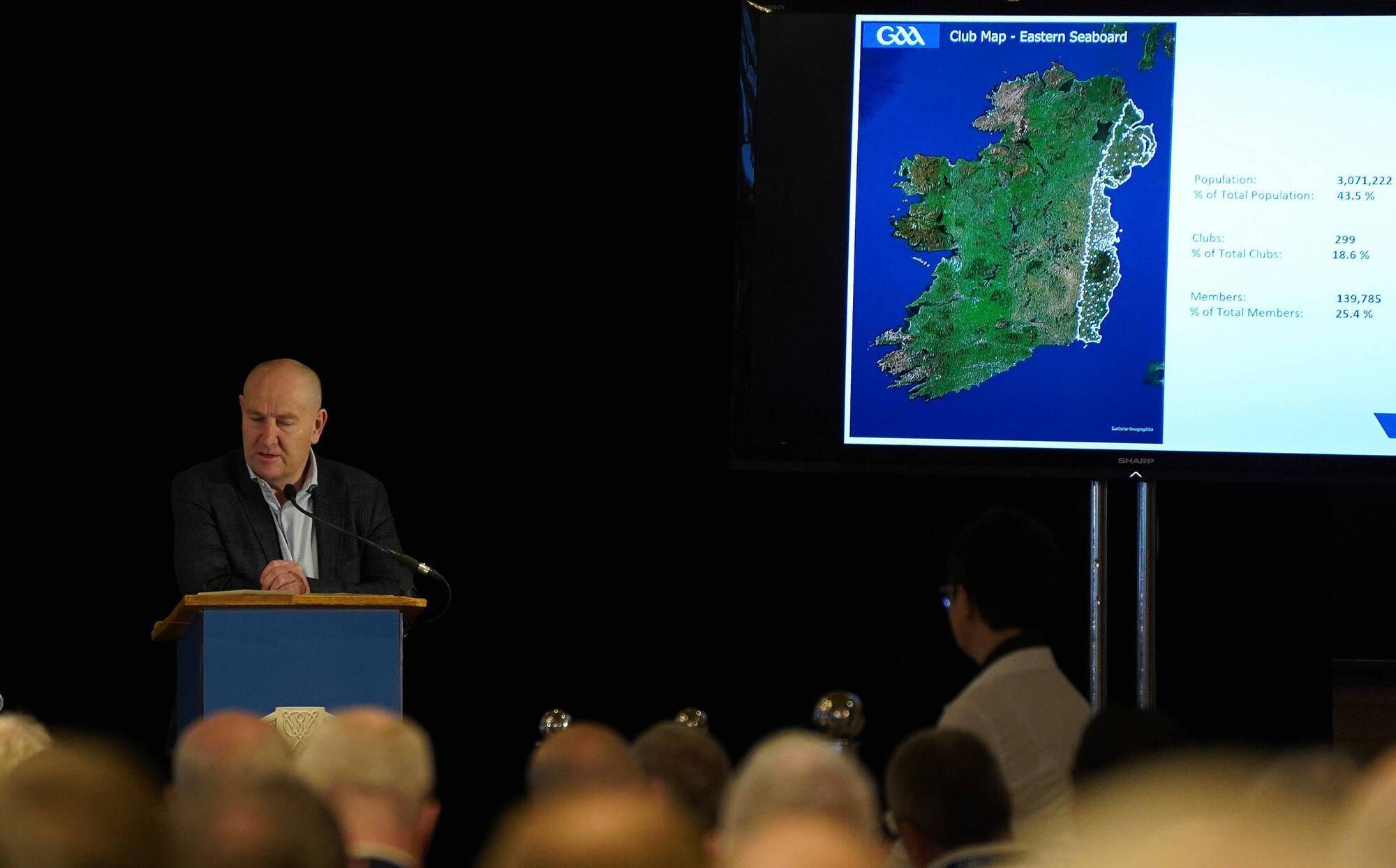
Speaking at GAA Congress, Chairperson of the Higher Education GAA Council Benny Hurl. Pic ©INPHO/Leah Scholes
Anybody expecting the second day of Congress to start with a round of backslaps was sorely disappointed when Benny Hurl took to the rostrum.
Hurl is an independent thinker, a man not afraid to say what others chose only to think. At the previous year’s Congress in Newry, he told the GAA that they have done nothing to curb excessive inter-county spending – “We keep shovelling coal into the burners to feed it.”
Integration is an untouchable subject for some but not Hurl. The Tyrone man warned that the GAA was hamstringing itself by committing to amalgamating with the ladies Gaelic games organisations by 2027 and it would put further strain on GAA resources.
Hurl is his county’s Central Council delegate and also chairman of the higher education committee. He can lead but he can disrupt too. When GAA president Jarlath Burns appointed him as the head of the national demographics body, it wasn’t to kill him with kindness but to tell the inconvenient truths.
On Saturday, Hurl, a quantity surveyor by trade, did just that. “We have committed huge resources to the FRC (Football Review Committee), we have committed huge resources to hurling development and amateur status (committees). But the feedback I have received is a growing sense of frustration that the whole issue of demographics isn’t being prioritised and needs to be prioritised.”
Hurl didn’t stop there. “As an association, we’re told that we’re thriving, we’ve never been as strong. But in terms of some of our clubs, we have never been as poor. You have heard of the challenges. I will appeal to you all in order to preserve our clubs and to maintain our preeminent position in Irish society so that we can really claim that we all belong, that there is a place for all of us.”
He continued: “One of Michael Cusack’s aims in the establishment of this great association was to enhance the self-esteem of the Irish people, Irish communities through Gaelic games.
“His vision was that we would have a unit in every parish, which we have at the moment, and we would wear the colours with a sense of pride. That we would drive the esteem of the nation, which it did, which it does to this day… as an association we need to act and to reimagine Cusack’s vision for a modern Ireland.”
Hurl’s convincing oratory was sobering but more potent was the graphic of Ireland he commissioned that appeared on the large screen beside him. There, east of a line drawn from Larne in Antrim to Danecastle in Wexford lay 43.5% of the island’s population (3.071 million) served by just 18.6% (299) of the GAA’s total number of clubs.
Consider that Connacht has a population of 591,363 (8.4% of the 32 counties) and accounts for 13% (213) of clubs and it’s evident the great imbalance in the organisation lies not in the provincial football championships but the spread of its units.
Burns described rural depopulation on Saturday as “an uncontrollable” but spoke about a collegiate effort being required to arrest it. He said: “It is unconscionable that we would be the generation who preside over the permanent demise of rural Ireland.
“The role that we play in Irish life and especially in rural life gives us a power and influence that we should use to ensure that rural Ireland is not allowed to die. The Government needs a national spatial strategy.”
Hurl refuses to believe that rural depopulation is a fate the GAA can’t escape. “I understand perfectly that some people maybe believe that demographics is insolvable,” he told Congress delegates in Donegal. “Anyone who knows me know I’ll do my best and knows I won’t be deterred and I have great people behind in Peter Horgan and Conor Weir (Croke Park staff) there as well.”
Identifying the problems is essential for Hurl. He plans on producing more maps to highlight the demographic inequalities. The GAA leadership are intrigued about some of the solutions he and his committee have floated. In his interview with PJ Browne of this newspaper last August, he spoke of culling sacred cows. The parish rule may very well be one of them.
Dublin is one county where the parish rule doesn’t exist but the need for new clubs there and other urban centres is abundantly clear. When Castleknock GAA formed in 1998, they became known as Shelbyville in the nearby, established St Brigid’s. As Castleknock matured into a force and Ciarán Kilkenny starred for them in the 2010s, it was they who were referring to their local rivals as the opposing town of The Simpsons’ Springfield.
The GAA needs more Shelbyvilles. Hurl recognises that more than most.
“You want it to be one way, but it’s the other way.”
Marlo Stanfield’s famous line comes to mind reading about the managers complaining about the new rules. This weekend, Malachy O’Rourke and Paddy Tally joined a chorus already featuring the likes of Mickey Harte and Tony McEntee that the kick-out now causes chaos.
“It is all 50-50 ball,” said Tyrone manager O’Rourke on Sunday, “so my thinking would be you can allow the kick-outs to be taken just outside the small circle, it might leave more variety in the kick-outs and it wouldn’t become a 50-50 battle all the time.”
A day before him, Derry boss Paddy Tally bemoaned: “Science-wise, the ball is going to go out to the middle now. It’s really going down to back to midfielders who can win ball.”
If that’s the case then consider this a victory for the Football Review Committee (FRC). More contests and chaos is what the people sought and from the FRC the public gets what the public wants. The data from the first three rounds of the league demonstrated contested kick-outs have risen from 26% in last year’s championship to as much as 68% this year (Round 3).
The anticipation around kick-outs is greater now than it has been for the last 20 or years. O’Rourke makes the point about hurling going the other way and becoming more possession-based but the comparison is flawed when hurling’s speed compensates for that.
Harte and McEntee made slightly different comments about the lack of clean ball being won, which is something to consider, but if managers are bemoaning the lack of control they now have on restarts they aren’t going to receive much sympathy.
Undoubtedly, managers have genuine bones of contention about the unfairness of the 12 v 11 overload and the anomaly with the black card. However, losing control isn’t one of them.
Kudos to Tyrone GAA and the club members of Pomeroy Plunketts for turning around Sunday’s venue change from Omagh so smoothly. Opened last year, the €1.9 million spent on the club facilities seems money well spent.
Where Tyrone and Kerry fell down for their fixture on Sunday was the match programme. Two changes to the home starting team was reasonable enough but three Errigal Ciarán men were drafted in as substitutes and then the Kerry team listed was not the one announced on Friday but the side that began the defeat to Dublin the previous weekend.
Tyrone chose not to wait for the Kerry team and Jack O’Connor apologised for the inconvenience, which meant the Kerry players listed to start had to wear the numbers they were assigned in Tralee, David Clifford sporting the No 21 being the prime example.
A sillier situation occurred in Galway where TG4 announced there was one change to the Donegal team when in fact there were six, five of them wearing the numbers of those they had replaced (Galway’s showed three alterations). RTÉ reported only four of the team were wearing the numbers they were allocated in the match programme. As media rights holders, they should be treated with more respect.
At Congress on Saturday, GAA president Jarlath Burns delivered the welcome news that media engagement is now linked to All-Ireland final team holiday funding. It’s not just for our benefit; if there is more promotion and build-up involving the players and management, the GAA stands to gain too.
But its tendency to shoot itself in the foot is still there.