Liam Sheedy: With hurling now played by chameleons and shape-shifters, it's adapt or die
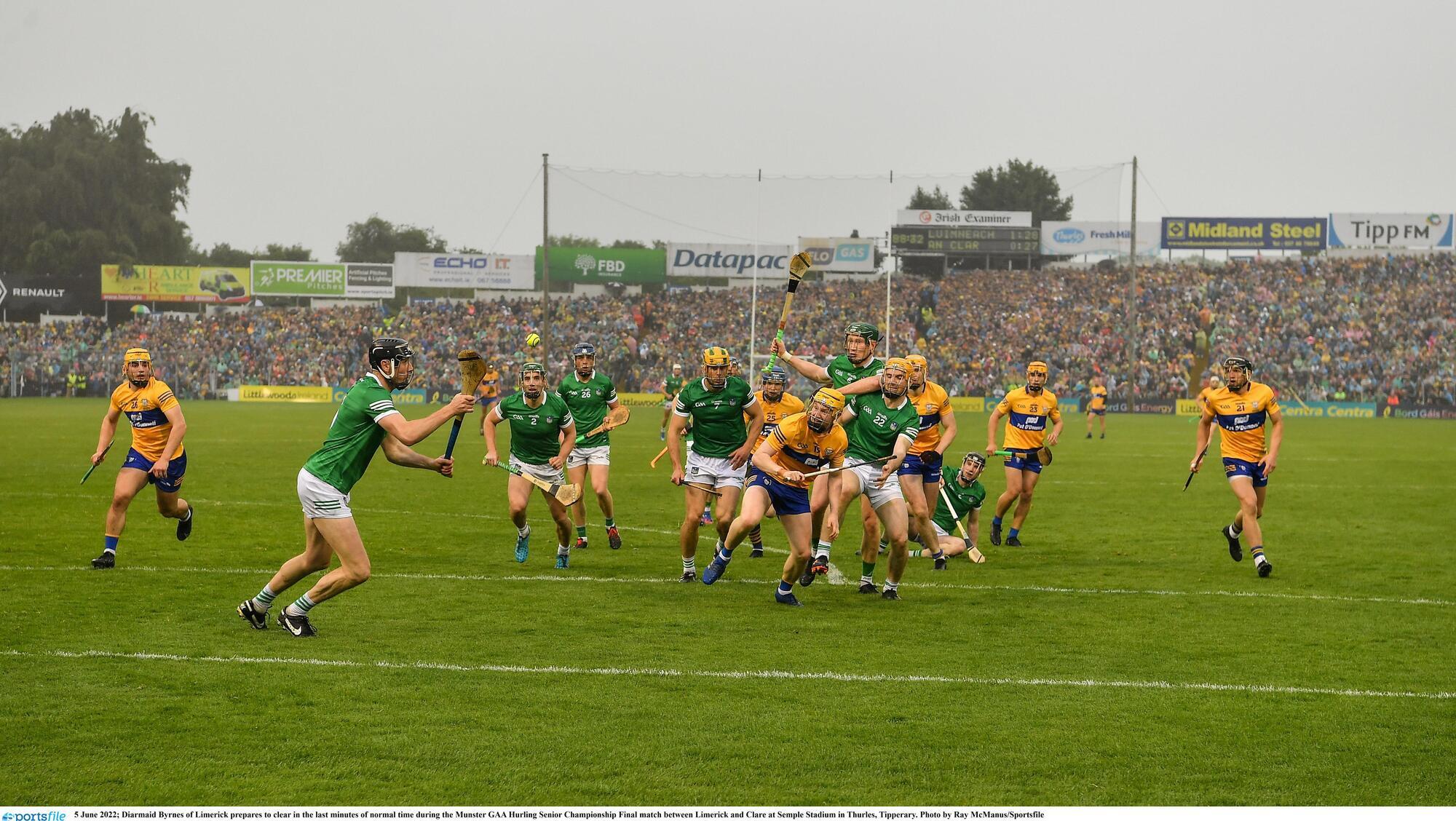
The heat of the battle: Diarmaid Byrnes of Limerick prepares to clear in the last minutes of normal time during the Munster GAA Hurling Senior Championship Final match between Limerick and Clare at Semple Stadium in Thurles, Tipperary. Pic: Ray McManus/Sportsfile

It’s just another beauty of our great game, that you can’t pin teams down anymore.
Remember Clare withdrawing en masse behind the 45 earlier in the year, and how everyone talked of it being the way to deny Limerick room to work through the lines. Then watch Lohan’s men last Sunday, on their biggest day, pushing up man for man on the best team in the country. And it worked for the guts of the match. Until Limerick adapted again.
‘Adapt or die’ has never been more apt. From game to game, and more importantly now, within a game. Hurling is played by chameleons and shape-shifters. Everyone wants the game played on their terms, to impose their system and style. Reacting to what develops in front of you is crucial.
Some of that ability to change and react comes from the riches the top teams have on their benches now. Numbers 9,10, 11 and 12 were replaced for Limerick last Sunday. That’s no surprise when you consider the expectancy on those players to cover ground and switch from defence to attack throughout the game.
But no team can become wedded to a single way of playing. Look at how Kilkenny played last weekend compared to against Wexford. Richie Reid was a different animal, serving 60/40, or better, ball to his forwards, instead of lorrying it on top of Matthew O’Hanlon to send back with interest.
Cody’s men were far more versatile against Galway and the pinpoint approach allowed them to get their hands on the ball and create scoring opportunities that bit easier.
In Thurles, Clare caused Limerick great discomfort with that full press. They were also prepared to commit bodies and fight really hard to win the breaking ball.
I’d say the heat maps will tell you how successful their approach was. On their good days, Limerick’s map burns red in that 13 zone, in front of Gillane. But Clare forced them long from the back, prevented them getting hands on the ball in the middle, and stopped the quality supply to the inside line.
Alright, Seamus Flanagan was still prospering, but he was having to travel for his supply. And some of his points were low-percentage scores - more on that risk-reward judgment anon.
It was really only in extra-time that Limerick worked out the puzzle Clare set them. And maybe part of that was the toll Clare’s workrate had taken. It’s a lot easier make those 60-yard runs back the way to fill spaces after 25 minutes than it is after 85.
Suddenly spaces were opening and Limerick’s template was clicking again. A midfielder gets his hands on the ball and they work a triangle. It could involve any three of the middle eight, they’re not fussed. That’s where they grind you down. Opponents are sucked in and the pass is delivered into the space inside.
Put the systems and tactics to one side for a minute though, and one age-old truth still holds. The three best teams in the country at the moment — Limerick, Clare and Kilkenny — are working the hardest. And a penny looks to have dropped in Cork too, in that regard.
Hard work still beats talent when talent doesn’t work hard. It’s worth writing down in every dressing room.
Kilkenny’s ‘no lost causes’ mantra, one they’ve always followed under Cody, still applies. Come to work. Win the ball back. The higher up the pitch the better. It was as obvious as ever last weekend and Galway couldn't match it.
Then the first two minutes in Thurles were incredible. A blink of the eye was a luxury you couldn’t afford. I know Limerick are going after this intensity index all the time. Not sure exactly how they calculate it, an in-house metric crunched out of tackle numbers and pressures against opponents’ possessions.
But you know it’s in the forefront of players’ minds when you see lads dance a jig after turning over possession.
But steel was met with steel last Sunday and I have huge admiration for the way Brian Lohan’s team went at it from the first minute and were relentless throughout the game all over the pitch.
One last word on adaptability. It applies too to how coaches handle players. There’s no one-size-fits-all.
The great beauty of our marvellous sport is that it’s above all a game of instinct. When you’re setting up your systems and gameplans and working out your shooting percentages, we all have to allow for genius. We can’t be too rigid.
I’m not a rugby expert but wasn’t that the failing they eventually pinned on Joe Schmidt, that what started as structure had become robotic, and that ingenuity was squeezed out by systems?
Some players defy logic. I think of prime Bubbles. Would you give out to him if he snapped the wrists from the sideline and it drifted wide? No, you wouldn’t. Another lad? Maybe you would.
We’re treated to these priceless moments and can’t take them for granted. Conor Whelan’s slice into the hand and over the bar. Tom Morrissey’s catch and pass to Gearóid Hegarty and his Gazza flick over the head. TK’s hook on Hego and that weaving, lung-bursting, brilliant point.
It’s a bad system if it restricts any of these guys. If Tony Kelly thinks it’s on, you trust him. If Seamus Flanagan is on one of those rolls, you roll with it.
In the long run you find the top players make the right calls anyway, make the right decisions about risk and reward. It’s what makes them great.