Eimear Ryan: Resistance to change is natural but would we be crankier if hurling wasn't evolving?
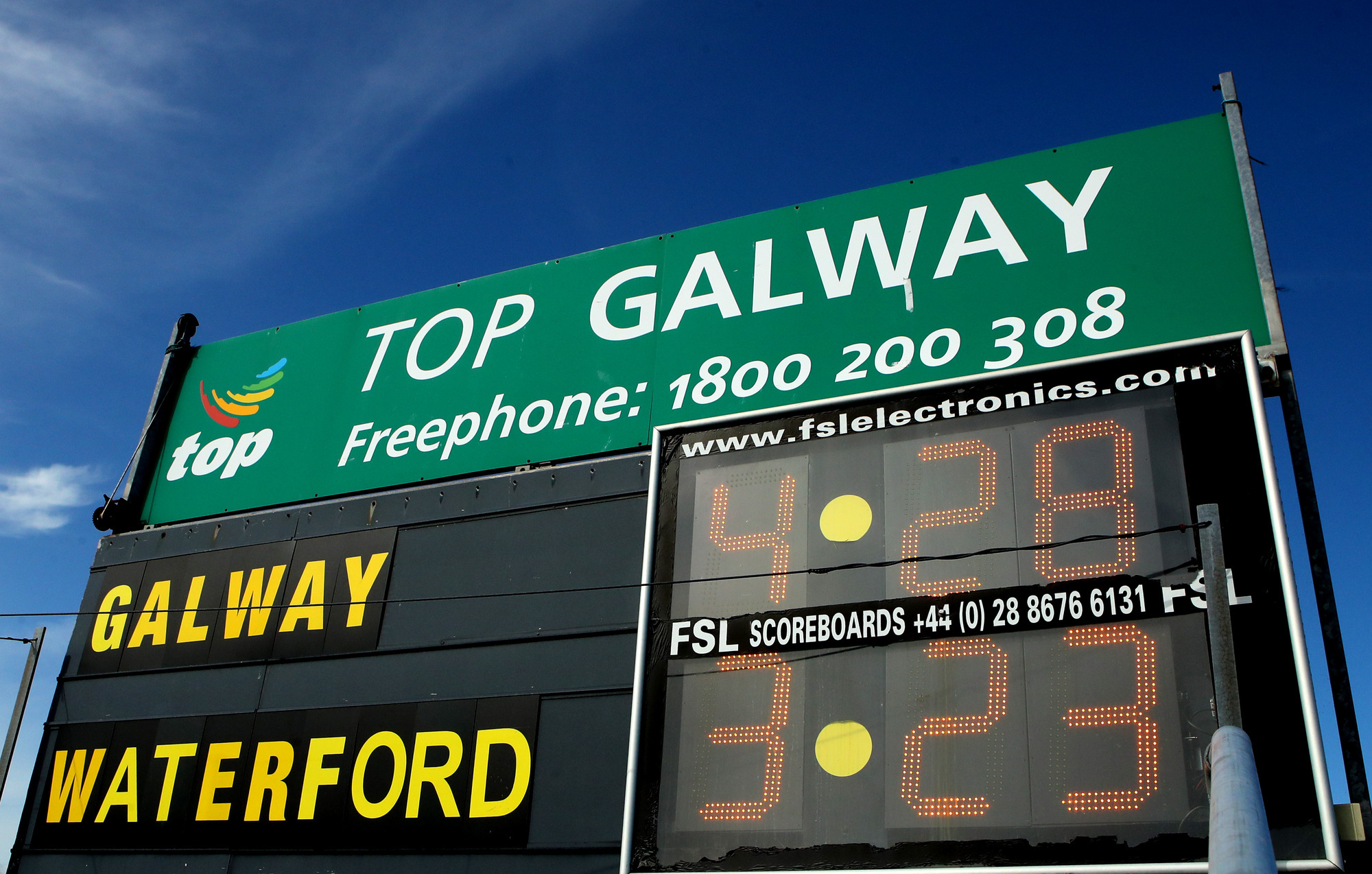
A view of the final scoreboard after Galway's 4-28 to 3-23 win over Waterford. Picture: INPHO/James Crombie
In his 1961 short story Harrison Bergeron, Kurt Vonnegut presents a dystopian sci-fi world in which the notion of equality has been taken to the extreme. Beautiful people are required to wear masks to hide their faces; intelligent people have disruptive signals installed in their brains; athletes must carry weights to counteract their strength. The title character is handsome, smart and strong, so he has to contend with all three.
The politics in this story are a bit more complex than they first appear. Once Harrison is liberated, he immediately declares himself king, becoming a bit of a tyrant in the process. It’s also a much funnier story than most dystopian fiction has a right to be. But when people start giving out about the way hurling has gone — scores too frequent, lads too fit — that was the first thing I thought of: Harrison Bergeron.
Okay, so no one is suggesting that hurlers should have to carry weights around the pitch. But we should face up to the fact that, in the current discourse, we are actively workshopping ideas to make hurlers less effective at what they do.Â
They are too fit, too strong, too comfortable scoring from their own half. The sliotar is too light, too aerodynamic. Bring out the calipers to disqualify all those oversized hurleys: these players need to be reeled in.
Don’t get me wrong: I do understand the nostalgia for the soggy ball/small bas days. We all have our own era that we privately think of as the golden age of hurling. Often, it coincides with our own coming of age. Just as one’s musical taste tends to be arrested in one’s early 20s (or is that just me?), the hurling of our young adulthood will always seem ‘right’ to us.
For me, it’s the noughts, the Eoin Kelly/Lar Corbett era — both a torrid and glorious time for Tipperary. The baggy sleeves of the 2000s will always look more orthodox to me than the skin-tight jerseys of today.
Change is always painful in a way. There is a part of us that wants to dig our heels in and resist it. But we would be equally cranky if the sport wasn’t evolving. And in all seriousness: what is the ideal amount of scores in a game of hurling? What is the Goldilocks scoreboard of not too big and not too small, but just right? What, truly, would keep us all happy?
Hurling fans are not unique in our handwringing over high scores. Basketball punters have been raising their eyebrows at the steep upward trend in scoring over the last decade. NBA scores in the 1990s would rarely breach 100; now scores of at least 130 are commonplace. There are a number of reasons for this: the increase in three-pointers, and rule changes that emphasise freedom of movement. No longer are NBA players allowed to drag opponents to the ground, as was so vividly illustrated in the Netflix documentary series . So, increased skill and a clampdown on playing the man. Ringing any bells?
Personally, I think we’ve been spoiled this season. The headlines for nearly every game so far in the league have been inclined to use words like ‘scorefest’, ‘blitz’ and ‘shootout’. This past weekend was no different, with Clare beating Dublin 0-34 to 2-23, Limerick beating Cork 0-33 to 2-19, Kilkenny beating Laois 1-29 to 0-22, Tipp beating Westmeath 4-27 to 0-16, and Galway beating Waterford 4-28 to 3-23. In years past, even those losing tallies would win many a game.
Last weekend’s camogie quarter-finals were similarly unshackled, high-scoring affairs, with Tipp beating Offaly 4-17 to 0-13, and Kilkenny needing two goals to overcome an impressive, fired-up Limerick. Soon, words like ‘scorefest’ will be redundant in describing matches; scorefests will be the status quo. And I think that’s brilliant.
It’s important to remember, too, that even though today’s players are more than capable of scoring from distance, starting with the corner-backs, that doesn’t mean that goals have gone out of fashion. It would indeed be a shame if hurling matches became chilly, long-range affairs, but that doesn’t appear to be in danger of happening any time soon. Far from it; the above results prove that.
How many of last weekend’s goals were the result of a delightful jink of the ball over the top of the defence, leaving a player in a one-on-one situation with the goalie? How many times did a forward sprint directly down the spine of a defence? Perhaps what we’re really experiencing is a crisis in defending, from which all this talk about light sliotars is a distraction. Maybe it’s not that scoring has become too easy; perhaps it’s defensive play that needs to evolve, and I’ve no doubt that it will.
There is one suggested amendment to the rules that intrigues me: the idea that the fouled player should take the resulting free, breaking the dominance of the specialist freetakers. Of course, it will only be a matter of time before every player on the pitch is a specialist freetaker, but at least it will result in a wider spread of scorers.
But for all my enthusiasm for teams putting up big scores, even I have to admit that last weekend’s most thrilling game was one of the most low-scoring. Antrim and Wexford racked up a trifling (by today’s standards) 1-21 to 2-18 in their draw.
Both teams run on emotion, and perhaps have suffered more than most in the era of empty stadiums, so it was great to see them play in front of a crowd in Corrigan Park, sowing the seeds of a new rivalry. The confidence and belief that Darren Gleeson has instilled in his players is something to see.
Goals, tight margins and sendings-off: the game had it all. Maybe in the end, a scoreline is nothing but a number.