Christy O’Connor: Crash-test hurling is now closer to rugby than football
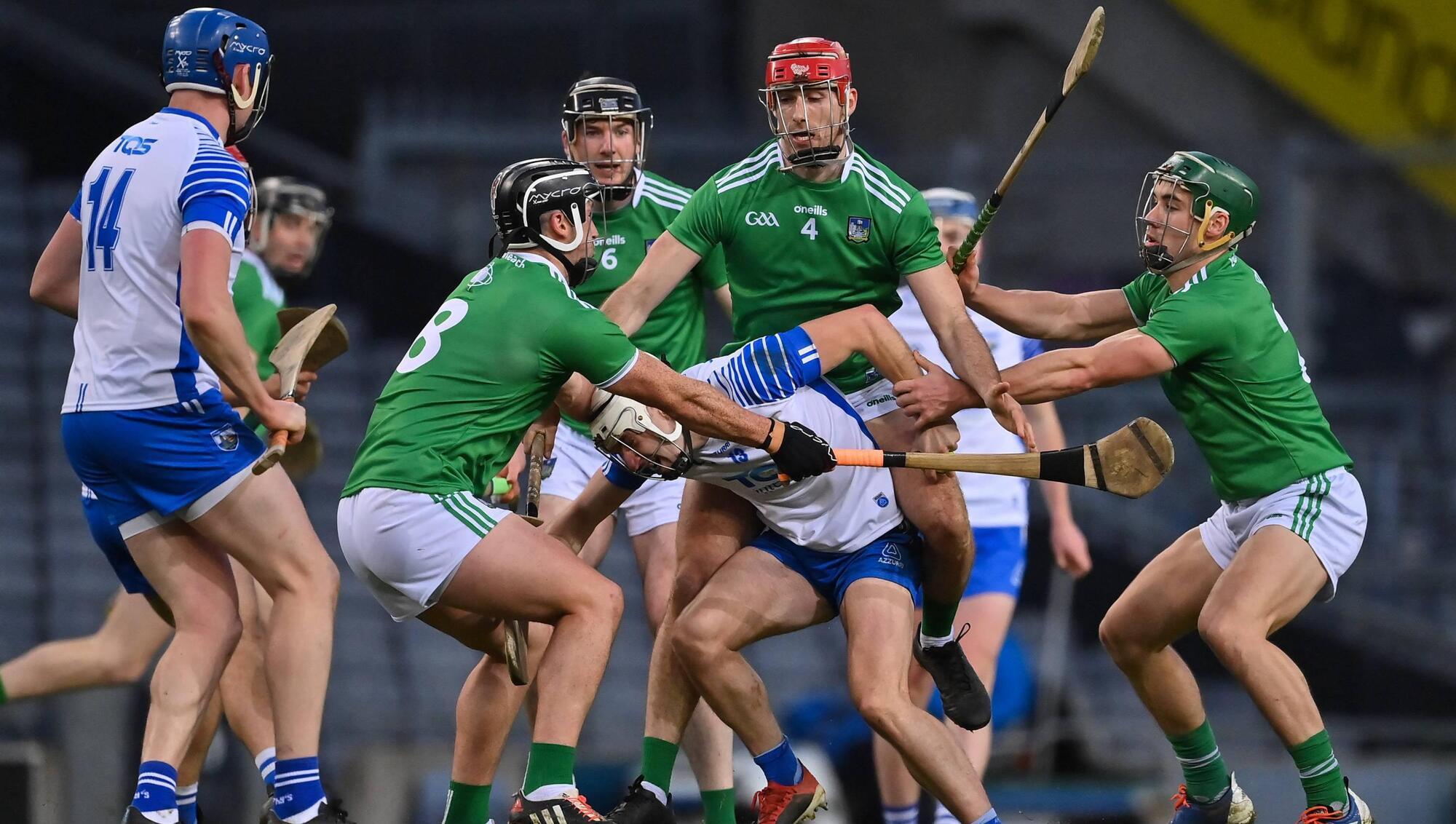
NOWHERE TO GO: Dessie Hutchinson of Waterford is tackled by Limerick players in the All-Irelad final
THE All-Ireland final was only seven seconds old when Seamus Flanagan scrambled the ball into his hand despite being chased down by three Waterford players. When Flanagan’s path to goal was blocked by Tadgh de Búrca, he handpassed back to Will O’Donoghue, who was immediately surrounded by four Waterford players.
O’Donoghue shifted possession back to Aaron Gillane but the phase of play was so manic and chaotic that Gillane couldn’t snaffle the ball and his attempt at a flash strike was blocked down. The subsequent ruck lasted 11 seconds before Ian Kenny eventually smuggled the ball back into his hand.
Kenny only managed to travel one metre before Limerick turned the ball back over. Yet as soon as Graeme Mulcahy had possession, Waterford had rifled it back. Jamie Barron tried to emerge from the chaos, but he was spun out of control after running into a wall erected by Flanagan. The spilled ball was picked up and slotted over the bar by Tom Morrissey.
The terms and conditions of engagement were instantly set — it was like crash-test hurling. In the first four minutes, there were an incredible nine turnovers in possession. As a comparison, there were just 14 turnovers-in-possession in the entire All-Ireland football final six days’ later. And with six of those forced by Mayo in the second half, Dublin would have considered that number a serious stain on their performance.
For decades, hurling people always resented any comparisons with football, but the modern reality is that hurling has become such a possession-based game that it is now often more comparable to rugby than its blood brother; every big hurling match now is heavily defined by rucks and turnovers, ferocious tackling, and systematically produced possession.
In that opening 39 seconds of the All-Ireland final, six players had the ball in their hand for a total of nine seconds. The opening minutes of a final is always bound to be more frantic than normal, but that sequence of play again confirmed the modern reality that, once an inter-county hurler has the ball in their hand now, they have, on average, 1.6 seconds to get rid of it.
So much possession now is governed from puckouts, restarts, and turnovers. With so many turnovers resulting from the physical combat required to secure the ball, one of the toxic by-products is repeated and elongated rucks; Waterford forced one of those early turnovers in the final at the end of a ruck that lasted 16 seconds.
Like the breakdown in rugby, rucks and collision zones are being hit by players behaving like open-side flankers. And as soon as possession is secured, the only way of avoiding more contact and risk being turned over is to pass the ball backwards, or to process it forward with a runner coming off the shoulder.
“Hurling is definitely gone like a mix of football and rugby,” says Jackie Tyrrell. “Apart from style, that is obvious in how important restarts and turnovers now are. I’m sure the Limerick lads are measured more closely on turnovers than they are on score creation. That looks to be a huge key performance indicator for them.”
It is because Limerick have become a team governed by turnovers. They create more shots from turnovers than any other team. The energy they generate from that source of possession is also the fuel which relentlessly drives the machine.
“Limerick win more turnovers than anyone else,” says their 2018 All- Ireland winner Shane Dowling, who retired from inter-county hurling in 2020. “They have the strength and power, but they also work the hardest. Plus, they thrive on turnovers.
“Limerick get a greater buzz from a forward turning over a defender in possession than from a Limerick defender blocking an opposition forward. That might sound hilarious when you consider what a forward’s job used to be compared to a defender, but it also shows how much the game has changed.”
Limerick have taken over from Kilkenny as the brand leaders of the power game. They expect to dominate collisions and rucks. They overpower teams in the tackle. Similar to Kilkenny in their pomp, physicality and aggression are the fundamental planks of Limerick’s game.
“There are a lot of similarities between this Limerick side and our team,” says Tyrrell. “They love a physical challenge, they welcome a dogfight. The physical contest doesn’t faze them because they have pure raw power in abundance. And once you marry that manic aggression and physicality in the middle third, it’s a serious combination.”
In one of his recent excellent columns on the RTÉ website, former Armagh footballer Aidan O’Rourke wrote about the immediate pay-off for All-Ireland winners in terms of their own self-confidence, and in the external perception of the team’s abilities.
O’Rourke reasoned that the latter is hugely contributed to by the media and, in the modern game, by the aura that social media can create.
“The impact of this Dublin team’s legend before it takes the field is significant on most opponents,” said O’Rourke. “Dublin don’t need the artificial help that most opponents present them before a tackle is made in anger.”
LIMERICK’S huge physicality is now similarly continuing to project and inflate the perception around their team. “All this talk about their power is feeding into Limerick’s aura,” says Tyrrell. “The more people talk about it, the more they, and everyone else, will believe it. Even when Marty Morrissey was interviewing Kyle Hayes and Gearóid Hegarty after the [All-Ireland] final, most of the discussion was around who was the bigger man. They’re both 6’5. They’re giants, huge physical specimens.”
Limerick had 11 starting players over 6’ tall in the All-Ireland final; two are 6’5, one 6’4, another 6’3 and four more players standing at 6’2. They are a huge side but they’re no bigger than the Galway team which won the 2017 All-Ireland; they had 13 players over 6’ tall.
“If you got the Galway and Tipperary teams to stand up beside the Limerick fellas this year, there wouldn’t be a huge difference in size,” says Seánie McMahon, the former Clare centre-back. “Power is a huge part of their game but it’s more the power Limerick bring to the tackle.”
Taking the ball into the tackle against Limerick is only inviting them to turn you over. Limerick overwhelm teams with their blitzkrieg tackling but their incredible power also enables them to protect possession in the tackle once they have secured the turnover.
There are so many different elements of pressure now in the tackle that players have to be conditioned to survive in that vortex of physicality and savagery. Limerick thrive in that whirlpool, but they also have excellent players with high skill levels, and the tactical smarts to maximise their possession once they secure it.
“It’s more than just power and physicality with Limerick,” says McMahon. “They have some brilliant players, but they have a very effective style of play and they’re really suited to the modern game.
“Hurling is becoming more like football from the point of view that it’s so possession-based. Then in other ways, it’s a contradiction because it’s taking the contest out of the game. Limerick remind me of the Dublin footballers: their use of possession is excellent.”
Trying to protect possession against Limerick is a whole different challenge in the face of their ferocity; Waterford turned over the ball 39 times in the All-Ireland final. Some of that possession was cheaply given away but guarding the ball against Limerick isn’t easy when they dial up the heat to maximum temperature.
“Limerick are guaranteed to have a certain amount of possession in the game because they have such a good puckout strategy and they have so many ball-winners,” says Tyrrell.
“You have to limit the amount of ball you give them so if you give them a load of turnovers, you haven’t a hope of beating them. They’re nearly as dangerous in their half-back line as they are in front of goal.”
Athleticism and explosiveness are as much a part of their power as their imposing physique. The Limerick half-forward governs so much of their system because their athletic ability to eat up ground and squeeze the middle is a massive part of Limerick’s game.
“When John [Kiely] took over, he identified that he wanted to have physicality in the half-forward line,” says Dowling. “John initially had Gearóid Hegarty and Kyle Hayes up there, even though they had played as half-backs. The half-forward line is the most important line in the field now.”
Their physical make-up is a fusion of nature and nurture. Limerick’s acquired power wasn’t just harnessed overnight. That process started for some of those players when they were in development squads in their teens.
“I didn’t grow up in that culture,” says Dowling. “In the early days, I’d nearly do what I could to miss the gym. And if I did, nobody would have batted an eyelid. But when John came in and put a huge emphasis on strength and conditioning, a culture developed where players started calling each other out if they did miss gym sessions.
“Most of these Limerick players that come into the set-up now are conditioned to that culture. Every county focuses heavily on strength and conditioning, but I think Limerick are top of the pile. They are the best conditioned team because of the work the majority of those players have done over the last seven or eight years.”
With such a short pre-season now, trying to make up that conditioning deficit on Limerick won’t be an easy task. Every team will try but there are a multitude of other areas counties will also be focusing on in trying to take Limerick down; skill execution; movement; maximising use of possession; forcing turnovers; winning rucks. And being able to survive in that relentless vortex of power and physicality.