Spiritual journeys to sacred sites, staycations on a higher plain
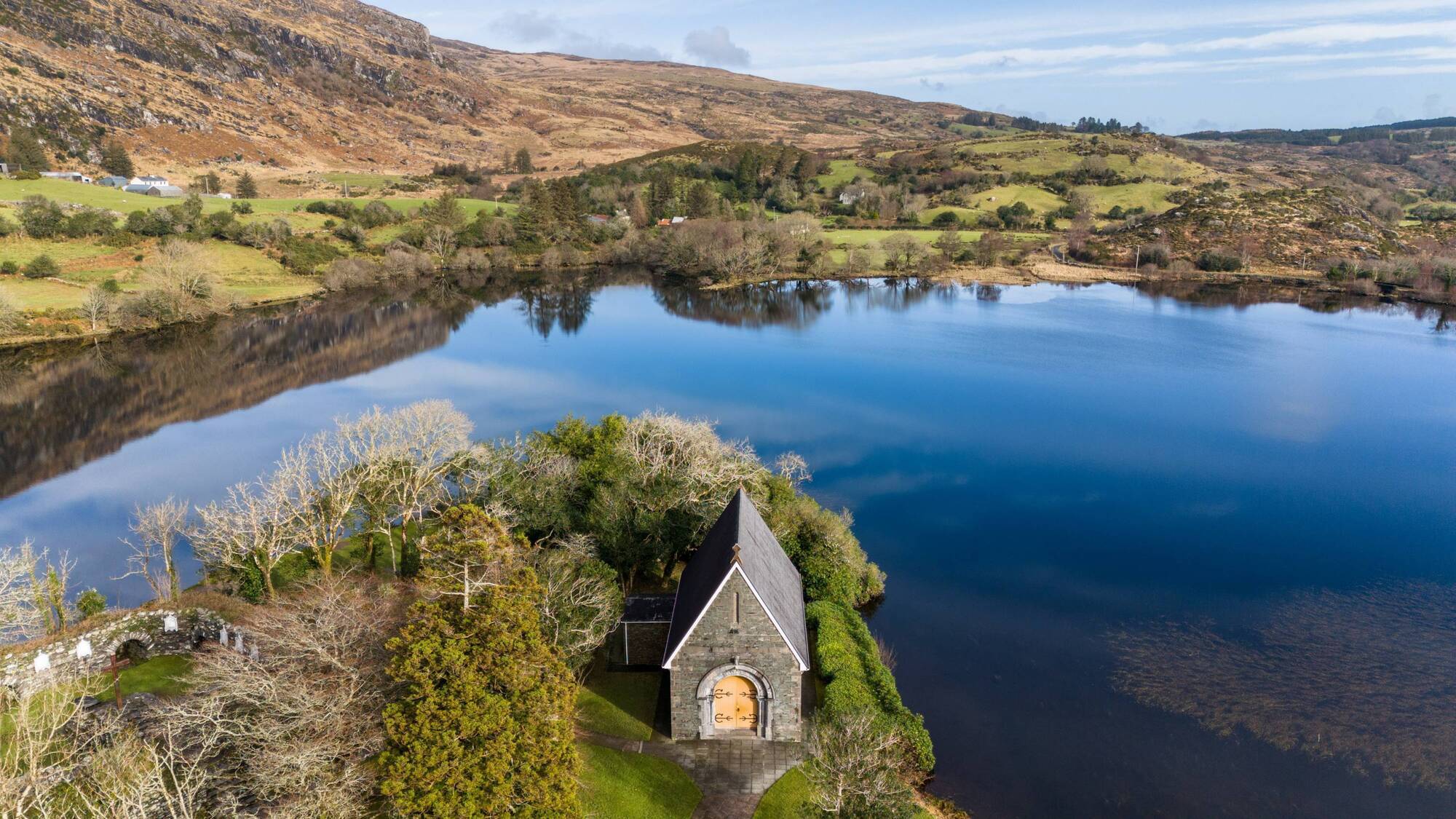
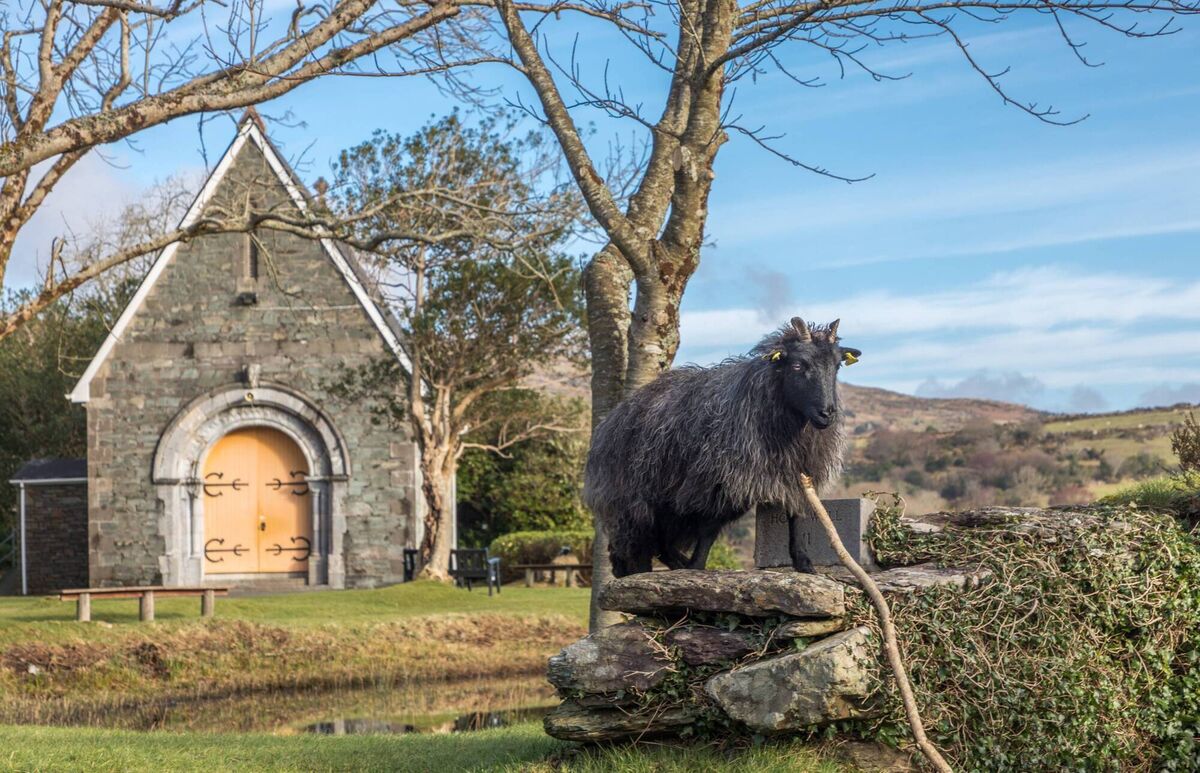
A bright winter’s day at St Finbarr’s Oratory in Gougane Barra, West Cork. Picture: David Creedon
Is this the year that you will try at last one of the legendary pilgrim routes across Ireland, a trip you always meant to make, but somehow never got round to?
There are so many wonderful and fulfilling pathways to sites of saintly interest that no matter what corner of the country you find yourself in, there is sure to be one which calls to you. And once you’ve heard that call, you simply have to answer it. You can’t pretend you haven’t heard it.
While you are walking your chosen path, though, you may well discover a few things that you hadn’t expected. Ancient pagan rites and rituals, for example, and old routeways that once had very different purposes to their present-day identification with Christianity.
Other fascinating stories and places that you never suspected existed. That’s what pilgrimages should be all about. You should come back a different person, with a mind full of new things, new experiences.
The coming of Christianity to Ireland around the 5th century has been credited with the emergence of pilgrimages, but in fact travelling to important sites of worship would already have been very much part of life from pagan times. The custom of making your way to somewhere special to improve your moral standing is actually an awful lot older than the new religion from Rome.
After all, humankind has always needed to beg for good fortune, advice, help, guidance, and our forefathers were no different. Those seeking a glimpse of the future, as well as those wishing to pay homage to the gods who made the crops grow and families prosper, made their way in ancient times to venerated hilltops, special islands and important burial sites at the appropriate times of the year.
The history of pilgrim paths, therefore, is very old, and to follow a particular route of worship often means walking on ancient tracks, worn down by countless generations following the bóithrín of belief down through the ages.
Sometimes the modern pilgrimage itself is of relatively recent origin, but has nevertheless drawn on older traditions and sites which people have already been resorting to for help and guidance over thousands of years.
And why should it matter if ancestors with different beliefs trod the same path as you do today? Does the name of a belief or religion matter so much? Aren’t you seeking the same things after all?
Among the many sites of pilgrimage in Ireland today, a few stand out as being of particular interest. See which one calls to you as you read these pages, and follow it this year. You will, of course, have the distinct advantage over your ancestors in that you are certain to find wonderful cafes, restaurants, and pubs along the way, where you can stop and rest your feet while refreshing the inner pilgrim. You will also discover some delightful places and things that you might never have known of, had you not set out on your own pilgrim trail.
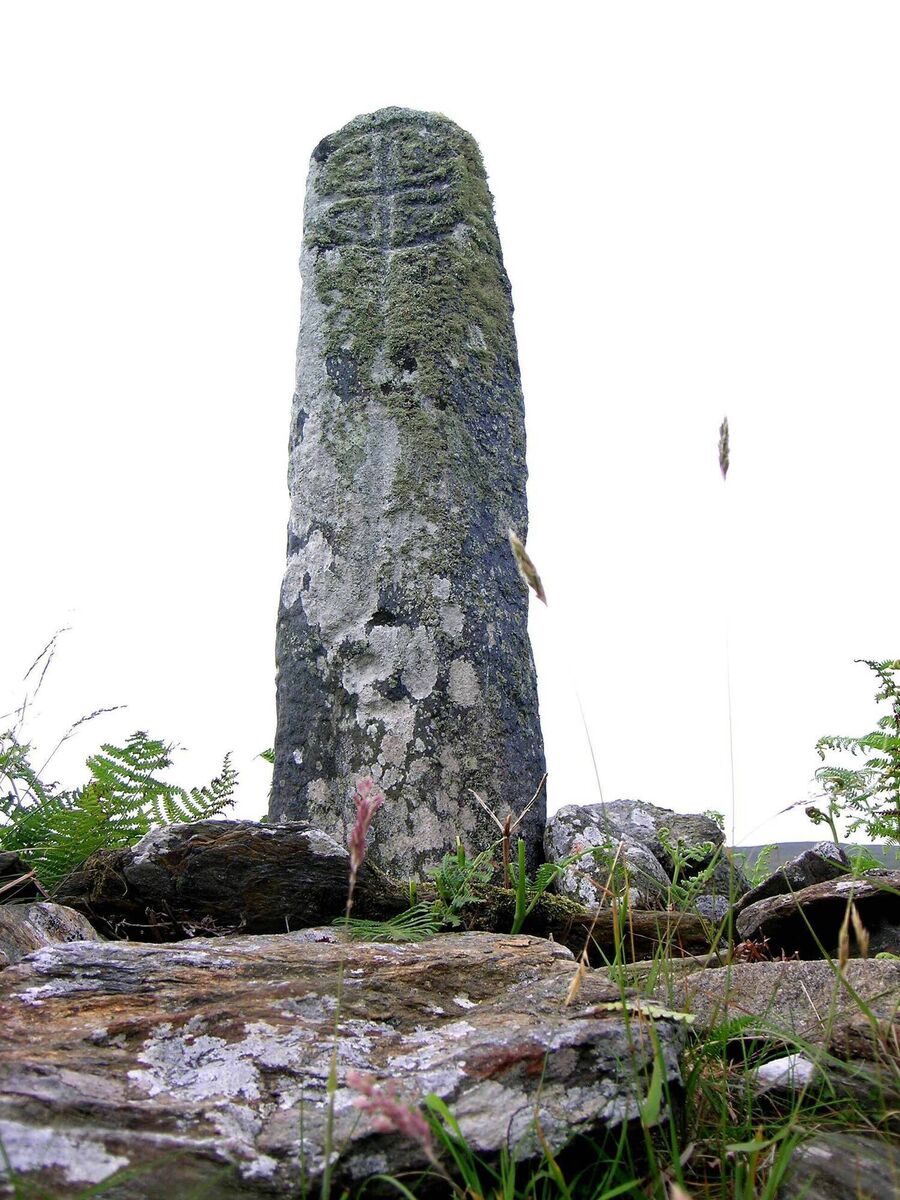
Turas Cholmcille is a particularly good example of ancient objects of worship being reinvented as Christian. In Glencolumkille on the western seaboard of Donegal, a magnificent collection of standing stones survives from prehistoric times, as well as court cairns, portal dolmens, and ringforts. Many of these, you will find, were later Christianised, or renamed to reflect newer beliefs. On June 9th each year, Lá an Turais (the Day of the Journey) brings visitors from far and near to walk barefoot around 15 standing stones and cairns.
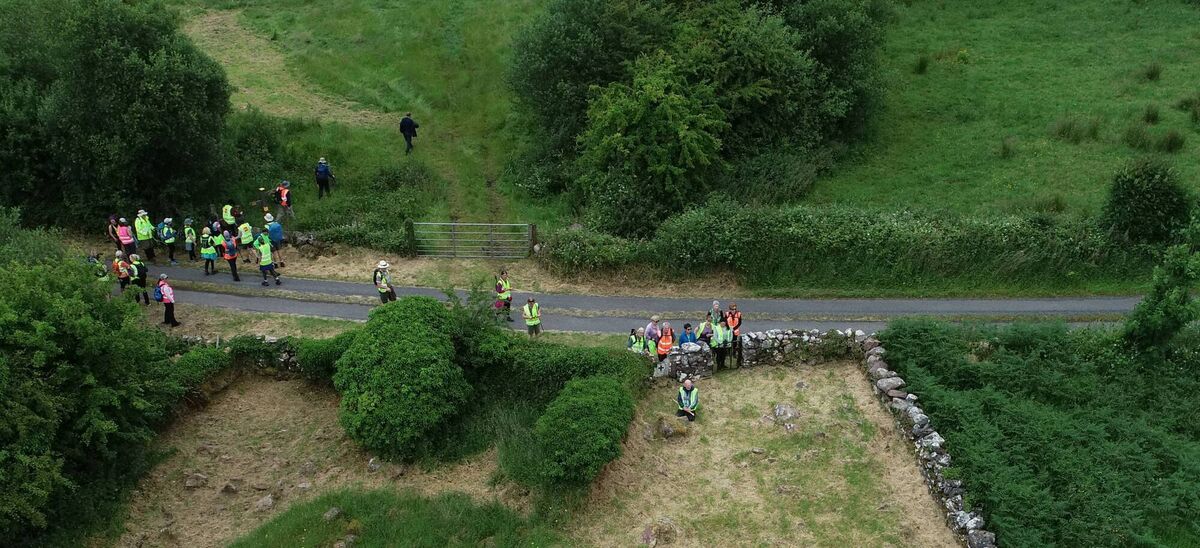
Significantly, the original name for this valley was Sean Gleann or Old Glen, before it became associated with the Christian saint. Glencolumcille is very likely to have been an ancient sacred site, with paths leading to it from both inland and the coast. Many of the minor roads of today probably reflect those old tracks. Take a dowsing stone along, swing it gently on a narrow pathway, and see what it tells you.
There is a longer version of the Turas Cholmcille, more of a long-distance hiking trail than a religious round. Known as the Slí Cholmcille, it travels right across the north of Ireland via Tory Island and Derry to Coleraine, and on to Iona, finishing up at Tarbat Ness in Easter Ross on the Scottish mainland. That might be one for a summer expedition (or several), rather like the Camino in northern Spain.
Lough Derg in Donegal (to distinguish it from the Lough Derg in Co Clare, on the lower reaches of the Shannon) is a deeply historic place. It was known from earliest times as an important sacred site, and it is marked on very old maps, showing that importance.
In Irish it was known as the Lake of the Cave, since at that time the most sacred place was the mysterious cave beneath the island. Pilgrims would venture here and stay fasting in the cave overnight, in the hope of seeing visions of the Otherworld. Today’s pilgrims visit a vastly developed Station Island, with a huge basilica covering most of the original ground, and definitely stay above ground for their purgatorial rituals.
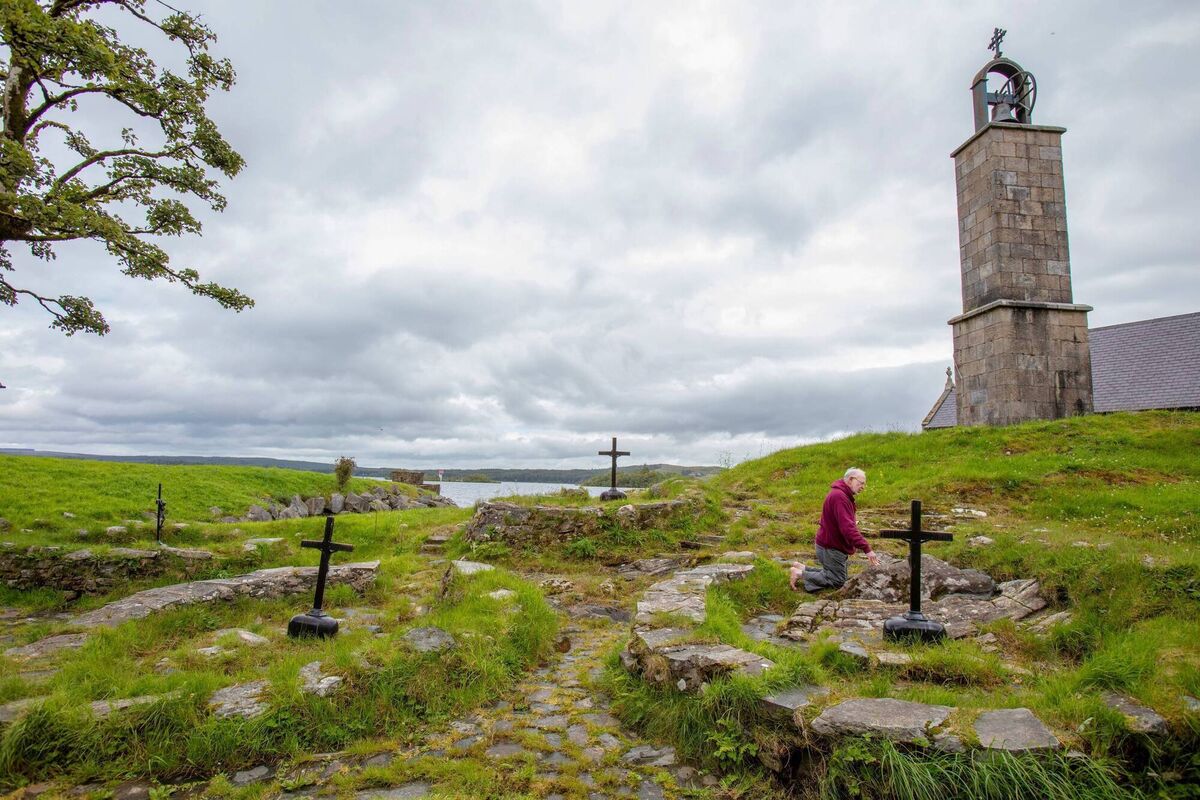
Visits to the island are booked and controlled, but you can take a very old pilgrim route from the visitor centre at the pier, following in the footsteps of those who came this way hundreds of years ago to reached their goal via Saints Island.
The 12km path leads you by St Brigid’s Chair, a mystic weathered boulder, and St Daveoc’s Chair, associated with a local hermit. This feature is partially natural, but bears signs of once having been a Bronze Age burial place.
This is the point where the modern route joins the ancient pilgrimage road that would have brought the medieval pilgrims from Templecarne, on the very border of Fermanagh and Donegal. Next, St Brigid’s Well and its ‘rag tree’ covered with offerings by those seeking blessing, and finally the edge of the lake opposite Saint’s Island, where you can still glimpse the stones which supported a wooden bridge bringing medieval pilgrims across to that daunting cave on Station Island. And from here you return to your starting point.
Tóchar Phádraig is another Christian pilgrim path which has taken over a much older route, and is today best known for the annual climb to Croagh Patrick on the last Sunday in July.
But the route from Ballintubber is in fact the ancient chariot road from Rathcruachan, royal seat of Queen Maeve, to Cruachain Aille, the sacred mountain. Did Maeve journey here to seek advice on her forays and battles in the Iron Age? Certainly it was an important and well-maintained road in pre-Christian times: ancient stone flags have been uncovered at various points along its route, indicating its high status in the time of Connacht’s kings.
That the festival is held at Lunasa is another indicator of its importance in pagan times, while archaeological finds have confirmed beyond doubt that Croagh Patrick was a sacred site long before the coming of Christianity.
The name Ballintubber, where this pilgrim path starts, comes from Baile an Tobair, the townland of the well. Formerly known as Bail Creevagh, it is now dedicated to St Patrick, and a large stone next to the well is said to bear the imprint of the saint’s knee. The abbey, built in the 12th century by a later king of Connacht, Cathal Crobh Dearg O’Conor, had a hostel which offered overnight shelter to pilgrims on their way to the mountain.
There is another marvellous boulder stone, boasting superb rock art, at Boheh (a modern rendition of bothar or road, another clue to its antiquity), along the pilgrimage trail at Brackloon, as you cross the N59 Leenane road, south of Westport. Today, naturally, it is called St Patrick's Stone or St Patrick's Chair.
Incidentally, if you find yourself standing right by the Boheh Stone around sunset in the third week of August, you just might be lucky enough to witness the phenomenon of the Rolling Sun. The sun at this time will appear to set on the peak of Croagh Patrick; but then seems to roll right down the north side of the peak. On a clear evening of course...
Further along the Tóchar Phádraig, by the 10th century round tower at Aghagower, is a circular stone trough known as Dabhach Phadraig, where pilgrims traditionally washed their feet. The soil at the base of the tree which overhangs this bath is said to have curative powers; but note that you are obliged to return the earth to where you found it once the cure has been effected. To neglect this part of the sequence would be asking for trouble.
It would be difficult to find a more wonderful setting than Clonmacnoise, seeming to float between land and sky on the banks of the Shannon where the Eiscir Riada or Slíghe Mhór meets the river at an age-old crossing point.
The natural esker or ridge of higher ground left behind after the Ice Age, runs east to west across the country, while the Shannon bisects it north to south. Such a location would have been recognised as of considerable importance from earliest times, both in druidical terms as a focal point of natural power, and in strategic terms as an ideal controlling point for both water-borne and land-borne traffic.
The monastery was founded by St Ciarán in the 6th century and drew the faithful in increasing numbers to worship, or seek guidance.
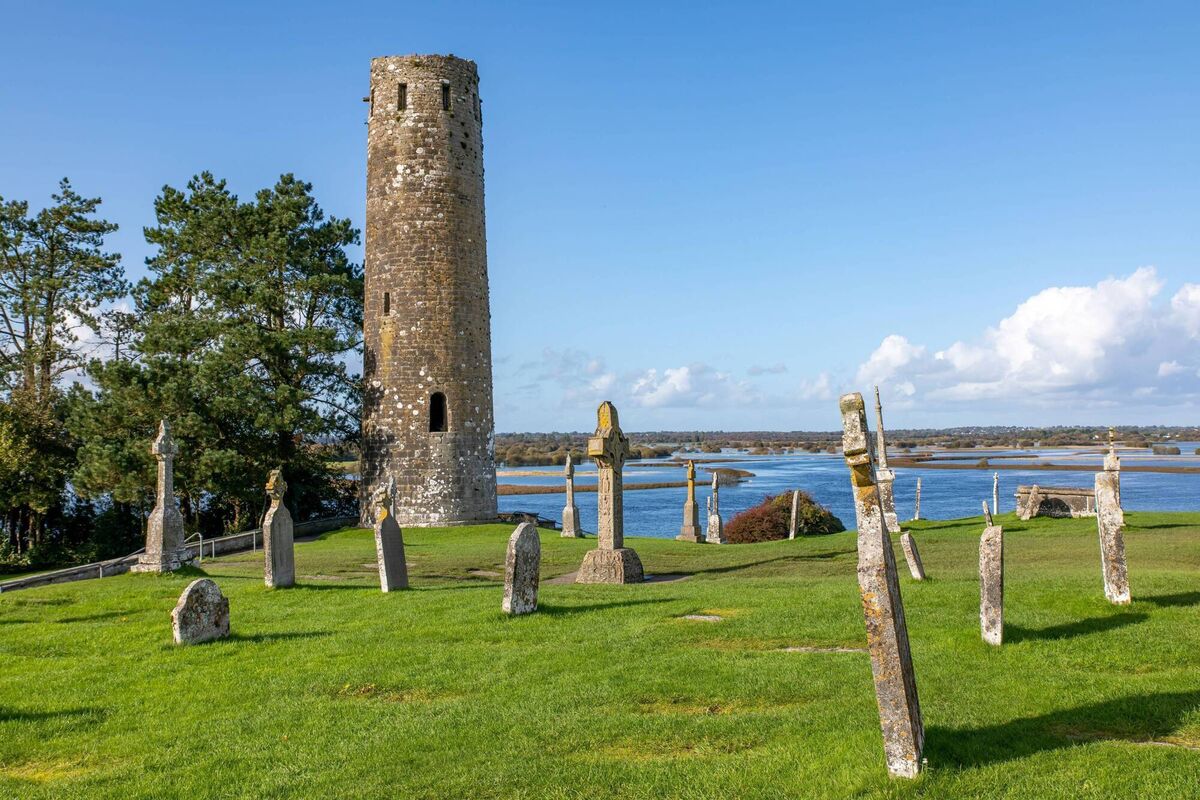
The Clonmacnoise Pilgrim Path starts at the village of Ballycumber on the river Brosna and runs 21km along An tSlíghe Mhór, The Great Road, which follows the firm raised ridge of the esker to the Shannon.
There is an old tale about Ballycumber and a landlord who rashly interfered with a local sacred well. Angry that local peasants trespassed on what he saw as his private fields in order to visit this site, he ordered it filled in. Immediately his own splendid house, set on a height some distance away, flooded, water pouring up from the basement and through the entire building, in defiance of all natural laws. It did not recede until he admitted defeat and had the well reopened; but even then a pond remained ever after in a hollow which could clearly be seen from his windows. A reminder not to trifle with the Otherworld.
Some of the pilgrim path today follows minor public roads (though it's still on the Esker Riada), and there is a superb piece of 12th century craftsmanship to be seen in the church at Boher, the shrine of St Manchan. This small box of yew wood, cased in bronze and richly enamelled and gilded, dates from the early 12th century and shows distinctly Viking influence in its decorative figures.
Ruined Doon Castle (formerly called Esker Castle, a reminder of its location) comes up next, then the raised Mongan Bog. This is one of the very few of its kind left in the country. It is over 9,000 years old and shelters a wonderful range of flora and fauna.
Finally the pilgrim way ends on the banks of the Shannon, amidst the high crosses, and gentle peace of Clonmacnoise. Another wonderful way to come to the abbey would be by the river from Athlone or Shannonbridge and land on the gently-sloping grassy banks right below the monastery as so many have done over the centuries. That is something which will truly take you back in time.
This 30km trail from Hollywood winds its way through the hills of Wicklow, following St Kevin’s journey to the haunting valley of Glendalough where he spent his life in prayer and contemplation. After his death in 618 AD, his quiet retreat developed into an impressive monastic city. Medieval pilgrims came from far and wide to visit Kevin’s tomb, and, interestingly, the alternative starting points to the walk reflect the different directions from which they are likely to have travelled.
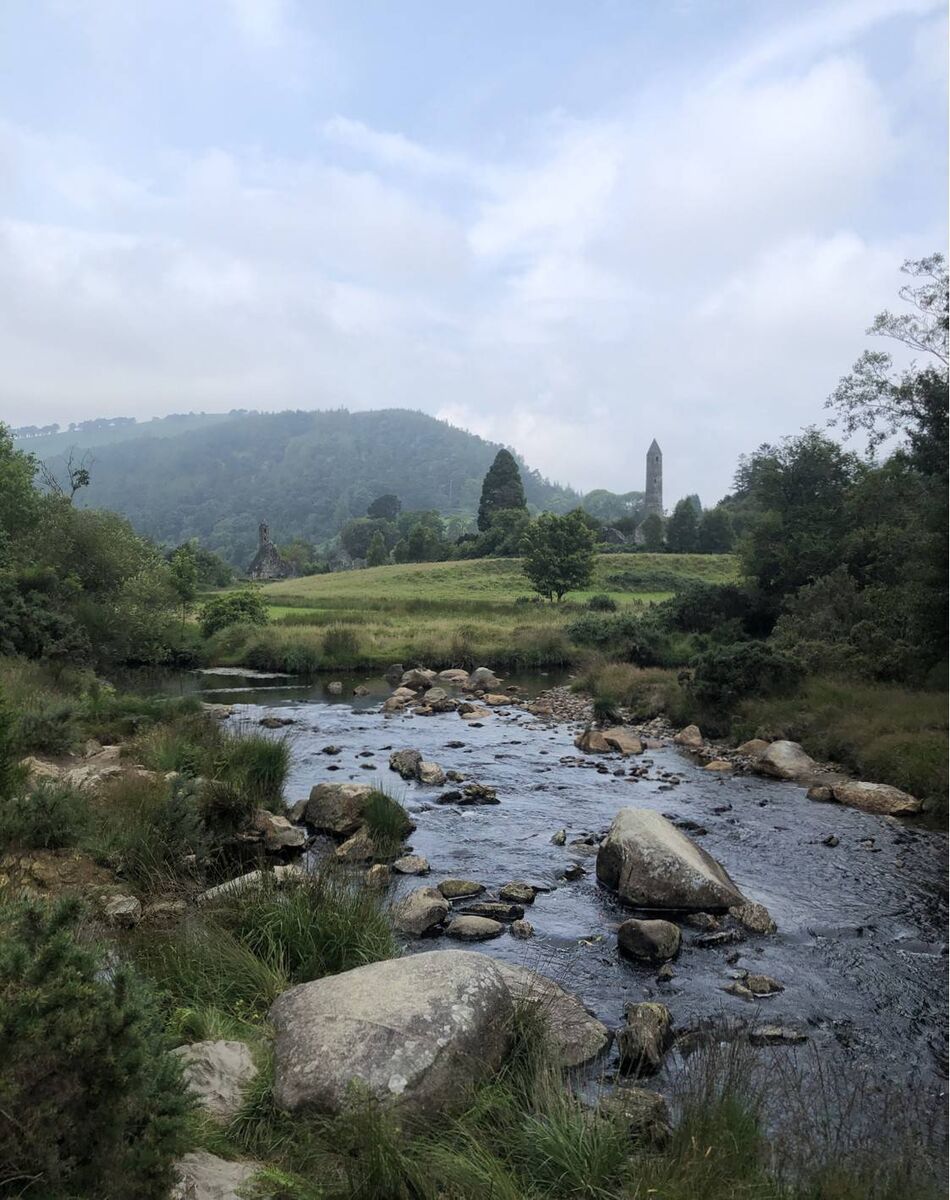
The main route starts in Hollywood, while the alternative route comes from Valleymount. The paths meet and join at Ballinagee Bridge. The walker next climbs towards the spectacular Wicklow Gap, a classic example of a wind gap [a gap through which a stream or river once flowed] and the highest point on the route. The flagstones of the old pilgrimage road are still visible in sections. The route then follows the descent of the Glendasan River into the valley of Glendalough. Most of the monastic buildings here date from the 11th and 12th centuries, the heyday of the European pilgrimage, including a magnificent round tower. The valley beyond the monastic settlement has much to offer, including a view of the inaccessible St Kevin’s Bed from which he reputedly hurled a seductive maiden into the lake below in a determined effort to preserve his chastity.
This is one that really must be walked, for several exciting reasons. A rich amount of archaeological heritage, some charming villages, proximity to the fabled Burren with its limestone moonscape and rare flora certainly; but most of all, trackways and paths that have been in use for thousands of years. Not to mention an enchanted lake with its own fairy badger, Broc Shee.
The pilgrim trail officially starts at St Blathmac’s medieval church near Rath, 4km outside Corofin. The ancient rath or ringfort, now heavily overgrown, which originally gave the townland its name, can be found as you turn off the Burren Way to get to the church.
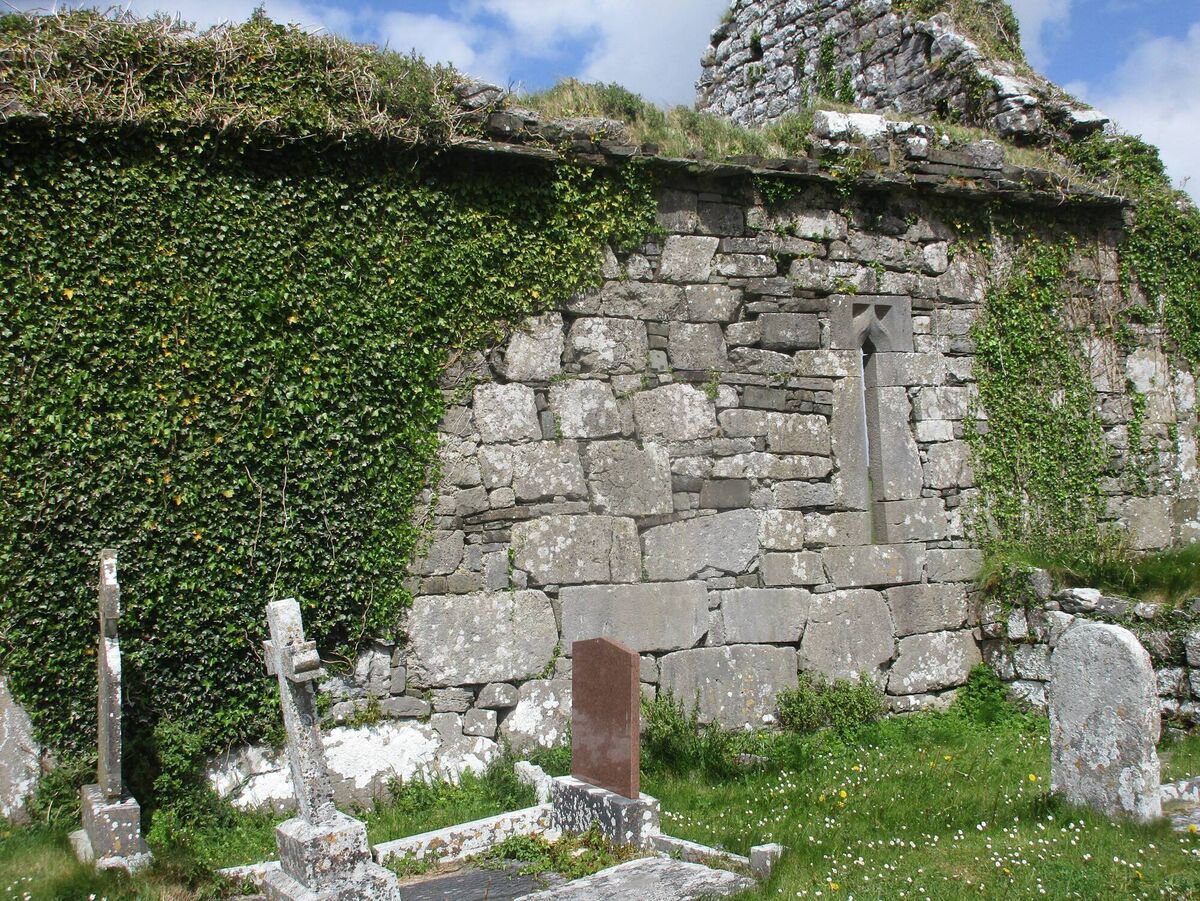
It’s a winding boreen that takes you to the church, tucked between enclosing stone walls, and it’s quite a shock to suddenly find yourself at the end of the road on an open height overlooking a small lake far below. The ruined church has an evocative arch remaining that frames the distant view beautifully.
It has more, though. Set into the wall within the nave is a fragment of a beautifully carved 12th century stone window. To one side of that fragment, on the selfsame piece of original stone, is carved that most pagan of symbols, a sheela na gig. To find this female figure on the outer face of a church wall is not unusual, but to find it inside, actually juxtaposed with a piece of clearly religious carving on the same surface certainly is.
It reminds one forcibly of those old illuminated church manuscripts which occasionally have a totally secular line drawing in the margin, perhaps inked in by a tired scribe in need of relaxation. We still don’t know much about the background to sheela na gigs, but this particular example does perhaps suggest defiance by a skilled mason who leaned more towards the older ways than the newer ones?
Look down from the churchyard to Rath Lake (Loch Ratha) and see if you can glimpse the dark head of a monstrous badger emerging from his cave, Poul na Broc. First recorded in the 6th century, it was the Broc Shee’s practice to seize both cattle and unwary children, and carry them back to his lair.
It is claimed that a St MacCreiche managed to overcome this Otherworld creature and chain him to the bottom of the lake (much as other saints are believed to have done with similar monsters) but evidently the chains weren’t too effective against fairy power as the Broc Shee was to appear regularly throughout the succeeding centuries.
The last sighting was in 1931 when several farmers saw a giant badger swimming in the lake. Keep quiet, switch on your inner eye, and you just might be lucky.
Today’s pilgrimage route takes you past Dysert church and Tobar Ortha, a sacred well renowned for curing eye ailments. St Tola’s church brings you back eventually on a loop to your starting point.
Or you could continue up the Burren Way to that mysterious stone landscape with its limestone pavements, dolmens, rare flowers and innumerable legends. The Burren Way utilises a far older road, the Poll Ban, which has linked Ennis with the Burren since the Stone Age. Another ancient track, the Bealach Arsa, has also been incorporated into the modern pilgrim path. Listen to the echoes of the past as you walk these old ways, and think of those who travelled them before you.
Cnoc na dTobar (Hill of the Well), a few kilometres outside Cahersiveen in the south west of Kerry, was an important sacred site in pagan times. The well at the base of the hill has long been known for its powerful property of healing eye ailments, and the festival of Lunasa was celebrated here at the beginning of August, just as it was at Mount Brandon and Croagh Patrick, with hundreds of people traversing the ancient path to the summit.
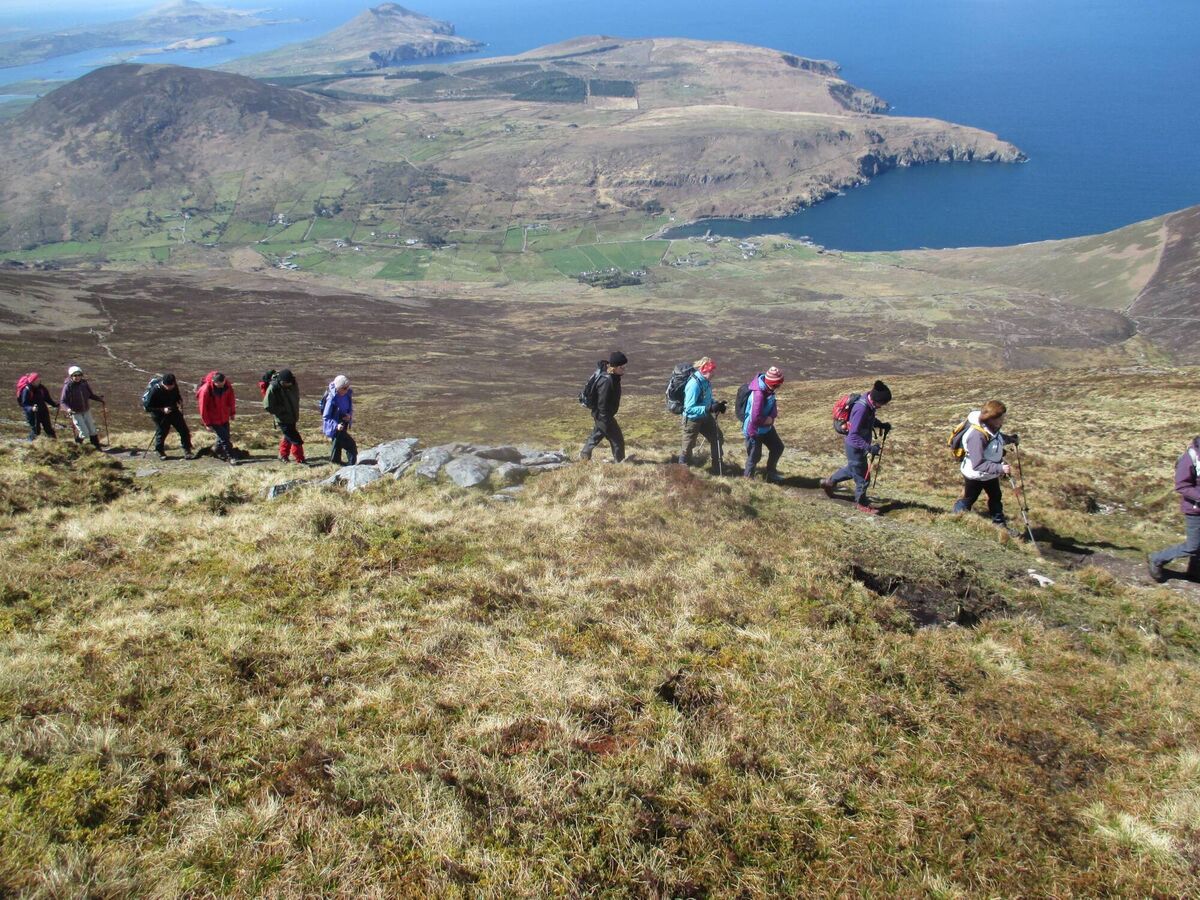
All around this mountain as well as on its slopes, are standing stones, inscribed stones, stone rows, megalithic tombs, wells, and, perhaps most poignant, many of those unofficial little graveyards in which unbaptised children were buried. When a remorseless church forbade their resting in sanctified surroundings, the grieving parents simply returned to the older beliefs and buried them in sacred pagan sites like fairy forts.
Perhaps because of the strong belief in the old ways, the local parish priest built the Stations of the Cross along this path in the 1880s and it became an official Christian religious trail with the well becoming dedicated to St Fursey. Today it is one of the officially recognised pilgrim paths of Ireland.
It’s a good trail to climb, as it is clearly marked and you have the added benefit of seeing the amazing Skellig rocks gradually come into view as you toil upwards. While you stand on one ancient pilgrim site, you can see two others: Skellig Michael and Mount Brandon. This makes it a powerful region indeed. In fact the views are spectacular across all of Dingle Bay and the wide-ranging Kerry mountains which seem to become bluer and softer as they fade into the middle distance. Even the coast of West Cork can be enjoyed from this bird’s-eye view on a fine day. From the N70, about 3km northeast of Cahersiveen, turn off just before Deelis bridge (OS map 83).
St Declan’s well at Ardmore on the Waterford coast has been a popular place of pilgrimage for centuries. He is said to have converted the Déise, a local tribe of Waterford, in the 5th century, preceding St Patrick’s arrival here. He set up his monastic site at Ardmore and the ruined oratory, sacred well, ogham stones, 12th century cathedral and round tower, are visited all year round, but especially in late July when his feast day is celebrated with a pattern or festival.
In recent
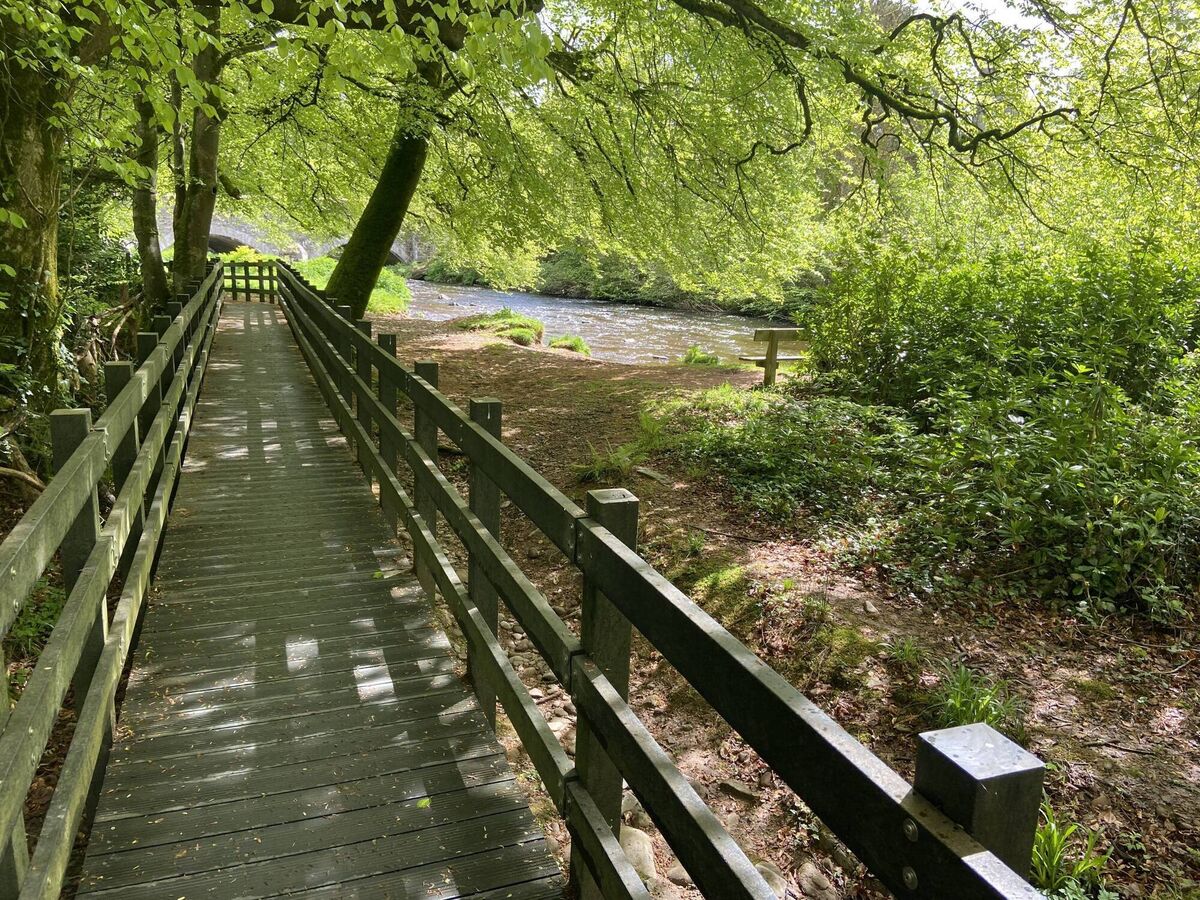
years a long-distance trail from Ardmore to Cashel in neighbouring Tipperary has been set up, winding over the Knockmealdown Mountains through Bottleneck Pass and along stretches of old pathways for some 96km (56 miles). This, it is said, was the route taken by Declan driving in his chariot to the royal court at Cashel. Although reverence for St Declan certainly cannot be denied, it is likely that this route was already well known from early times, when Cashel was the seat of the Kings of Munster.
Every king needs his access route to the sea, for both strategy and supply, and the lords of Cashel would have known the speediest and the most direct way, as well as the most practical way to take goods in either direction. Those who set up the new pilgrim path were at pains to ensure it incorporated all such ancient routes as were already known, such as the Rian Bó Phadraig (the Way of St Patrick's Cow) which itself echoed an earlier path, the old route of the Cashel kings from their stronghold to the ships lying at Ardmore.
You will need a good map and a good sense of direction to follow this path all the way from Cashel to Ardmore, and be prepared to stay a few nights along the way (it’s even more convenient to have a willing friend with a car to follow by main roads and pick you up each evening). What makes it enormously worthwhile is suddenly realising that you are tramping through a mountain pass that has been a natural gateway for thousands of years, or have dropped down from the hills into a wooded valley and are following a very old track indeed, beside a rushing stream.
You come to a crossing point, and there are age-old boulders placed in the water just where you need to place your feet. How many travellers over how many centuries have crossed that way before you? How many laden pack-ponies, how many traders? At times like this the past feels close enough to touch.
In West Cork and South Kerry the practice of walking pilgrim paths to St Finbarr’s hermitage in Gougane Barra has been in place for many centuries. You can still see one of the oldest customs on what is now known as Gougane Sunday at the end of September, when the faithful climb the hills from old starting points beyond the mountains. And there is now a path from Drimoleague, where – local tradition has it – St Finbarr arrived at the Top of the Rock in the sixth century and admonished the people to return to Christ, before making his way to Gougane Barra.
In 2008, the practice of walking this ancient route was revived (though its history stretches far back into the mists of time) and, today, groups are regularly found walking the 35km path which has been opened up to the public with the goodwill of local landowners.
This is a truly magnificent pilgrim path which traverses three mountain systems and four valleys, namely those of the Ilen, Mealagh, Ouvane and Lee, with spectacular views over Bantry Bay and stretches of the West Cork coastline. A rich archaeological landscape is combined with interesting folklore.
Get talking to local farmers on the Kerry side of the hills, and find out where one of the ancient traditional routes over the mountains on Gougane Sunday starts. It will be hard work and you had better wear good footwear, but it will be an unforgettable experience.
And there are more. So many more. We can’t fit them all in here, but go check out or do a bit of your own research to discover other, less well known routes of the believers. Best of all, create your own. Find two places that matter to you. One might be a childhood home, the other a special place on the coast or in the hills where you spent happy times. Then walk from one to the other, remembering the past and considering the present, while surrounded by the most beautiful and peaceful places that Ireland can offer. That’s a true pilgrimage.