US multinationals stay positive on future investment in Ireland
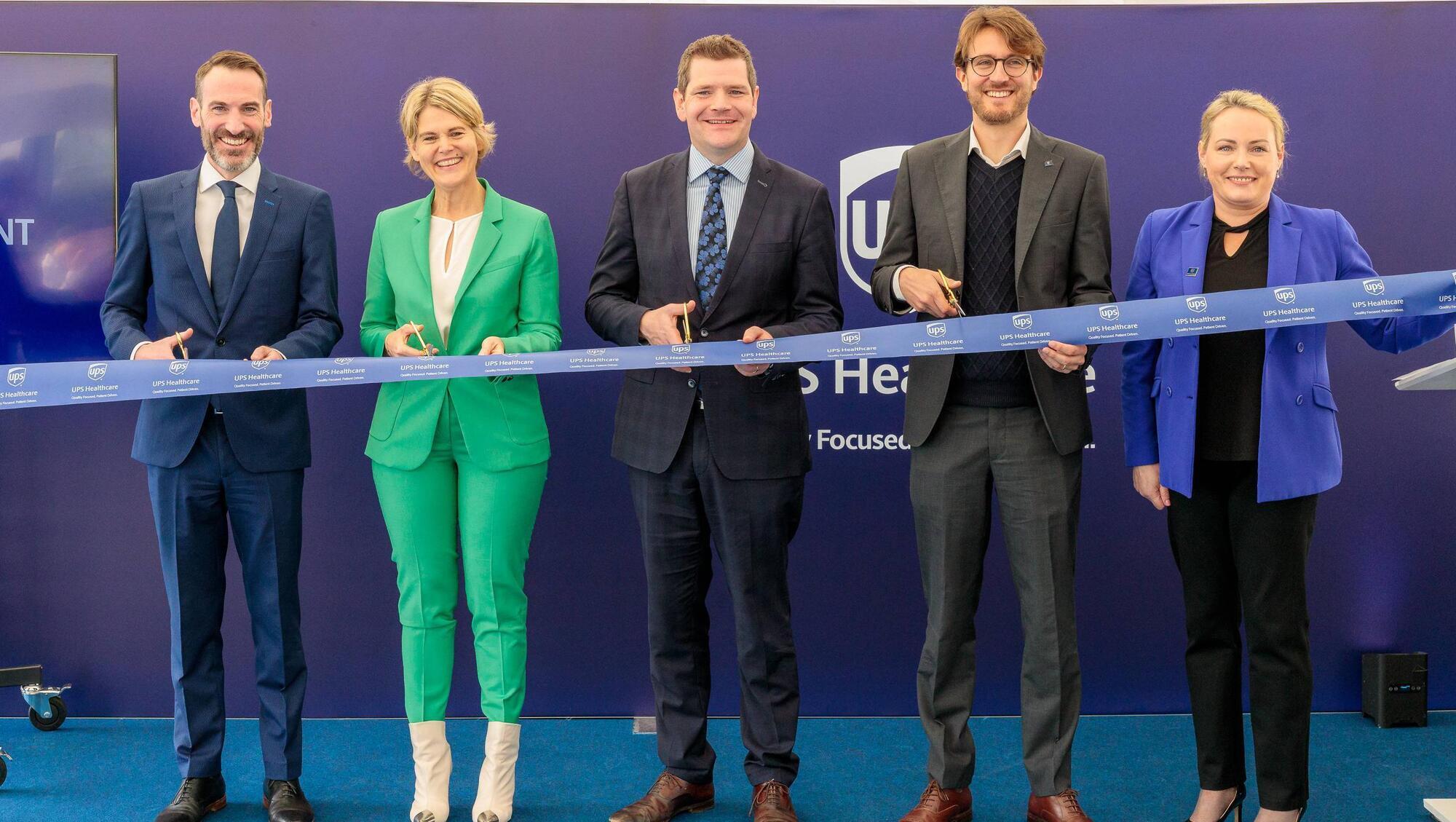
Paul Sweetman, CEO, American Chamber of Commerce; Susanne Klinger-Wesner, president, UPS Supply Chain Solutions Europe; Peter Burke, Minister for Enterprise, Trade and Employment; Felipe Morgulis, president, UPS Healthcare; Cathy O’Brien, VP of International Sales, UPS Healthcare.
At its Thanksgiving lunch last November, the American Chamber of Commerce Ireland (AmCham) hosted over 700 members and guests to celebrate the longstanding economic and cultural ties between the US and Ireland.

A recent survey of its members found that the US multinational community sees Ireland as an important location for strategic investment, and optimism remains high for the future of their businesses in Ireland.
Some 48% of respondents to the AmCham FDI Insights Survey said they expect the number of employees in the Irish operations of their organisation to increase over the next 12 months, and a further 48% expect to maintain current employee numbers.
“It is encouraging that the latest findings from our member survey remain strong and that Ireland continues to be an important location for investment and growth,” said Paul Sweetman, CEO of AmCham.
“Over the past six decades, Ireland has fostered an exemplar community of business leaders and laser-focused policymakers to make Ireland a premier location for investment. Longsighted policies, the tremendous work of our state agencies - the IDA and Enterprise Ireland — the dogged efforts of the business community and close collaboration with the US Embassy and successive Irish Governments, have all resulted in phenomenal growth.”
He added that strengthening these efforts and adapting to support Ireland in achieving a prosperous future must continue, driving continued growth and delivering for its communities and people.
“In a world where geopolitical shifts are becoming ever more prevalent, it is essential that Ireland maintains a pro-business, stable and competitive environment, all underpinned by being a leading advocate for open trade.”
Nine in 10 AmCham members said their corporate headquarters continues to have a positive view of Ireland as an investment or growth location.
Furthermore, some 35% of respondents to the survey said Ireland’s stable, pro-enterprise eco-system is the main reason for their organisation’s confidence in the Irish economy.
When asked what the top priority for Government should be in improving Ireland’s transport connectivity, 37% pointed to the enhancement of Ireland’s road infrastructure. Some 30% cited public transport in Ireland’s regional cities and towns, while 24% said it should be ensuring capacity at all of Ireland’s airports and ports.
AmCham’s survey shows that cost competitiveness is now ranked as the number one issue by 32% of members looking to expand in Ireland, marking a significant increase on the 19% and 10% of members who reported this as a challenge in the same survey in July and March 2024, respectively.
“We are ranked fourth in the world as the most competitive location for investment, but when you delve into those stats there are some figures such as basic infrastructure where we are ranked 38th, prices were ranked 46th and scientific infrastructure ranked 20th. So there is work to be done to improve Ireland’s competitiveness.”
This is the focus of AmCham’s new strategy launched at the end of 2024 — Competing For The Future — where competitiveness is at the heart.
“We have identified five key policy pillars in order to address Ireland’s competitiveness and make sure that we rise up the rankings. This will and maintain our reputation as both a very strong location for US FDI and an equally strong location to support companies using Ireland as a springboard to invest into the US and EU.”
AmCham’s five-pillar strategy is built on: improving Ireland’s physical and digital infrastructure; securing cost competitiveness, stability and the ease of doing business; building the future talent and skills pipeline; enhancing research, development and innovation offerings; and making Ireland the primary economic bridge between the US and EU.
Over 210,000 people in Ireland are directly employed by 970 US multinationals, and 168,000 indirectly — which together adds up to approximately seven and a half percent of Ireland’s entire population working for US multinationals, and spending more than €41 billion in the Irish economy annually.
Meanwhile, Ireland is now the 7th largest source of FDI into the US with 500 Irish companies employing almost 100,000 people across all 50 states.
“Many US multinationals have been in Ireland for decades, and they are attracted here because of factors like talent, our ‘can do’ attitude and our pedigree for delivery. When you look at the other side of the two-way investment relationship, Ireland is now the seventh largest investor in the United States, which is a phenomenal figure given the country’s size.”
There are Irish companies present in every US state, employing at least 100,000 people in America — and in some US states Irish companies are the largest employers. “So it really is a very successful two-way business relationship.”
Mr Sweetman adds that competitiveness remains central to this success story: “It is that spinning plate we have to constantly tend to. There is a new world of challenges and challengers, and we can’t be complacent about our global position as an attractive location for US Foreign Direct Investment.”
The vast majority of AmCham members surveyed were optimistic about Ireland’s economic potential, with 97% responding that Ireland is competitive when compared to other advanced global economies. Some 52% said the main reason for this was a highly educated and skilled talent pool.
“It is a very strong result from our survey, and indeed 96% of companies said they were planning to maintain or increase their employee numbers over the coming year.
“While Ireland has continued to cement its position as a destination for investment within the global business environment, it is also clear that challenges remain within infrastructure, transport, access to talent, and cost competitiveness. Smart policy and investment decisions can sustain Ireland’s reputation as a powerhouse in supporting companies’ growth in the years and decades ahead.”