Saintly wishes falling well short of real climate change action

Colm Greaves hears echoes of Saint Augustine’s chaste intentions in Ireland’s slow path towards its renewable energy goals
Saintly wishes falling well short of real climate change action

A stained glass panel of St. Augustine in an Episcopal church in New York City. Ireland's climate change path arguably retraces the saint's famous plea: “Lord, make me chaste and celibate. But not just yet.” Picture: iStock

Saint Augustine of Hippo (the Algerian town, not the animal) was an important figure in the development of the early Christian church. His reputation endures in the public domain mainly through a prayer he presented in his most notable work, Confessions.

“Lord,” he pleaded, “make me chaste and celibate. But not just yet.” 

Ireland, 1,600 years later and the pace of our progress towards meeting our mandated renewable energy targets suggests that we may have chosen the wrong patron saint.

Our performance can be ranked in one of three ways depending on your point of view. The optimist: ‘Doing grand, getting there.’ The realist: ‘Things are going too slowly; we need to get the lead out! (literally). The Pessimist: This is going nowhere fast, we’re all doomed.’ We are definitely not ‘doing grand’ but we are probably not doomed yet either but the national climb to the summit of our climate change targets, can at best be described as ‘Augustinian’.

“Lord, make us emission free. But not just yet.” 

The current state of play; In its most recent update the Environmental Protection Agency (EPA) projected that Ireland will achieve a reduction of only 29 per cent in its greenhouse gas emissions by 2030, significantly below its legally binding target of 51% by that year.

In fairness to the legislators, meeting any kind of targets these days is a complicated matter. The FAI’s target date to appoint Stephen Kenny’s successor seems to rolls over daily and despite the unending melodrama at Westminster, the number of immigrants that the UK government has deported to Rwanda to date stands at precisely zero.

In relation specifically to climate change, missing targets can have monumental political consequences and legislators need to keep one eye over their shoulder. In Scotland last month, the devolved government retreated spectacularly from the aggressive goals it set during the euphoria of hosting COP21 in Glasgow three years ago.

Their specific commitment of a 75% reduction in green house gases by 2030 (base year 1990) has been replaced with the woollier target of ‘net zero’ by 2045 and the supporting processes for measurement and accountability have been watered down significantly.

This decision shattered the ruling SNP and Green Party coalition and in turn led directly to the resignation of the First Minister, Humza Yousef at the end of last month.

  The coalition parties in Ireland are unlikely to be careless enough to manoeuvre themselves into a political dead end over climate change targets but there are indications that frustration is growing among the electorate over the pace of progress. An IPSO poll last year found that 90% of all voters believed that climate change was an important government priority, with one in five believing it should be the number one policy focus.

But there is an ongoing difficulty in communicating on such an opaque subject as renewable energy targets, especially when they are subject to regular alterations in both timing and the desired quantitative outcomes.

Additionally, the message tends to be delivered to the average citizen like an existential headache when more immediate and noisier concerns such as war in Ukraine and the Middle East or the mind-boggling complexity of recycling an empty bean can has already consumed most people’s anxiety quotients. Many people are reaching for the ‘off’ button.

Progress in meeting our targets has been slow and fragile to date. There are two overriding goals. The Government is statutorily bound to ensure that 80% of electricity consumption is supplied by renewable sources by 2030 and 100% by 2045, the year of the climate change holy grail — net zero carbon emissions.

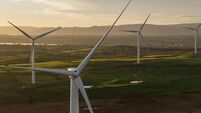
Although reams of subsidiary objectives have been set in all sectors of civic society to support these objectives, three critical sources of supply must be radically scaled upwards. By 2030 offshore wind farms are required to generate 7 gigawatts (GW) of electricity; onshore wind requires 9 GW and photovoltaic or solar target is 8GW by that year. [One GW can power a city of one million people.] To put this into starker terms, in the next six years the Irish State needs to double the levels of energy it harvests from renewable sources. 

Argentinian artist Pedro Marzorati’s sculptures “Where the Tides Ebb and Flow” point to the rising waters of the global warming, capturing the need for action during COP21, United Nations Climate Change Conference, in Paris in 2015. Photo: Francois Mori / AP Photo

Can this be done? The probability is of this is the only thing close to ‘net-zero’ in this process. We can still get close, but only we get the lead out and soon on several critical points on the supply chain.

In goal setting the acronym SMART is often used when establishing the scope of a project. Objectives must be specific, measurable, achievable, relevant and time bound. The S, M, R and T parts are all in broadly in place but they are the ones created by pen and paper. The problem lies in the real world ‘A’ — achievability.

Important stakeholders charged with the practical and physical delivery of emission free increased wattage over the next couple of decades are experiencing a significant confidence wobble.

For instance, a recent survey by KPMG found that executive level management in enterprises sub-supplying the onshore wind sector are frustrated by the speed of delivery in a hyper constrained supply situation. They worry that the targets are not evidentially sound and that they are being delivered ‘top down’ when they should be set by a collaborative process. Over 95% of those surveyed don’t believe that we will meet the 2030 ‘80%’ target.

The obstacles to accelerating the delivery are not trivial. There are constraints in material, labour and infrastructure across all stages of the supply chain. Raw materials and component parts for the physical construction of wind farms and solar installations are globally scarce and Ireland is competing against state entities with far superior purchasing muscle.

There are emerging initiatives to encourage domestic production in key areas but the cost barriers to entry and the lead-times necessary to commission new factories suggest this is not likely to be of benefit anytime soon. 

Additional but significant bottlenecks remain in overall power grid capacity which has been described as ‘not fit for purpose’ and the only port on the Island currently equipped to handle high volume offshore wind is Belfast.

The biggest obstacle to success, however, as is normal in Ireland, is the glacial trudge planning process. An example is the 9GW target for onshore wind by 2030. Installed capacity is running at around half that with only 2GW actively in the planning phase, one fifth of which has lain dormant there for at least three years.

Speaking to this newspaper late last year, MEP Sean Kelly, an ardent proponent of accelerated delivery of renewable energy, remarked that, “I think that if the project is shown to be in the public interest it should be given permission by default. That will speed it up, and will also help to get rid of nimbyism, where people become objectors to any projects in their own area.” 

 In that recent report, the EPA stated that the 2030 target “now requires implementing policies that deliver emission reductions across all sectors of the economy in the short term,” and concludes that this years regenerated climate action plan must be much more aggressive in removing barriers to delivery.

Friends of the Earth chief executive, Oisín Coghlan, reacted much more starkly to the EPA projections, describing them as a “stark warning” and “the kick in the backside the Government needs”.

In other words, somebody needs to get the lead out. Literally.

More in this section

Cookie Policy Privacy Policy Brand Safety FAQ Help Contact Us Terms and Conditions

© Examiner Echo Group Limited