Installing a fence to establish our property boundary
Property Advice: What you can and can't do when building a fence
Installing a fence to establish our property boundary

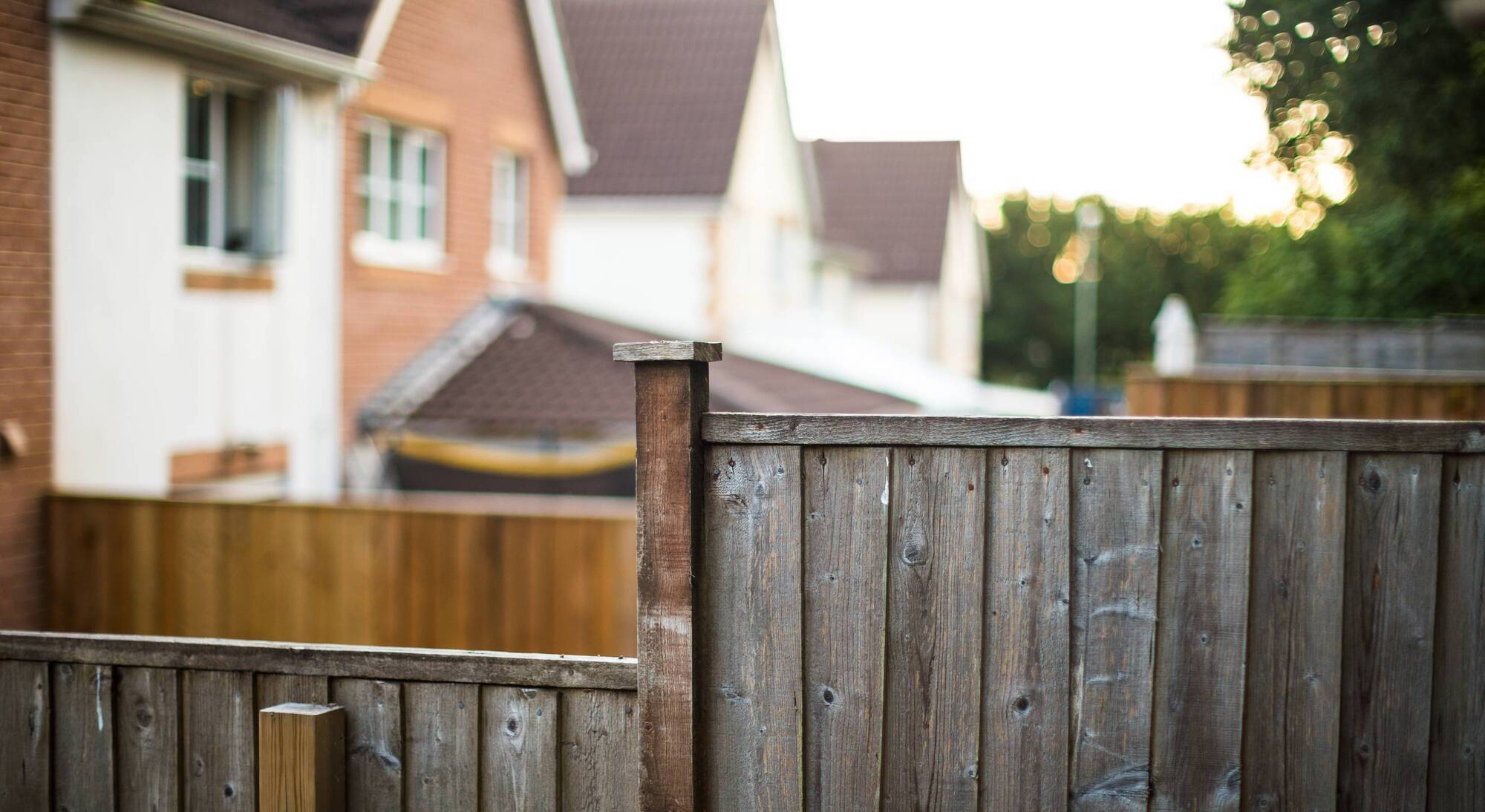
Close up color image depicting a wooden garden fence with new modern houses blurred out of focus in the background. Lots of room for copy space.

Hi Brigid, We moved into our ‘new’ home a year ago. It’s a corporation-built three-bed terraced house — from the 1950s we think — which we are very happy with. One issue which my partner and I felt we would always have to address is the fact that our driveway is only separated from our neighbours on one side by several poles and three strands of loose wire. It’s the same with our back garden on that side. They are visually very unattractive, and we always planned on getting them replaced when we had the money.
It has become more pressing after the summer as the three kids next door seemed to be constantly coming under the wire to retrieve footballs, rugby balls and sliotars. Very often these are hitting our car. They also leave their bikes up against the wire on a regular basis and these come through to our side and we have to step over them. Our neighbours and kids are fine, but we would like to maintain our privacy and establish proper boundaries.
On the other side, there are walls which have been there for a long time. Our neighbour on that side said they were there when he moved in. The wall at the back is covered in ivy and the one at the front, which is lower, has flowers and shrubs growing beside it. For space reasons, we probably will just have to replace the poles with a narrow wall or wooden fence of some type. Could you outline the options to us, front and back? How do we go about it and who pays for it? Do we need planning permission? 

Thanks, Alex

Alex, I’d imagine how kids coming into your garden to chase a ball the first few times would have been cute and a novelty, but I’m sure it wasn’t long wearing off with balls hitting your car on and off and having to step over obstacles on a regular basis. Reading your letter, I can even feel my hackles rising on your behalf! Given your experience, it’s quite natural that addressing this issue has now become a priority. We are hardwired to protect our plot, and this must be very trying, to put it mildly. Especially if, like me, you love gardening… and your car. So, where do you start?

If this were a newer property, I’d do a search online of the local planning files (give the Planning Department in your local authority a ring if you are unclear how to navigate their system). As this is a terrace, the file would include the other houses, so I’d put aside a bit of time. Lots of developments are online, but if they are older you may have to ring/email the Planning Department and order the file from its archive.

This will be a paper version, and you will have to go to the planning office to view it. I’d look at the Schedule of Conditions attached to the file and see if anything about boundaries is mentioned. This is often referred to as Boundary Treatment. If boundaries are not mentioned, I’d look at the drawings to see if boundaries are covered there. Plans can have an overwhelming amount of information, so ask the person at the planning desk to assist you. At the end of this, you’ll know your restrictions concerning boundaries, if they are referred to at all.

As your property predates the Planning and Development Act 1963, and is a corporation house to boot, you won’t find a Schedule of Conditions.

So, the next port of call are the exempt development regulations. Exempt development means that you do not require planning permission. The allowances for boundaries are listed under Class 5 of the Planning and Development Regulations, Schedule 2, Part 1 Exempt Development – General. This allows you to take the side and rear boundaries up to a very generous 2m in height and to take the front boundary up to 1.2 m in height.

But a word to the wise for those one-off houses in the countryside or where there is little streetscape, there may be sightline requirements to allow you to exit your property onto a public road, and it might be the case that splayed entrances and setbacks come into the calculations, for safety reasons. But that’s an article for another day.

To get back to the question in hand, Class 5 lists the kinds of boundaries you are permitted. When it comes to concrete block walls and mass concrete, these must be faced with render and capped, and no palisade or security fencing is allowed. If something is not permitted under exempt development, it does not mean it is off the table. It simply means you require planning permission for it. If you want palisade, security fencing, or an alternative not listed, you will have to look for it under a planning application.

When you have all the relevant information to hand Alex, it’s then time to speak to your neighbour. I suggest that this happens after your research because you are likely to get a barrage of questions, but you’ll be prepared. As you share a boundary, you both have a claim to it. You will have to get his/her agreement to substitute the boundary. You may have to compromise on the type of boundary you wish to install. And you may also have to bear in mind that the neighbour may not want to pay his part of the alterations.

If the neighbour is not open to your proposal, you can always set a new fence line inside your shared boundary. This will mean a marginal loss of the garden, but it will not alter the legal boundary. That is, the original fence will remain the legal boundary. My understanding of the regulations is that you may set a fence inside your property, to the same exempt details listed under Class 5, but this only pertains to the front boundary. However, to get a true interpretation, I suggest you submit a Section 5 Declaration of Exemption application to the planning office, and they will let you know what you can do. If you require planning permission, you can seek it.

If all goes well, the next step is to approach fencing contractors. These should be reputable companies, with insurance, tax clearance, and testimonials from clients that you should be able to contact to check the company’s bona fides. They should have satellite levels and equipment to ensure the boundary they are replacing sits on the line of the former fence. I hope this helps. Happy fencing!

Brigid Browne is a chartered building surveyor and Chair of the Southern Region of the Society of Chartered Surveyors Ireland. She is the owner/ managing director of Cashel-based Fortress Planning which offers a range of services including assigned certifier, design certifier, building surveyor and conservation consultancy to clients all over the country. www.fortressplanning.ie

If you have a property-related query or issue you would like to raise with Majella, please email irishexaminerpropertyqueries@scsi.ie.

x

More in this section

Revoiced

Newsletter

Sign up to the best reads of the week from irishexaminer.com selected just for you.

Cookie Policy Privacy Policy Brand Safety FAQ Help Contact Us Terms and Conditions

© Examiner Echo Group Limited