Understanding the household water conservation charge
Domestic water charges for excessive consumption are on the way, with the first bills hitting the mat in 2022
Understanding the household water conservation charge

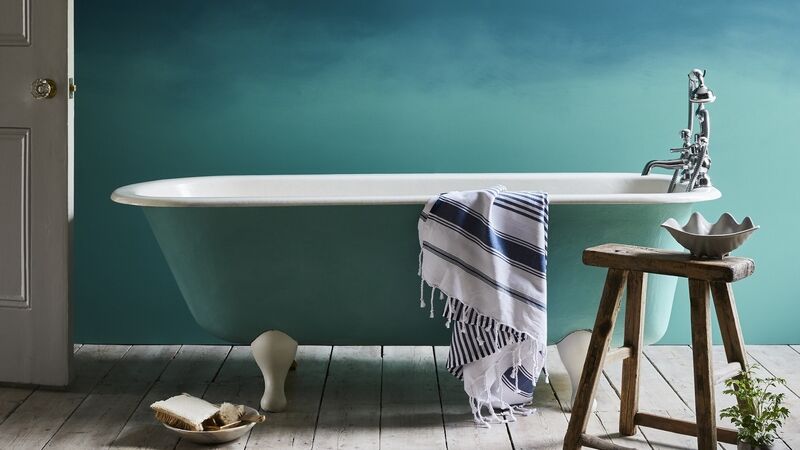
How well do you know your water usage? If you're way over the expected household usage of 213,000l you might be in line for a financial bath. Picture: Ombre Aubusson Blue Wall Paint And Provence Chalk Paint from Annie Sloan
Well, it really is a glass half full. In its environmental performance review last May, the OECD asked the Irish Government to introduce measures to mitigate climate change and the decline of biodiversity due to poor water infrastructure measures. We have a stinking record on water, both with high water loss and with the quality of our water, according to the OECD.

We’re sinking fast. Our own EPA has noted that 50 urban areas still discharge wastewater into our rivers and surrounding ocean. Only 60% of us are connected to advanced wastewater treatment systems.

To upgrade our water delivery and waste system, and to encourage more responsible water usage, water charges were put on the table for the first time since the Irish public stormed the streets in 2014. We are the only OECD country that does not have domestic water charges, opponents claiming that we are already charged through our taxation system and this was simply a stealth tax.

As the distressing chatter thrummed back to life, Professor John Fitzgerald of Trinity College told Pat Kenny on Newstalk last month that charges must be on the table, saying: “Every drop of water we use costs money because it’s been cleaned and so on — so we need to pay for it.”

Any threat to our water supply is stressful. Think beyond the spectre of charges and involve yourself more fully in managing the supply within your boundary. Recycled Broadway Carafe, Garden Trading.

The response from on high pointed back to the collapse of the issue, with a recommendation for the abolition of charges passed by an all-party Oireachtas committee in 2016. With the tide of public opinion rising around their ankles, Taoiseach Micheál Martin and environment minister Eamon Ryan were cheery and firm — no charges, as promised, under his Government. With only half the country even having a water meter installed, most of us can carry on running multiple baths daily and fill up a sink to brush our teeth unperturbed.

Even cranking the tap open with blithe indifference to the wider consequences and lack of funds to potentially fix an ageing, failing supply and wastewater infrastructure — there is something everyone should know about their domestic water supply as it is today, so let’s dive in.

There are, in fact, some punitive domestic water charges for excessive consumption on the way, with the first bills hitting the mat in 2022. These fees set out by the 2017 Water Services Act of 2017, are targeted at the 10% of metered homes who are supping up 40% of our total mains consumption (we don’t know where up to 45% of our total supply even goes). Now, of course, they are the homes with meters installed, or where the problem has been spotted by Irish Water.

These 80,000 or so homes are using 1.7 times the average amount water usage as set out by the Government legislation way back in 2017. The maximum expected usage was then set at 213,000l per year (for a household of four — there’s a rising scale). The erring customers (some through genuinely no fault of their own suffering undetected plumbing faults, leaks, or bracketed as a different household than they are) are using more than 362,000l or more per year.

I think all of us can agree that unless you are caring for a vulnerable resident or multiple individuals who need extra showering (situations covered by what’s termed a medical exemption) — that’s a generous amount of water for one household. Irish Water explains: “In certain circumstances, you may be allowed increased water usage, for example, if there has been a change to the number of residents at the property — called an ‘additional occupancy allowance’.” For a simple need-to-know, visit
citizensinformation.ie

The actual average water usage per household in Ireland in 2018 was actually just a drop under 130,000l, according to the CSO. The proposed water charges of 2014 were always intended to be aimed at excess, not standard usage. The household water conservation charge works as follows:

  • A procedure for Irish Water to assess, notify and, if required, charge customers for excess usage — installing a flow meter on the supply;
  • A procedure for the treatment of metered and un-metered customers;
  • A €1.85 unit rate charge per 1,000 litres consumed over the annual allowance (charge is per service of water and wastewater);
  • A capped charge of €500 for both water and wastewater (€250 for each service).

So how would your sodden habits or cracked pipework even be measured if you don’t have a meter at all? Irish Water can, with sufficient evidence, introduce a meter to the domestic supply outside the boundary and measure what is going up the pipe for that residence over 12 months. Then (and this is going on right now) a warning letter is issued. The same procedure applies to both owners and tenants.

In case you think the OECD is rowing in with these measures, that 2021 environment performance review that started up the whole damned water debate afresh stated that these modest excess water charges will raise nowhere near what is needed to shore up our water problems.

Laura Brien, director of water and compliance at the Commission for Regulation of Utilities, which has approved the proposals for this system, states: “Conservation must play a significant part in addressing future resilience of the water infrastructure in Ireland. This policy clearly sets out how customers must be treated by Irish Water if excess use is identified, and how customers will be given the opportunity to address this in terms of either fixing leaks or adjusting their consumption levels before any charges may apply.”

Under the First Fix Free Scheme, managed by Irish Water, you may be eligible for free remedial work to repair pipes detected within your boundary. Some homeowners will have received a leak notification letter. Others will simply have suspicions that there is something sodden on their property. Either way, there have been some positive changes to this scheme since April, so you can apply for help even if you:

  • Are not registered with Irish Water;
  • Do not have a meter;
  • Have no internal stop valve;
  • Have a shared service connection;
  • Are a mixed-use customer, who mainly uses water for domestic purposes.

If you have received a letter from Irish Water or are worried about an apparent leak, simply call 1850 278 278 and a member of their team will explore the issue to find out if you qualify for the scheme. It’s important to ensure that the errant water demand is not being caused by plumbing failures. This could account for as much as 19,000l of water loss. If you have a water point reference number or WPRN, have that on hand.

x

More in this section

Revoiced

Newsletter

Sign up to the best reads of the week from irishexaminer.com selected just for you.

Cookie Policy Privacy Policy Brand Safety FAQ Help Contact Us Terms and Conditions

© Examiner Echo Group Limited