Nesting cranes offer hope of a return to Ireland after centuries
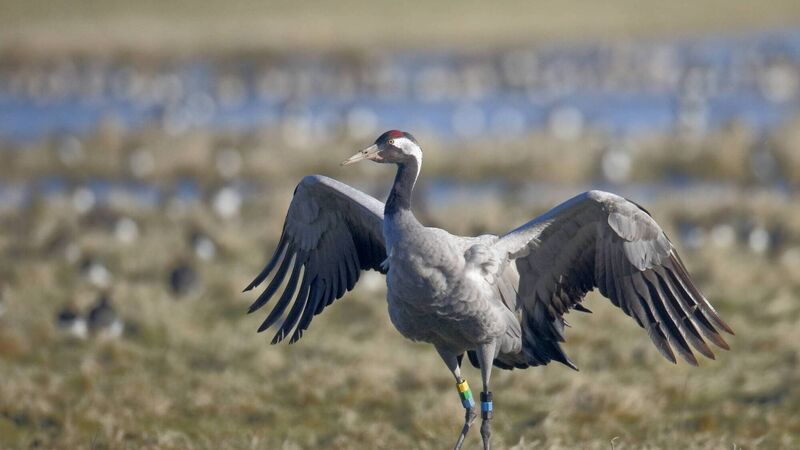
The crane stopped breeding in Ireland 300 years ago.
A REPORT from Bord na Móna says that cranes are nesting on a rewetted bog in the Midlands. It's the third year in which the birds have tried to breed at the secret location. The previous attempts failed, as is often the case with young, inexperienced cranes, but it's hoped that the pair will succeed this time.
This news will please bird-watchers, folklorists, and social historians.
The crane was, and still is, a much-loved creature, not just in medieval Ireland, but throughout Europe.
'Cor', its name in Irish, goes back to Indo-European, the parent of most Western European languages, as well as of Sanskrit.
Place-names such as 'Corofin' and 'Corbally' embody it. 'Corcaigh', usually translated as 'marsh', may have meant 'crane-meadow' originally.
People still refer to the grey heron as the 'crane'. It's as though our ancestors, unable to accept the loss of this special bird, transferred their affections to one that resembled it.
In , his in-depth study of the crane in Ireland, Lorcan O’Toole remarks that, at 1.5m, the adult crane is almost as tall as an average person was long ago.
This swamp-dweller, with a skinny, Giacometti-style profile, would seem to be an unlikely celebrity. Its head is too small for its body and an untidy bush of wing-feathers protrudes from its rear end.

But migrating cranes flying in V formation, with their necks extended forward and their legs trailing behind them, is an exhilarating sight.
The astonishing dancing display, with its parade-ground marches, leaps into the air, and runs in circles, is one of nature's great comedy routines.
Being loved, however, didn't save the crane’s neck, not here or in Britain. Although kept as a pet, this bird was also eaten. In 1210, the notorious King John, of Magna Carta fame, set his falcons at cranes in Cambridgeshire, killing seven of them.
In 1465, 204 cranes were served at a banquet celebrating the installation of the archbishop of York.
The crane ceased breeding in Ireland about 300 years ago. It had stopped nesting in Britain even earlier. A young bird offered for sale in Norfolk, in 1542, is the last known evidence of breeding. Cranes are temperamental; they hate being disturbed. Hunting, persecution, and drainage of their nesting areas forced them to leave.
The bird was gone, but, like the prodigal son, it was not forgotten. 'Come back crane, all is forgiven' might be the mission statement of the Great Crane Project. Beginning in 2010, crane eggs were imported from Germany and hand-reared youngsters were released to the wild in Somerset.
Then, in 1979, to everyone's amazement, two juvenile cranes set up territory in Norfolk. Breeding commenced in 1981; the prodigal had returned. Nine pairs produced six young in 2010. According to the British Trust for Ornithology, 64 pairs held territories in 2020, 56 attempted to breed, and 23 chicks fledged.
Cranes never abandoned Ireland entirely; stragglers continued to visit. The Cork branch of BirdWatch Ireland, for example, recorded a flock of 19 at Midleton between November 13 and 25, 2011. An influx of 63 from October to December that year was exceptional.
In view of the recent recolonisation of Britain, it's likely that the Midlands nesting pair came from there.


CONNECT WITH US TODAY



Be the first to know the latest news and updates