Get the measure of every task: Understanding your measuring tape and its hidden hacks
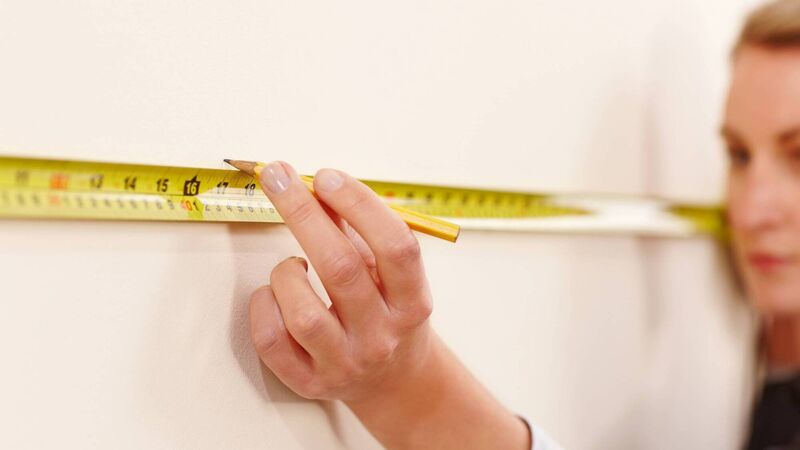
Mastering the measuring tape is crucial when carrying out small and big jobs. Picture: iStock
Metal tapes start at around €15-€22 for a small 5m everyday tool to throw in a kitchen drawer to €50-€70 for a 15m renovation-ready weapon from DeWalt or Stanley. Long fabric tapes are commonly used for landscaping, but they can stretch over time, so don’t rely on them indoors.
There are some fascinating legends and handy hacks in a metal tape — curious little detailing you’ve probably noticed with the tape on idle but never questioned. Examine a professional measuring tape, and you might find a variety of diamond and triangular symbols to show the standard spacing of structural elements – wall studs and flooring joists — lengths regularly on call on a building site.
Quality tape is made in Mylar-coated carbon steel, and most cases are in ABS plastic, as it’s warm in the hand and impact-resistant. The standard EC Class I or EC Class II means the tape has enhanced accuracy. Choose a tape with both Imperial and metric on the tape, as there are some materials, like the diameter of hoses and water pipes, still given routinely in fractions of inches.
With both metric and Imperial on one side, you can easily convert measurements where needed. Length? 5m to 8m is enough for regular home use, with widths varying between 16mm and 32mm. If you insist on sticking with Imperial readings, you should know how to break readings down into inches and fractions. The figures 1/8” or 1/16” to express odd numbers are popular with woodworkers — the 1/16 being the tiniest marks on a tape. Working metric, just don’t mix up your centimetres and millimetres.
For items like cabinets, suppliers will sell by the millimetre. The 5mm mark is the long one in the group of 10-millimetre marks on your tape.
The longer and wider the tape becomes, the heavier it becomes, so think about a couple of tapes, including something handy (around 5m/16mm) to slip in your pocket when shopping for furnishings, DIY materials or appliances. The width of a tape matters as it impacts what’s called the stand-out of the tape.
This is the length the tape can sit out horizontally without serious sagging — something you don’t have to worry about with the wizardry of a laser measure. Tapes are wider and more curved to make them stronger and to give them better stand-out.
The horizontal stand-out might be as much as four metres in a good builder’s tape. Here’s a little tip: For small measurements, when you pull out the tape, rather than struggling to mechanically lock it in place, hold it from underneath near the housing of the tape with your pinkie finger. Read looking straight down or with the tape on its edge to get the measurement and write it down immediately. Measure twice at least.
At the end of the tape (with a professional level model), there are indented teeth on the hook or tang coming off the impact plate at the end. This can be used to press into timber and scribe it if you don’t have a pencil. You can also press a pencil against the tang and run it with the tape down a panel of plasterboard or MDF to mark it off.
The riveted tang of your manual tape is deliberately loose by a tiny amount, and this floating hook creates a true-zero whether you create tension by pulling it right out or butt it up against, say, the inside of a window reveal. Looking further up the hook, there’s sometimes a small slot or hole.
If you don’t have something to push against or grab when measuring, you can use this to place a tack or drop it over an existing flat-head nail or screw. I like 2-3 flat little magnets on the end of the tape (quite common even with budget models) to grab on to metal surfaces. These are sometimes removable.
The tape itself will often have a measurement on the case — what’s termed a known length. You can use this to measure out of corners without bending the blade (and potentially damaging it or being off by several mm). Just add the length of the case to the reading on the tape. If you’re using a digital tape, the unit will do this automatically.
For long distances, either pull the tape out in arm lengths until it drops and reaches the floor and then extend it until you can press it against, say, a wall or hook it onto something and draw it out. Many things are not true, including walls and reveals, so it’s standard practise to take three measurements at different points to get the longest and shortest width and depth (ordering recessed blinds, this will be crucial). One of the biggest mistakes with tapes is what’s termed parallax error, where you’re unwittingly putting an angle on the measurement.
If you’re alone and having to wrangle the tape over long distances, be extremely wary of proper measurements. For example, we all know how to fold a measuring tape back on itself to make it easier to read the height of something like a ceiling. However, this circus trick should only be used for rough measurements rather than accuracy by an amateur, as you’re reading off a bend. Should you just pay the extra and get a laser measure?
They are fantastic for determining large distances, for say ordering carpet, getting wall volumes before buying paint, or getting a read on a hard-to-reach element like a beam up on a ceiling. Laser measures, once you understand any settings, are quick and intended to work at accuracies down to 1/16” or 1.5mm, and can throw in extra talents like volume and area. A tape measure is highly versatile, it’s always ready, and for curved and small surfaces, tricky little spaces – it’s not influenced by light conditions, or a failing battery. In an ideal world, get both tools when you can afford them — starting with a good quality tape.
CONNECT WITH US TODAY



Be the first to know the latest news and updates