Euphorbia: the reliable, adaptable plant for every garden
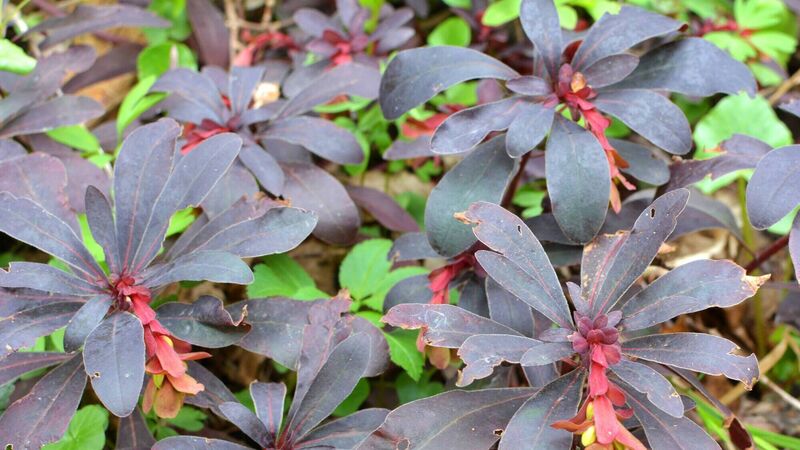
Euphorbia amygdaloides rich, wine-coloured foliage gives it real depth. Picture: iStock

Some plants earn their place by simply doing the job properly, year after year, and for me, Euphorbia is one of them.
From low, spreading natives tucked into hedgerows to bold architectural forms in planting schemes, they cover a surprising range. And right now, in early April, many of them are coming to their aesthetic best.
Our native species, such as Euphorbia amygdaloides (wood spurge), give a good starting point. You’ll find it naturally in woodland edges, shaded banks, and undisturbed ground where the soil is reasonably free-draining but still holds some moisture. It forms low clumps of dark green foliage and then lifts in spring with those distinctive green flower heads that catch the light in a way very few plants can.
Another native, Euphorbia helioscopia, turns up in more open and disturbed ground, field edges, cultivated soil, even cracks in paving. Euphorbias as a group are adaptable, but they are very clear about one thing: they do not want to sit in wet, compacted soil.
In heavy ground that holds water, especially through winter, roots struggle for oxygen, and plants weaken. You might still get some growth, but it will never be strong or long-lasting. Where the soil is open, free-draining and reasonably balanced, they establish quickly and will reward you for years to come.
Euphorbia characias is probably the best known of the commonly planted garden species. Evergreen, upright, with blue-grey foliage that holds through winter, and lime-green flower heads in spring. It’s a plant that provides structure when very little else does. It sits well in gravel gardens, coastal sites, and anywhere that gets a bit of exposure.
I have always loved Euphorbia amygdaloides var. purpurea. The rich, wine-coloured foliage gives it real depth; these are my colours, and in spring, that contrast of the rich purple with the sharp green flowers is hard to beat.
In more recent years, though, I have found myself drawn to Euphorbia Tasmanian Tiger. Only in the past few weeks I have planted several through my own garden, using them quite deliberately among white and green planting to create that lovely, calm and restful feel. The foliage colour is just so beautiful, a soft creamy edge against fresh green, and it lifts everything around it without dominating. You could just as easily take the opposite approach, contrasting the pale tones of Tasmanian Tiger against the darker, richer colour of purpurea. Between the two, you can create quite the drama without relying on strong flower colour.
Although both Euphorbia purpurea and Tasmanian Tiger are evergreen, they do benefit from an annual haircut to keep them looking fresh. Left alone, they tend to become leggy, a bit bedraggled and unkempt, a bit like myself by the end of the week.
The key is timing. As soon as flowering finishes in late spring, go in and remove the stems which have just bloomed. Follow each flowered stem right down and cut it cleanly at the base, leaving any fresh leafy shoots untouched, as these will form next year’s display.
Avoid trimming across the top or cutting everything back hard, as that will spoil the structure and reduce flowering. Done properly, this simple yearly cut keeps the plants bushy, compact and full.
Herbaceous species such as Euphorbia griffithii or Euphorbia palustris won’t need pruning like this as they will naturally die back under the ground each winter.
Before planting, it’s worth taking the time to open up the soil properly. Break compaction, improve drainage where needed, and incorporate organic matter. Adding a biochar-based feed can make a real difference, as this will feed the newly planted Euphorbia in the short term and, in the longer term, will improve the soil’s ability to function.
There is also an ecological value, particularly with the native species. Early flowers provide a source of nectar for insects when little else is available, and because they sit naturally within the landscape, they support a wider range of life than more heavily bred ornamental plants.
All Euphorbias produce a milky sap when cut or damaged, and it can irritate the skin. For some people, it causes a fairly strong reaction, so it is worth wearing gloves when pruning or handling them and avoiding contact with your eyes.
Beyond that, they are straightforward. Choose the right place, get the soil into good condition, and they will do what they are meant to do.
That applies not just to Euphorbia, but to everything you plant. If the ground is right, the plant has a chance. If it is not, you are always working against it.


CONNECT WITH US TODAY



Be the first to know the latest news and updates