Home Q&A: All you need to know about planning permission and demolition

If you had a site with an unremarkable house overlooking a stirring view, or wanted a cinema, bar, and two swimming pools to grace your life, would it be that easy to dismiss and destroy the existing property?
Home Q&A: All you need to know about planning permission and demolition

What may seem unimportant to you, may pique the interest of your local planners. File picture

Movie star Saoirse Ronan and her husband Jack Lowden were frustrated in their efforts to flatten a bungalow near Ballydehob, in West Cork, recently. Looking at images of the pretty but unremarkable 125sq m stone-faced 1990s Irish dormer, this refusal might have been a surprise to many of us.

The rejection by Cork County Council’s planning board stated that the cottage was regarded by the planners as “well integrated” in the site (and it clearly is to my eye). 

However, the demolition was not the only issue. It was that the new and far taller 332sq m house proposed by the celebrity couple was deemed not proportional to this sensitive coastal position. 

If their developer re-applies, with the right plans, that cottage may still be flattened — or at least, heavily reimagined.

Saoirse Ronan and Jack Lowden. The tall 332sq m house proposed by the celebrity couple was deemed not proportional to this sensitive coastal position. Picture: Getty

Conor McGregor made a similar application to demolish his five-bedroom house at The Paddocks, Castledillon, Straffan, Co Kildare, looking to replace it with an astonishing 3,037sq m six-bedroom build. The Kildare County Local Development Plan dealt his plans a knock-out blow.

So, if you had a €650k site with an unremarkable house gazing out over a stirring view, or wanted a cinema, bar, and two swimming pools to grace your life, would it be that easy to dismiss and destroy the existing house?

Let’s start with what is generally allowed and not allowed in terms of planning. Within the curtilage of your property, you can demolish without planning permission anything that’s not a habitable house, or not a protected structure (not to say farm buildings of national interest and on the minister’s register).

What is a habitable building?

In legal terms, it’s a building already in use as a dwelling or intended as a habitable dwelling (occupied or not). A building not in use, but when last used it was a dwelling and is not derelict. A building where the last permitted use was as a house, even if it has been in unauthorised use since then. Even where a structure appears to be derelict, I would always encourage readers to contact a local structural engineer and/or their local planning office before accelerating towards an extant house/wall/shed — anything made by human hands or machine.

In general, if an outbuilding is more than 40sq m, make a call to the local authority for guidance. This sizing is anything bigger than 100sq m in commercial circumstances. What about a protected building? This information is easily available through the conservation office at your local authority, so don’t assume that every old stone building is fair game. Protected Structures are listed on each local authority’s Record of Protected Structures (RPS) and are protected under law as set out in Part IV of the Planning and Development Act, 2000.

Even if you’re not found out for murdering some protected old shed, hedge, or lodge, you could be either informed upon by an interfering neighbour or it can and will come to light when you come to sell, and the buyer’s solicitor performs a simple search.

Hello, potential court proceedings. If there’s any conservation order on any part of your property, even the house itself, ask for guidance from your local authority before going ahead.

Terrace

You cannot demolish a building that forms part of a terrace of buildings (even if it’s not a habitable house) or abuts another building where you don’t own the structure next door, without planning. This makes sense as there’s a party wall and possibly an adjoining roof, so you can imagine the structural damage and dangers that might occur swinging a wrecking ball or even a sledgehammer close to a building married to your own.

This doesn’t mean you won’t get planning to demolish. Your property may be deemed unsafe, or you may get planning with stipulations on the mechanism to get it down safely, but you must ask.

Requirements

So, say we’re going ahead with knocking down an old piggery or a collapsing cottage, what’s going to be required? First of all, presuming we’re including it in our overall permission for planning, there should be a survey with plans, elevations, and sections — anything you’re asked to provide before planning is approved. If you leave these out of your application, you can expect it to be delayed, as with any PP.

Having recently returned from Dublin, where I visited an old Georgian house in a smart area of D4, the owner told me just how much more valuable the site was without the house (unprotected), as these homes and their gardens are being feverishly redeveloped from single old stately places into multiple units.

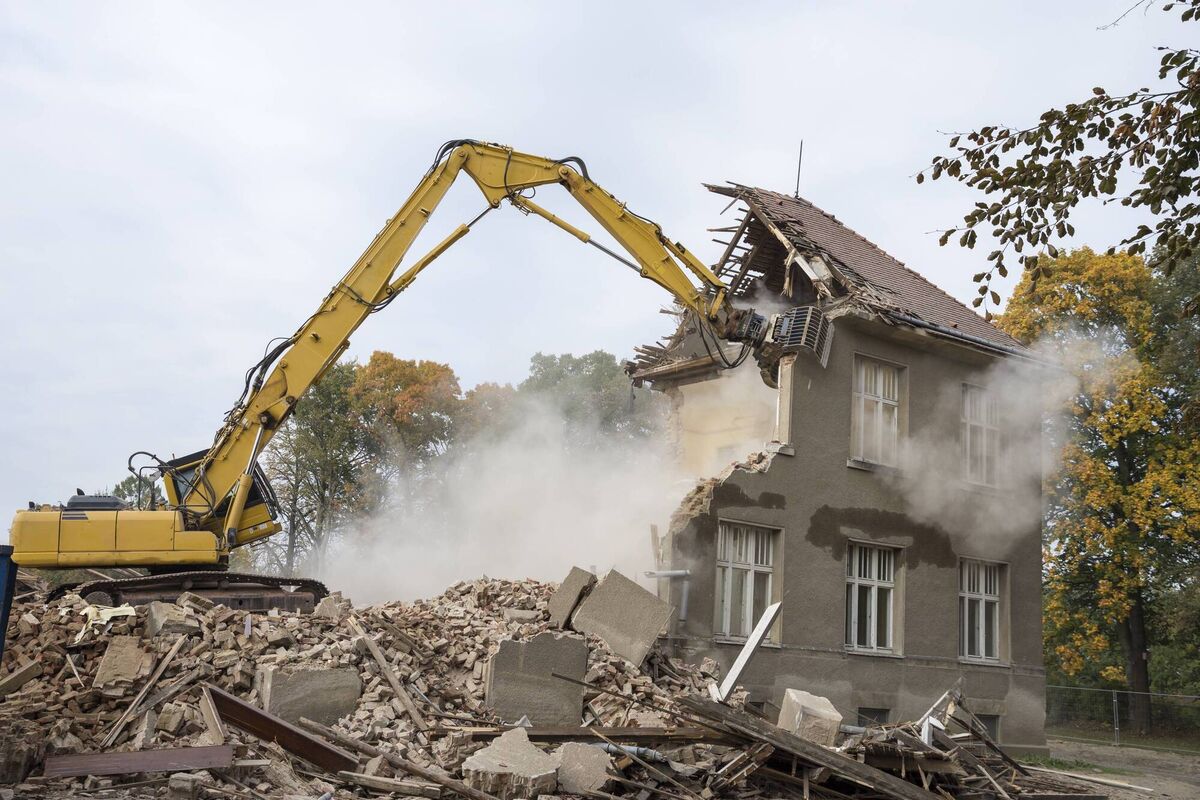
Tearing down a habitable house requires planning permission, and it doesn’t need to be lived in to be deemed habitable. File picture

Always keep in mind that just because there’s permission to demolish does not mean there is tacit permission to build something else instead of demolition. The application by you, your engineer, or architect will, in all likelihood, incorporate both the knocking down of the old house and outline proposal for the new house or outbuilding is a separate issue to get completely right.

The public has the same right to object to a demolition as they do with any redevelopment, but they can’t just object to be frivolous and interfering. Where there’s any question in your mind, it’s always worth chatting to your neighbours about the project ahead of time, taking on board any concerns they may have.

  • There’s an excellent planning guide to the basics of all planning permission published by the Office of the Planning Regulator at exa.mn/planning; find a chartered surveyor at scsi.ie

More in this section

Revoiced

Newsletter

Sign up to the best reads of the week from irishexaminer.com selected just for you.

Cookie Policy Privacy Policy Brand Safety FAQ Help Contact Us Terms and Conditions

© Examiner Echo Group Limited