Home: Design ideas to make the most of your roof space
Velux’s Balcony range takes your opening roof window (set at floor level) to a small balcony with side rails, with fresh air, increased light and improved views; €3,999 with flashing set, velux.ie.
A roof over our heads. It’s how we commonly describe having a home but have you fully explored everything that familiar protective structure might offer?
Here are just a few notions to send your build or home improvements skyward.
Slates, both natural and fibre-cement, are not the only way to put a hat on the house. Many celebrated homes in the annals of the Royal Institute of the Architects of Ireland (RIAI) are finished with malleable, handsome zinc, copper, aluminium, and steel roofs.
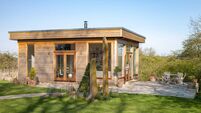
Even good old, corrugated or box-profile steel under a red or green oxide paint makes an attractive alternative to a rustic extension, mirroring agricultural building elements. We have an accepted vernacular in Ireland of metal roofing, and in European cities, 19th-century zinc and copper roofs are still intact.
Standard planning permission (if you don’t specify your roof choice) will generally vouch for colour and type, and it’s generally black/grey slate or tile. Beyond checking with the planners, there are a few things to know.
Copper is the most expensive roofing choice, and zinc is around twice the price of standing-seam steel roofing panels, with aluminium coming in as the most affordable. Steel can be treated with a zinc coating. Grey zinc with its mild, natural “oil-canning" iridescent patina, has an honesty that sits perfectly in the Irish countryside and town settings.
Malleable metals like steel, can be folded and bent into infinite shapes and zinc is “self-healing” when dented. All are robust, corrosion-free and weather-proof. Take a look at standing-seam metal dormers, porches, flat-roofed extensions and matching soffits, facias, flashing and copings.

Apart from a professional installation (metal roof installers are famously fussy) — insulation elements needed to cut down on impact noise may push the project cost beyond that of a natural slate.
For a good gallery of roof and cladding possibilities with 10-year guarantees on workmanship, try weatherseam.ie and copperandsheetmetal.ie (Pat O’Leary), Cork. Aluminium is another sustainable, durable choice.
For suppliers of the popular Ruukki steel sheet system with GreenCoat (rapeseed-based finishes), based in Helsinki; litcore.ie.
Real gardens at roof level can comprise trees, shrubs, grasses, beds and even glasshouses. For the rest of us, the green roof to a new build or renovation will be a sedum roof in a full or part roof area termed an “extensive green roof” not intended for walking on.
Since this hobbit behaviour arrived some 50 years ago from Germany, embedding low-slung eco-houses into rolling meadows and turning apartment roofs into carbon sinks, the green, growing roof has become a modular, well-understood roofing option for full roofs and extensions.
Green roofs insulate that part of the roof in winter and keep the building cooler in summer while encouraging rich biodiversity and supporting local wildlife. Here in Ireland, there are suppliers for just about everything needed for direct labour or DIY installation of a warm, environmentally friendly roof.
Membranes, irrigation, drainage, and the strength of the roof will all have to be spot on for both building regulations and your insurer’s peace of mind. For the horticultural layering on and green stuff, Green Roofs Direct in Larne can supply roof separation layers, substrates for natural drainage, and its EverMat of Sea Hardened Sedum Blankets for €63 plus VAT per square metre to your site.
The firm also offers pebble borders and steel rims to your builder/garden designer’s plans, greenroofsdirect.com.
Landtech Soils also offer pioneering Green Roof Tray technology (rather than traditional mats), and you can check them out at landtechsoils.ie.
It’s exhilarating to step out level with the slates, margarita in hand, to a sunset, but let’s get this right. If you have an existing flat or inset roof area, even if it’s structurally supported, waterproofed and ultimately strong enough to take you, your plants, flooring and your patio furniture, without specific planning permission, you are frolicking on the roof.
The Planning and Development Regulations, 2001, (S.I. No. 600/2001) Schedule 2, Part 1, item 7 specifies: “The roof of any extension shall not be used as a balcony or roof garden.”
In short, if you put down grass, decking, patio stones, railings, and stairs — you’re fiddling on the roof. Undo those “improvements” before selling the home. Otherwise, it will come up at survey as breaching permitted development rights and could kibosh your potential buyer’s mortgage approval.

Applying for planning, get an engineer or architect involved to strategise for roof loads and reinforcement, and to demonstrate to the local authority that any overlook issues with the neighbours have been addressed and that the terrace is suited to any urban environment.
Starting a new build or renovation, ensure any roof terrace is part of the original design submitted to planning including correct 1.1m high balustrades and toughened glass where glazing is used, and meeting fire regulations for means of escape.
A naked roof is a wasted roof. With the increase in energy prices, the return on the capital outlay for photovoltaics has fallen to as little as five years, and it’s well supported by the growing number of green loan mechanisms with low-interest rates.
If and when you can, jump into solar PV to reap the benefits of not just powering your home but harvesting kWhs back to the grid with the Microgeneration Support Scheme (MSS).
Averaging out at 21c per kWh hour with many suppliers, this can take a good bite out of your standing charges. The MSS removes the absolute need to have a battery to make solar PV a good investment.
Grant support managed by the SEAI has declined to €2,400 (for 4kWp of panels) from a former high of €3,800 of maximum grant support that at one time included a battery.
How and ever, VAT has been removed from the expense of installation and suppliers should reflect that in their quotation (politely ask when tendering with at least three suppliers). Prices start in the area of €6,000 before grant aid. The future in my view will be integrated solar tiles, removing the rather clunky appearance of solar panels.
Systems include Nulock and Tyle, offering up to 100w generation per tile. Currently, these systems do not offer quite the same efficiencies as full panels and are only suited to new roofs with the correct pitch and angle; seai.ie.
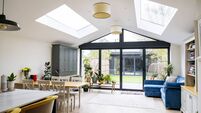
If you have a blinded-out piece of roof over a shadowy room, a fixed roof window or an older opening section, think about shifting up to the latest products to improve insulation values and increase daylight in your spaces.
These relatively affordable changes can be transformative, teasing open the envelope of your home. With a pitch of 15 degrees to 90 degrees, Velux offers a two-in-one roof window with one fixed and one opening window from €1,299 ex. installation.
Step that up to the two-in-one solar-powered roof window and never have to worry about rain, as the integrated rain sensor automatically closes shop, €1,967.

Velux’s Balcony range takes your opening roof window (set at floor level) to a small balcony with side rails that are enough to stand up in, taking you right out onto your roof with fresh air, increased light and improved views. €3,999 with flashing set, velux.ie.
If you’re lucky enough to have a proper roof terrace on a flat roof area but need to pour light into challenged spaces, look up the DXW window by Fakro, with a reinforced, anti-slip coating which sits flush with the roof covering material, and which can be walked on safely and is sealed and waterproofed to a high degree.
Prices from around €2,000, with standard centre pivot roof lights from €320 and roof balcony prices comparable to Velux, fakro.ie.
In terms of planning, the regulations are often muddled and too many presumptions are made about exempted development. If a bank of say Velux windows is taking up more than 20% of any roof area, is projecting more than 150mm from the original roof, or is on the front or side aspect of the house facing the road or a neighbour’s home, start the conversation with your local authority.