Richard Collins: Thor’s Hammer packs a mighty punch
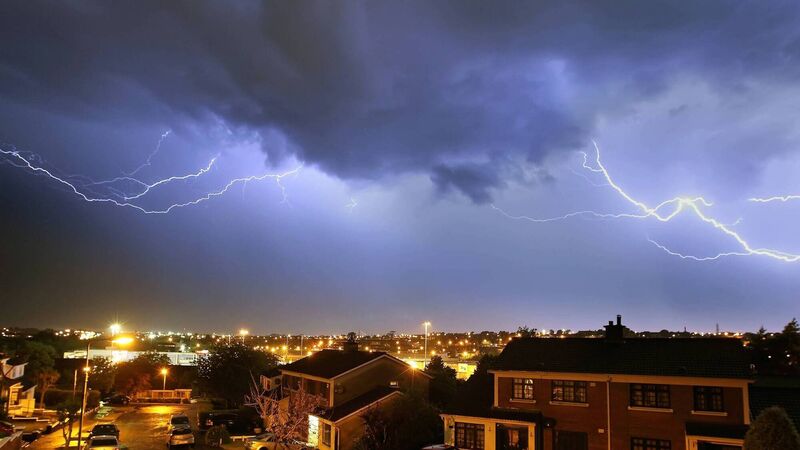
A lightning storm over Waterford last year. Picture: Noel Browne
Many people fear thunderstorms, although lightning-strike fatalities are extremely rare. There are about four deaths annually in Britain and about 100 in the United States. African countries have higher casualty rates, with 240 victims each year in South Africa alone. Mortality, worldwide, is around 24,000. Electrical storms are most frequent in warm climates. They may be uncommon in Ireland now, but their number and severity will increase as temperatures rise with global warming.
Dogs and cats also experience astraphobia, the fear of loud noises, but only farm animals are at serious risk from lightning. Trees, the tallest objects in the countryside, attract strikes. Livestock, sheltering under them,
become victims. Last May, The Farmer’s Journal reported that three store cattle were killed in Co Westmeath and that seven calves died in Co Carlow on the same day. In 1918, two lightning bolts killed 654 sheep at Mill Canyon Peak in Utah.
If there is no shelter, cattle and sheep may huddle together during storms. They are seldom struck by the lightning itself, but electrocuted by a surge from the strike passing through the ground. The greater the distance between an animal’s front and back legs, the higher the electrical potential tapped. If you should happen to encounter fallen wires, retreat, keeping your feet close together.
The extent to which lightning threatens wild creatures isn’t known. Not surprisingly, tall animals such as giraffes are particularly vulnerable. Betsy, a giraffe at Walt Disney World in Florida, was killed in 2003. In 2016, 323 reindeer, herding together, were found dead at a location in Norway. Their deaths were a mystery initially, but it turned out that lightning was to blame. Five elephants, found dead in Bengal in 2007, were probably lightning victims. Rhino casualties have been reported. Nor are birds entirely safe from Thor’s Hammer; 32 geese, flocking together, were killed by lightning in Manitoba, Canada in 1932.
There may be burn marks on the body of a recent lightning victim but, to date, it has been impossible to decide whether older remains are those of a lightning victim.
Now, researchers at Johannesburg’s Wits University have developed a technique which can reveal whether lighting caused a death.
Human bone, from corpses, was subjected to artificially generated lightning strikes in the laboratory. A typical cooker element draws 5amps to 10amps. Currents of up to 10,000amps, of exceedingly short duration, were generated artificially to simulate lightning strikes. High-powered microscopy revealed a pattern of cracks in bone samples subjected to the surges; ‘a combination of electrically- thermally- and pressure induced alterations’ in the bone tissue, the authors say in a paper just published. The damage marks were unique, differing from the cracks produced by fire, a frequent cause of death in wild creatures.
The team then examined the bones of a giraffe, known to have been killed by lightning; they too exhibited the telltale pattern.
The technique will aid forensic pathologists. Its wildlife applications will be limited, but the causes of mysterious deaths, such as those which occurred in Utah and Norway, will be more easily determined.
Nicholas Bacci et al. Harnessing Thor’s Hammer: Experimentally Induced Lightning
Trauma to Human Bone by High-Impact Current. Forensic Science International. 2021


CONNECT WITH US TODAY



Be the first to know the latest news and updates