Vintage View: Let's take a look at Whitefriars Glass 
AJ Powell & Sons, later Whitefriars, was founded just outside the accepted City of London in the medieval area of Whitefriars
Vintage View: Let's take a look at Whitefriars Glass 

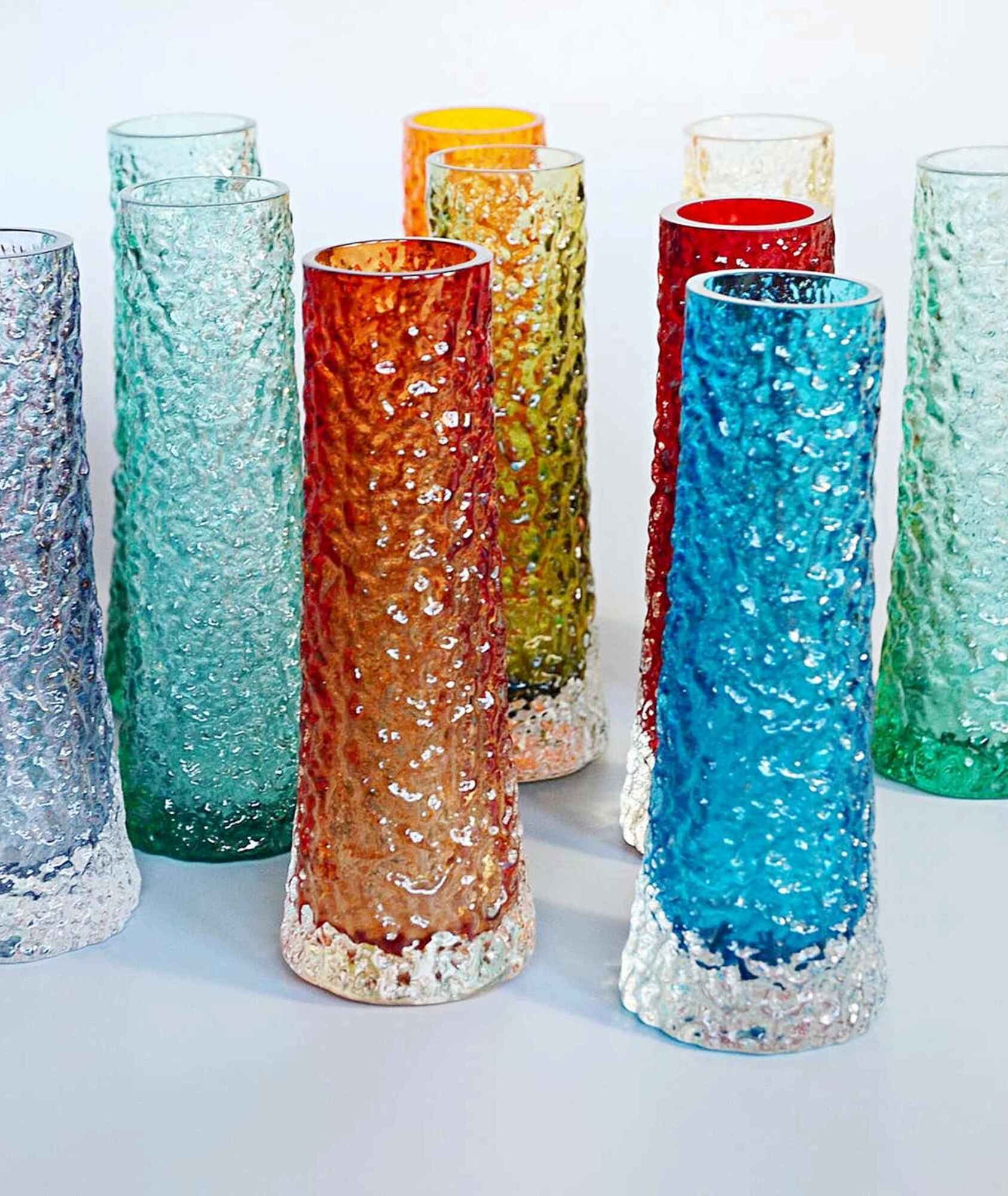
Volcano vases with a lovely warty finish, from €120, Etsy and eBay.

Accessible, beautiful and relatively plentiful, Whitefriars pieces have an assuring art glass look, and were snapped up by the 1960s generation exhausted by the post-war drudgery of safe front-room decorating.

Fringed lampshades, blunted art deco and cloying Victoriana regarded as classic and classy were starting to bore the bright younger things. With Britain turning away from Europe politically right now, it’s interesting to consider how close the art, crafts and design community remain across the continent — exchanging emerging ideas and exciting new techniques that still leap over national boundaries.


Geoffrey Baxter Banjo vase with Geometric Vortex. Late 60s. Examples from €250. Price depends on the colour/pattern combination with Whitefriars glass.

AJ Powell & Sons, later Whitefriars, was founded just outside the accepted City of London in the medieval area of Whitefriars, and would move to Middlesex in 1923. In business from 1834 to 1980, it was to become Britain’s longest-established glasshouse and a real player in the industrial arts movement that brought design to the masses.

They served up innovative Venetian-informed classic, art nouveau and radical art deco pieces, plus stained-glass and scientific vessels right through the early decades of the 20th century. Re-branded as Whitefriars in 1963, the firm is best remembered for its 1960s line of thick, textured, factory-produced ornamental glass, including the iconic Geoffrey Baxter textured range.

Scandinavian glass was highly influential from the 1950s forward, and firms including Whitefriars and King’s Lynn Glass were in hot competition to get popping, post-modernist new pieces out to the British public. 

The Drunken Bricklayer. Prices from €300 at auction. Picture: Afterglow Retro

Coloured glass was perfect for lighting up the planes of teak furniture and back-lit on windowsills in candy colours it retains the perfection it had coming out of the moulds six decades ago. When the firm closed in 1980, many of these coveted jewels were dismissed to the €1.00 box at car-boot sales — I’m guessing because they were a hint too brutalist in look. It’s unusual to find a piece of Whitefriars completely unrecognised in a charity shop today, but as with all glass, without an identifying sticker or engraved mark, it can sneak under the eye of the in-house appraiser.

The chief designer at Whitefriars from the mid-50s was Royal College of Art graduate, Geoffrey Baxter (1922-1995), a bold creative who introduced his own line in 1967. One of the first to train at the Royal College’s Department of Industrial Glass, his startling Textured vases and vessels carried the marks and materials Baxter incorporated into the moulds — natural bark, nails, wire, tin tacks, whatever would leave the dramatic imprint he was looking for. Alongside Whitefriars’ more expected 1960s forms of controlled bubbles and cased glass bud vases, ovids and bowls, Baxter’s pieces had followed the influences of Kosta Boda in Sweden with its crystalline, moulded surfaces.

Every piece in the textured range was individually cast in blow (cheap) soda glass, forced into a hand-built mould. These moulds were heavily used over at least 10 years, and simply wore down, so there are differences in the quality of even identical vases. Early pieces made with freshly made moulds are said to have greater definition.

Prices for Whitefriars textured glass peaked in the early noughties when mid-century British design was mopping up the market, but the values have fallen back considerably, making some of the most iconic Baxter pieces affordable yet again.

To spot a Baxter piece, look for a distinct free-form and the sort of markings you would expect to see carved on a Celtic tombstone in a melting icy, fat glass. Most are mould-blown, cased (two colours), with clear glass set over a rich, eye-watering colour. Baxter had a particular love of colour — blue and green in particular. Some of his most feted and collectable forms are as follows.

Ribbed 1970s Sherringham candlesticks by Ronald Stennett-Willson for Wedgwood. From €90 per stem, Ebay.

The Banjo is shaped like a faceted banjo with a rudimentary swirl called a “geometric vortex” on its belly. The company’s Tangerine is the best colour you can generally find in terms of impact, with lesser vases starting at €250. A softer take on the Banjo, the Nipple or Onion vase looks like a sliced onion.

Next up is the delightful Drunken Bricklayer, usually three bricks high with the centre one cocked out of position. This often gets overlooked in duller colours like Cinnamon and Willow, keep your eyes open in mixed boxes at auction and Etsy, and beware as they are widely faked.

Look up the brilliant feature by Mark Hill (of Antique Roadshow fame BBC) to discover more about spotting Baxter fakes:
markhillpublishing. com/whitefriars-fakes. Originals are priced from €110.

My favourite in this group of warty Baxters is the Nailhead, a monumental, hobnail surfaced, upright, cased, rectangular vase. With the charm of a glacial lump-hammer, it looks incredible in Whitefriars’ Kingfisher Blue. There are plenty of other angular Coffin, Volcano, Hourglass, Pine-cone and Bark vases by Baxter around, with prices on eBay for a perfect example starting around €95.

Colours can be rare depending on their combination with the pattern, with Meadow Green (a bold emerald) and more unusual still Red Banjo vases reaching four figures in fine arts sales. For a good rundown of Whitefriar patterns matched to colours go to the identifying Encyclopaedia section of 20thcenturyglass.com

Other Whitefriars to look out for are the Knobbly vases designed by William Wilson and Harry Dyer. Hefty, and silken like a boiled sweet turned over in the mouth for a few minutes, they come in a range of colours and shadings and pulsate with rudimentary human faces, waves or whatever you can see in their tortured forms.

Frank Thrower’s work for Darlington Glass was closely derived from Geoffrey Baxter’s and you can find his 1960s brick styles, many decorated with Thrower’s favoured Greek Key device (beloved of the Georgians), imprinted on Banjo like vases. Lovely, but not Baxters.

While you’re trotting your fingers around Etsy, grab up a pair of ribbed Sherringham candlesticks by Ronald Stennett-Willson for Wedgwood. Try to get the highest disk heights as you can find (seven is a rarity) Undervalued right now, they were hand-built by a team of artisan glassmakers, an elegant investment in perfect condition you’ll want to enjoy every day; from €120 for one.

More in this section

Revoiced

Newsletter

Sign up to the best reads of the week from irishexaminer.com selected just for you.

Cookie Policy Privacy Policy Brand Safety FAQ Help Contact Us Terms and Conditions

© Examiner Echo Group Limited