Richard Collins: Hatch the dog had a very important job on Henry VIII's favourite ship
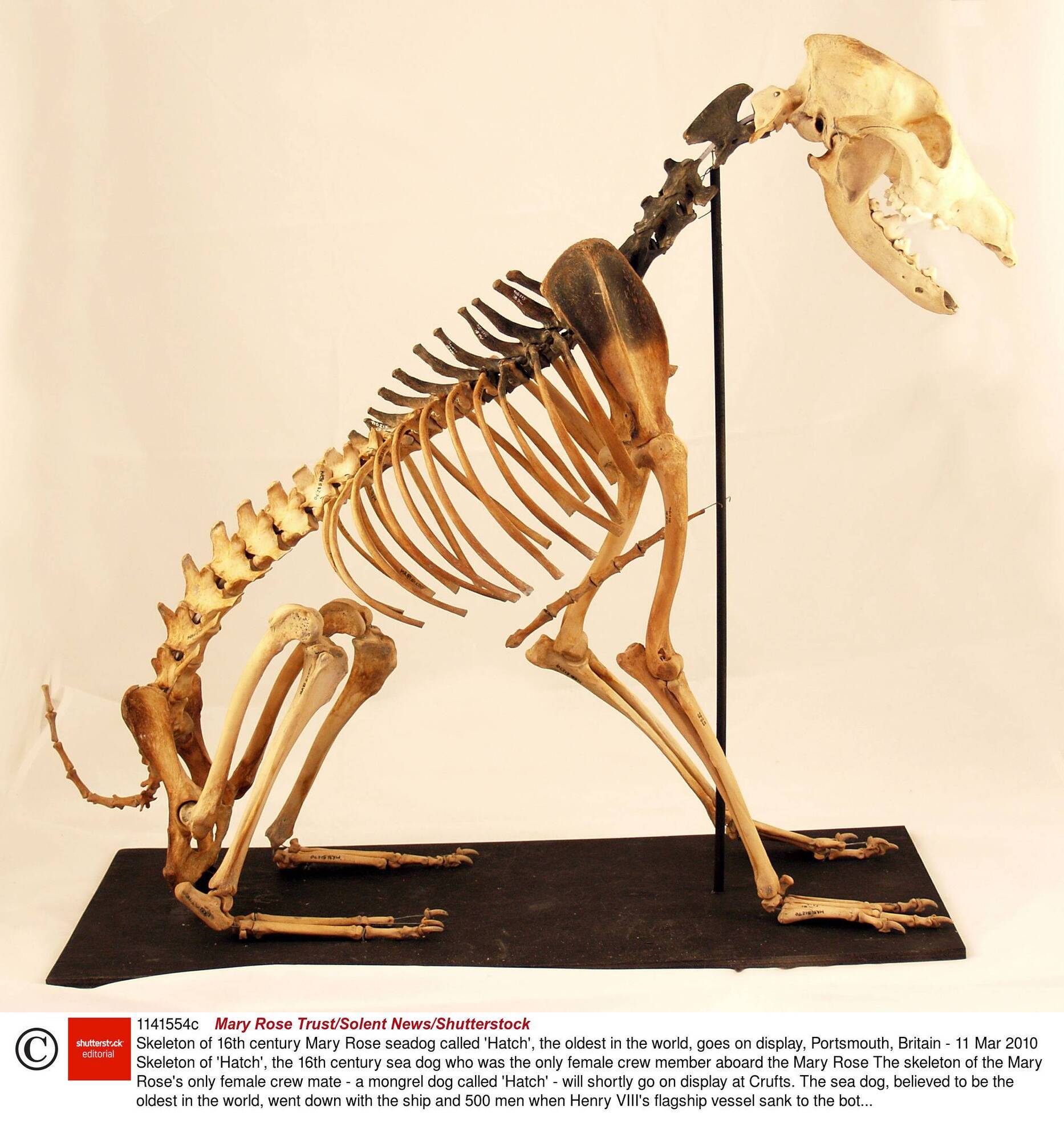
The Skeleton of 'Hatch', the 16th-century sea dog who was the only female crew member aboard the Mary Rose. Picture: Mary Rose Trust - Shutterstock
At the naval museum in Portsmouth last week, I came on the skeleton of a dog. Archaeologists had retrieved the bones from the seabed of the Solent. The dog, nicknamed ‘Hatch’, had perished on 15th July 1545 when, during an encounter with a French fleet, Henry VIII’s favourite warship, the Mary Rose, sank. Following a discharge of cannon, doors on the vessel’s lower gun-deck were left open; the ship rolled with a large wave, took water, and capsized. Of about 400 men on board, only 38 survived.
Hatch’s DNA has been analysed. Resembling a cross between a modern foxhound and a whippet, he had been the ship’s rat-catcher.
Rats were a major pest on sailing ships. They broke open food stores, spread disease and chewed through ropes. Warships were particularly vulnerable; rodents could make holes in gunpowder barrels which had to be stored in rat-proof magazines.
There would have been more rats than men on the Mary Rose. A Spanish sea-captain, who systematically exterminated the rodents on his ship, claimed to have killed over 2,000 of them. If there really were that many, it seems unlikely that Hatch, or any rat-catcher, could seriously reduce their numbers.
The rat of those days was of the ‘black’ species, not the ubiquitous ‘brown’ one found throughout Ireland today. The name is misleading; the fur of either rat can be black or brown. The black rat is slightly smaller, more handsome, and lives closer to people than the brown one. Although here since early Christian times, its days in our part of the world were numbered. During the 18th Century, brown rats irrupted westwards from China, displacing their brown cousins.
James Fairley in A Basket of Weasels noted that 71,580 rats were killed in Dublin docks between 1932 and 1937. About 80% were brown ones, ‘which implies that the black rat was still to be found in quantity’. There is said to be a colony on Lambay, but during visits over the years, I never encountered one there. Fairley mentions ‘a reliable record from Cork city’ in 1976.
Hatch could ‘smell a rat’, but was he an unlikely choice for the role of ship’s ratter? Daylight hunters, dogs depend mostly on sight to locate and chase down rodents. This approach must have been challenging in the pitch-black cavernous bowels of a wooden ship. Cats, nocturnal hunters, can see in the dark. Their stealth and ambush techniques seem far better suited to that habitat. However, a large rat can see off a cat in face-to-face encounters. Dogs, being bigger with more powerful jaws, are not so easily intimidated. Terriers are said to be better ratters than cats.
There’s another reason for choosing dogs; cats were seen as beasts of ill omen. In 1484, Pope Innocent VIII declared them ‘unholy’. Sailors were notoriously superstitious, which is understandable considering the constant danger of shipwreck they faced and the risk of contracting horrible diseases such as scurvy. Pets of ‘witches’, cats suffered the grisly fate of their owners in the public squares of those times. Plague was carried by rat fleas but cats were blamed for causing it.
Poor Hatch, mercifully, didn’t endure quite so terrible a fate. A true sea-dog, he drowned.

CONNECT WITH US TODAY



Be the first to know the latest news and updates