Islands of Ireland: Armada far from invincible
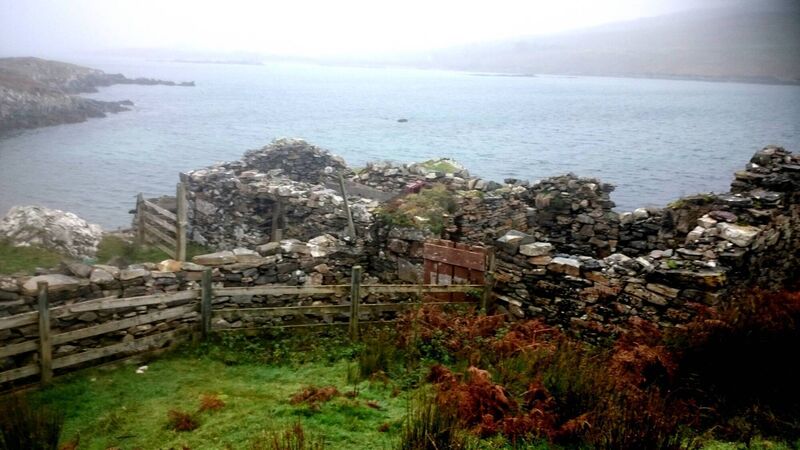
Freaghillaun South (Fraochoileán Theas or Heather Island) is one of several islands of that name in the country. Most are in Co Galway. This one is plonked at the mouth of Ballynakill Harbour in Connemara, beneath the gaze of Tully Mountain. There is another on the other side of the mountain, serenely centred in Tully Lough — and another in the sea beyond.
A large inlet has penetrated the west of Freaghillaun South and cut off a sizeable unnamed islet. The main island is hilly and largely overgrown with furze and fern. It must have been a grim enough place to live, with a few stone houses huddled together in a sheltered spot.
Previous occupants were listed in the 1901 census. There was only one house as recorded by the enumerator then, although the 1837 Ordnance Survey map shows several houses.
The listed house was occupied by a widower, Martin Cloonan. Also residing there were his daughter Bridget, 48, and her husband John Murphy, 55, as well as the couple’s children: John, 24, Margaret, 19, Gregory, 15, Thomas, 10, and Peter, 8. The same family appeared on the 1911 census without Martin, who had passed on by that stage. Farming was given as the occupation of John, Gregory and Peter.
Several of our islands are associated with the ill-fated Spanish Armada mission, which sought to invade England in 1588, but which got diverted around Ireland by fierce and fatal storms. O’Connor’s Island at Streedagh in Co Sligo was the site of three sinkings, while the galleon San Juan managed to avoid a watery grave at Beginish in Co Kerry due to prodigious seamanship.
Another dramatic incident took place at Freaghillaun South. In his exhaustive study of the armada, Niall Fallon recorded that four ships, some with several hundred men, sank in the Galway/ Mayo area. There was a suggestion that one sank at Davillaun near Inishboffin. The author suggests that the ship actually went down just off Freaghillaun South, a theory supported by local tradition, he writes.
“Ballynakill has always been known as a safe harbour and doubtless was so in the late 16th century,” he writes. He speculates: “Whether or not the Spaniards had decided to try to enter on their own or whether a pilot had helped them is not known, but it is evident that they were attempting the passage between Bundouglas on the south and Bradillaun on the north into the inner recesses of Ballynakill.”
He surmises that the weather was probably bad and, when the ship encountered strong currents, it foundered on a reef just to the west of Freaghillaun South.
However, large numbers survived and came ashore in small boats or by swimming. They would have landed on the mainland and Freaghillaun South. What a sight that must have been to see a ship splintered to pieces and its occupants clamouring for survival.
Fallon writes that several of the sailors were accorded a friendly welcome by families in the area, including the Conneelys, who were desperate to protect the Spaniards from governor Richard Bingham, whose reign of terror had laid waste to the region. Fearing reprisals, the men were handed over to the O’Flaherty clan, who in turn handed then over to the English authorities.
The ship that had sunk at Freaghillaun South was the Falcón Blanco Menor and had on board several noblemen, including Don Luis de Cordoba, who was seen as a valuable captive. De Cordoba and his nephew, Don Felipe, managed to buy their pardon, but 1,100 of his countrymen were put to the sword by Bingham. The governor was later to write: “God be thanked, this province stands clear of foreign enemies save a few silly prisoners.”
If Fallon’s theory is correct about Freaghillaun South, as a ship’s hull, far from home, shattered on the rocks and desperate men clambered ashore to an unknown fate, then many armada artefacts remain to be discovered at Ballynakill Harbour. What a film could be made of this episode alone of the travails of the Spanish Armada.
- How to get there: No ferry. Kayak from Ross Beach 10km west of Letterfrack or inquire in village for a trip.
- Other: 'The Armada in Ireland', Niall Fallon, Wesleyan; heritage.galwaycommunityheritage.org
CONNECT WITH US TODAY



Be the first to know the latest news and updates