Damien Enright: Small boys have their way with pesky plants
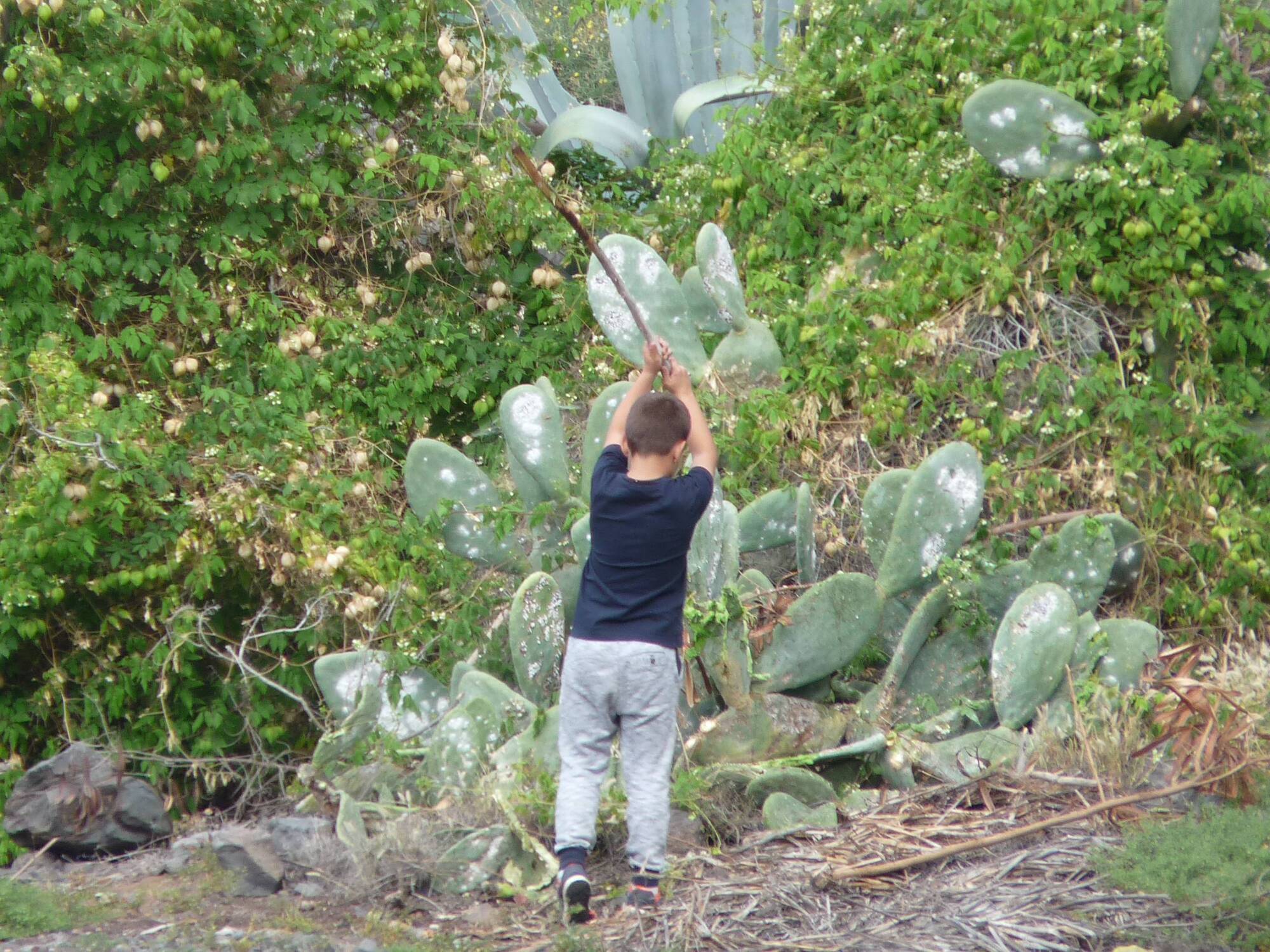
Small boys everywhere feel it's their duty to punish 'weeds'. In Ireland, they thrash nettles. This boy, in La Gomera, is trashing cactus and the cochineal beetles on it. A century ago, his father would have given him the stick!
On Sunday morning, looking out the bedroom window before the sun struck the fields, I saw an elderly man and his wife harvesting avocados from the trees.
Beyond them, a schoolboy was energetically attacking a stand of cactus with a stick, There was a time when his grandfather might well have taken a stick to the boy. The cactus was once the basic food for an industry that brought wealth to these, then isolated, Canary islands.
Pre-teenage boys take it to be their duty to punish weeds. I’ve seen my sons thrashing nettles; my brother and I vigorously attacked these icons of herbal medicine when we were children. Visitors to the Canaries will be very familiar with the tunera or “plate” cactus, the edges of which sprout red, prickly pears, delicious when the spines are burnt off. On the plates, colonies of small, dark beetles like truncated woodlice gather under a white, waxy “spider” webs, secreted to protect them from the sun.
The Aztecs first used these cochineal beetles for dyes. By the 17th century the colouring of fabrics had become an important European industry and cochineal dye from Spain’s South American colonies was a commodity equal to gold and silver. Wisely, just before Mexico became independent in 1836, they introduced the beetles to the Canaries where the Opuntia cactus on which they feed was already successfully producing the prickly pear fruit. The climate and temperature were perfect.
It’s hard to believe that these innocuous, apparently torpid insects are the source of a dye redder than blood. It was originally used for textiles and ill-advisedly for the brilliant scarlet tunics worn by British officers during the Indian Mutiny and at Rorke’s Drift in the Zulu wars. The colour could only have made them easier targets for the enemy.
The dye, being natural and non-toxic, was used to colour sweets and icing, and for flavouring, medicines and cosmetics. Plantations of cochineal-laden cactus made fortunes for their owners and were also a life-saving peasant industry; the cactus escaped, went wild and the beetles followed. The females produce the dye. Typically harvested by hand, they could also easily be transferred to the plates of wild plants. In fact, they need no help to create new colonies. Female nymphs crawl to the tops of cacti, and use wind to disperse to others, travelling up to several metres.
Female crawlers that successfully and safely land find a suitable spot, insert their mouthparts and feed off the cactus for the rest of their lifespan which is around 70 to 90 days. After three weeks of feeding, moulting and undergoing physical change, they lay eggs that produce 1,100 to 1,250 successful offspring. They are harvested close to their natural deaths, so that they grow as large as possible.
As for the males, they are much fewer. Unlike the wingless females, they can fly. It is the duty of a solitary male to fly from plant to plant and cope with about 300 females for the purpose of reproduction. The industry survived in La Gomera until the early 20th century, when synthetic dyes replaced the carminic acid produced by the beetles. When demand collapsed large scale immigration to Cuba and Venezuela was the only option for many smallholders.
Cochineal is still produced in Lanzarote and Gran Canaria although synthetic dyes have made the breeding and harvesting of the cochineal beetle too costly and labour-intensive. It requires 70,000 beetles to provide a single pound of cochineal dye as well as the labour of, largely, a lot of women wearing layers of protective clothing against the cactus thorns when gathering the beetles.
Historically, women scraped the insects into flat metal trays. The trays would then be placed in ovens for the insects to toast. They were also put into boiling water and later dried in the sun. Another method involved mixing the insects with black sand in a linen bag several feet long which would then be swung back and forth by men holding each end of the bag until the juices seeped out.
Up to 3,000 tonnes of cochineal were annually produced in 1870s. Now, the market is much smaller, but significant production still occurs of possibly 200 to 700 tonnes. Insect welfare advocates and vegans argue that the annual death toll of the cochineal beetles is likely five to 20 trillion and that cochineal should be entirely replaced by synthetic dyes.
However, adversely, the naturalness of cochineal dyes makes them popular for high-end consumer goods and natural foods. In 2012, after it became public that they used insect-derived dyes in drinks, Starbucks bowed to consumer pressure and switched to tomato-derived dyes.
CONNECT WITH US TODAY
Be the first to know the latest news and updates