When cute-looking jellyfish mushroom into a big problem
Can be as deceptive as dangerous varieties of mushroom
When cute-looking jellyfish mushroom into a big problem

An armada of Portuguese Man of War jellyfish came ashore on West Cork beaches after Hurricane Aidan. The sting from their blue 'tentacles' is excruciating. Dog walkers, keep your pets away! 

On Monday, a friend who had walked a dog on Garretstown Beach, in West Cork, afterwards emailed me with a warning: "Keep your dog away from the small, 'plastic balloons' found on beaches after recent storms. They are Portuguese Man of War, and can be deadly."

Overnight, hundreds of these balloon-like jellyfish had been washed onto the sands and blown by the hurricane above the limits of the highest tides.


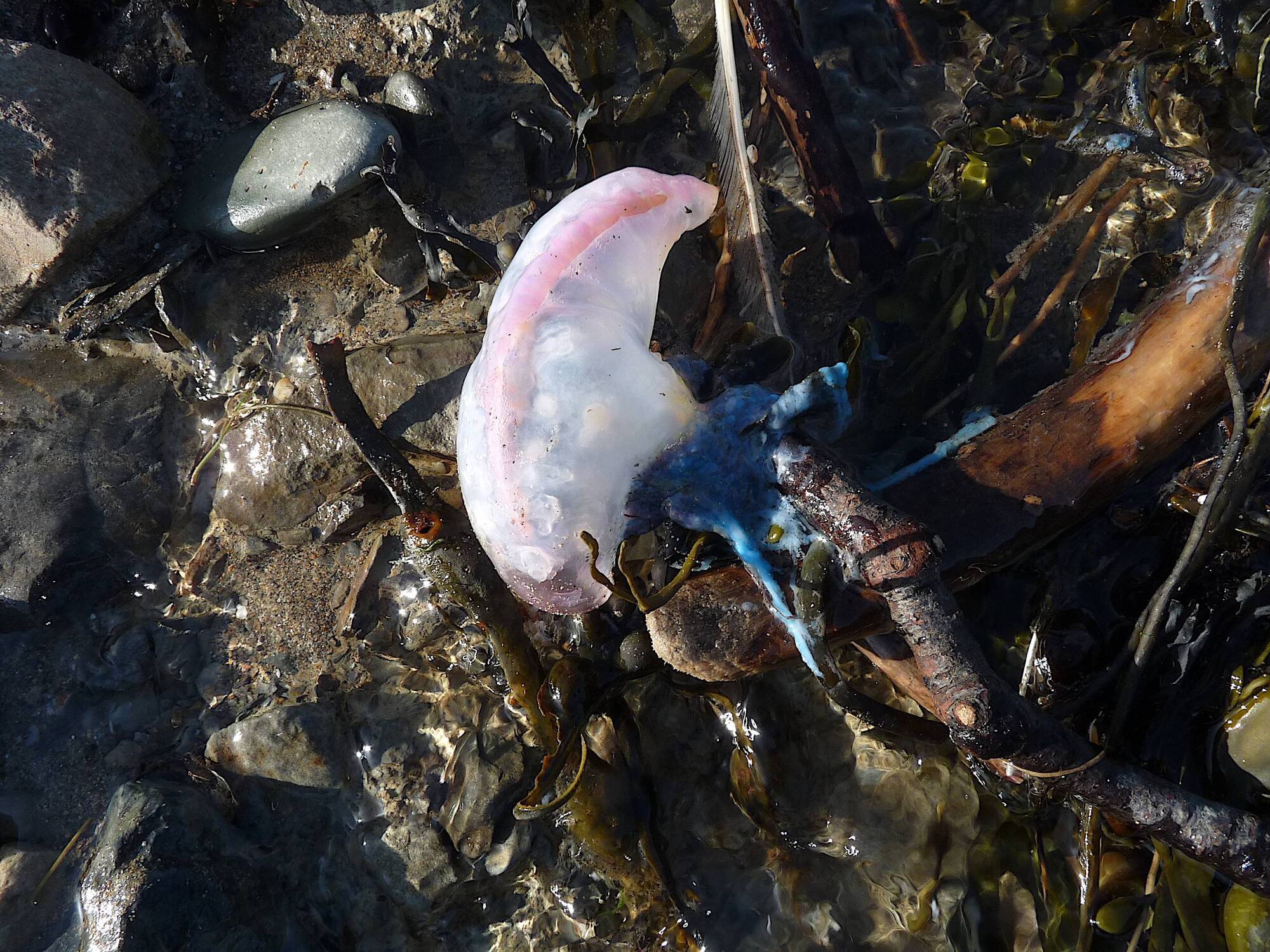
Attractive — and 'curious' — to look at, the see-through inflated sails are about five inches long, with a pink-coloured, crenelated crest along the 'back' and a wodge of dark-blue goo underneath.

The blue 'goo' is the business part. As the bubble floats on the tropical and temperate oceans of the world, the goo opens into dozens of stinging threads, trailing up to 50m (165ft) strings behind the sailor and all but invisible in the water. Their object is to touch, paralyse, and capture small fish, which are then drawn to the body and consumed.

A marine biologist, Dr Jeremy Dorman, explains that the creatures are technically not jellyfish, but siphonophores, and the body is not a single creature, but a colony of creatures living in 'symbiosis', each playing its part: The bubble that sails, the stingers that paralyse, and the digestive system that feeds the colony.

An armada of Portuguese Man of War jellyfish came ashore on West Cork beaches after Hurricane Aidan. The sting from their blue 'tentacles' is excruciating. Dog walkers, keep your pets away! 

Washing ashore, they are, of course, first a danger to bathers, then to children and dogs on the shore. The scar left by touching a stinger is like a burn. Recent research from NUI Galway and the University of Hawaii has found that the most effective treatment is to apply vinegar and warmth to the wound.  

I've recently been asked to identify white mushrooms very similar to the familiar field mushroom (and with rings or veils beneath the cap), the only difference being that the stems are stained yellow.

Agaricus xanthodermus, Yellow Stainers so-called, are inedible, and cause sweating and stomach cramps. They look inviting and it's disappointing to find the yellow on the stem, the warning sign.

They grow in widely different climates and environments. A daughter sent me pictures for identification of a group found under a bush on the edge of London. I once spied a carpet of them in a Dorset field; a disappointment when I took a close look.

A few days later, a son sent me pictures from La Gomera, in the Canary Islands. Suspicious of the yellow stains on the stems and caps, he asked me if they were safe to eat. Once again, I had to say no.

They are not uncommon here in Ireland, and the message is: Beware! However, the horse mushroom (Agaricus avensis), an excellent edible species, may also stain yellow when picked — but not as yellow as the Yellow Stainers, so there is the conundrum, I'm afraid.

The other evening, a knock on our door announced a neighbour arriving out of the night bearing a pot of delicious, October-made Loganberry jam, and a box of a single mushroom species, for identification. The caps were brown, rather than the white of field mushrooms, and the stems had a veil-like ring under the cap.

These were horse mushrooms, similar in every way to the more common, white-headed field mushroom (Agaricus campestris), but for a greater stoutness and a darker cap. All three of the agarics mentioned have rings or veils under the caps; the horse mushroom often has a double veil.

The yellowing on a horse mushroom will usually occur only when they are bruised in picking; the yellow on the Yellow Stainer is stronger, a bright chromium yellow, and it is present when there is no bruising and often seen on the cap in blotches, or under the skin of the cap if this is peeled.

When the Yellow Stainer is cut, it has an inky smell, while the horse mushroom smells pleasantly of aniseed or liquorice. Cutting the stem of a fresh specimen will reveal bright yellow in the Yellow Stainer, while the horse mushroom will often show no yellow or a very light colour.

In Ireland, the only fatal species are the Death Cap and the Panther Cap, both Aminitas (not Agaricus) species. 

However, as I've said before, mushrooms can affect people differently, so don't take my word for it!

When I first became a mushroom forager, I bought two books, to be sure to get the species right. In decades of autumn foraging, I, and all my family, have never suffered any distress from the fungi we've eaten on toast or mixed with pastas, or simply fried and served solo from the pan. On the contrary, they have added great flavour to autumn meals.

x

More in this section

Revoiced

Newsletter

Sign up to the best reads of the week from irishexaminer.com selected just for you.

Cookie Policy Privacy Policy Brand Safety FAQ Help Contact Us Terms and Conditions

© Examiner Echo Group Limited