Discover the secret to daffodil success
Hannah Stephenson consults a daffodil guru to learn the best way to grow this spring favourite

Discover the secret to daffodil success

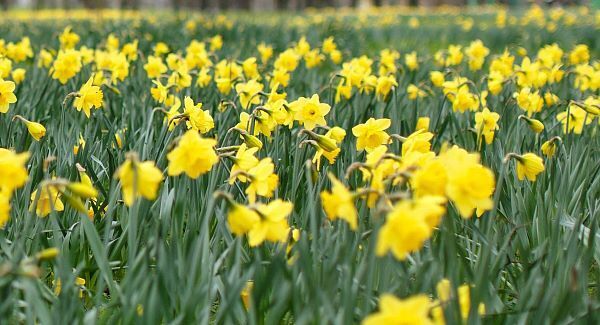
A host of golden daffodils will be in bloom this spring in gardens nationwide, celebrating the 250th anniversary of the birth of William Wordsworth whose most famous poem, “I Wandered Lonely As A Cloud”, is also known as “Daffodils”.

It’s the 250th anniversary of the birth of William Wordsworth, who celebrated daffodils in poetry.

Across the Irish Sea, RHS Garden Harlow Carr in Yorkshire has planted 22,000 bulbs, a golden mile of narcissi, while more than 70,000 daffodils will be on display throughout the garden.

Daffodil specialist Ron Scamp offers the following tips on how to plant daffodils and get the best show of blooms.

So what’s the secret of daffodil success?

Daffodil Bulbs

Make sure bulbs feel firm to the touch. “The most important thing is that your bulbs are sound and of good quality. Make sure the bulbs are firm,” says Ron.

You can go to many places to see bulbs, in supermarket and garden centres. Just give the bulb a little squeeze. If it feels firm and looks healthy, that should be fine.

“If you are buying from an unknown source and you don’t know what the bulb’s going to look like, you are relying on the reputation of your supplier.”

How to plant

Plant with at least four inches of soil on top of the bulb, says Scamp. “Bear in mind that soil will settle, and if you plant too shallow, the bulb will split up too quickly and the bulbs will be too small to initiate a flower,” he adds. “That’s just one of the reasons bulbs go blind.

“If you plant at four-six inches deep, the bulb will settle and grow and multiply naturally.”

What soil?

What sort of soil is ideal? “Daffodils will grow in almost any soil, but ideally something slightly alkaline is good,” says Ron. “They grow in all sorts of conditions, from very dry and arid places to mountain alpine pastures.”

Ideally, the soil should be free-draining.

“If you have a heavy clay soil, add a bit of grit to the bottom of the hole,” adds Scamp. “Bulbs don’t want to sit in water. If you are growing them in containers, add a bit of grit to the mix to maintain free drainage.”

Plant the bulbs from September and before the end of October.”

After flowering

How long should you leave them after flowering before tidying up? “Leave them for at least eight weeks,” says Ron.

Don’t cut leaves off until eight weeks after flowering, which is the time to harvest your bulbs if you are going to lift and divide them.

He adds: “Don’t tie them up. If you tie them in a knot you are just cutting off the sap and the growth within the leaf. It’s like having your throat cut. This year’s leaf is next year’s flower because all the goodness in the leaf has to go back into the bulb.”

Straggly leaves

How do you disguise straggly leaves? “You could plant the bulbs in among other herbaceous plants and small shrubs, then you can hide them,” says Scamp.

“If you have them growing in grass, by the time June comes along, the grass is getting a bit lanky.”

Favourite flowers

As for Ron Scamp’s favourites? “I love some of the top show flowers we have like ‘Cape Cornwall’ and ‘Centenary Gold’,” he says.

Ron Scamp (left) and Adrian Scamp with their daffodils at the RHS Flower Show Cardiff 2014     Pic: Bethany Clarke.
Ron Scamp (left) and Adrian Scamp with their daffodils at the RHS Flower Show Cardiff 2014 Pic: Bethany Clarke.

“I have a soft spot for the historics, the old-fashioned daffodils which have been around for a hundred years, like ‘White Lady’, ‘Elegance’ and ‘Amabilis’.”

Containing them

Which types should you choose for containers?

If you have big pots outside, any sort of daffodil is fine, but if you have a nine-inch pot or a small bowl, I’d go for dwarf types like the cyclamineus hybrids and apondanthus hybrids. Many miniatures are superb.

Which are best for scent?

“Not all daffodils are scented, but most scented ones come into the poeticus, jonquilla and tazetta sub-species. Some are multi-headed and some tazettas can have up to 20 flowers on a stem.

“Tazettas are invariably very tall,” says Ron. “The bulbs are like cricket balls and the flowers are on long stems, growing to around 24 inches. They look best in the back of the border.”

x

More in this section

Revoiced

Newsletter

Sign up to the best reads of the week from irishexaminer.com selected just for you.

Cookie Policy Privacy Policy Brand Safety FAQ Help Contact Us Terms and Conditions

© Examiner Echo Group Limited