Jackass penguin talk is similar to humans
When horses were shown photographs of angry human faces, their hearts speeded up.

Jackass penguin talk is similar to humans

When horses were shown photographs of angry human faces, their hearts speeded up. Similar responses have been demonstrated in dogs; our four-legged friends can sense their owners’ moods. Is emotional communication taking place here, or are these merely instances of conditioning? To what extent, if at all, do animals in the wild detect, and respond to, the emotional states of their peers

In a paper published last July, Dr. Livio Favaro and colleagues claimed that goats exhibit ‘emotional contagion’; they pick up on neighbours’ feelings on hearing their calls. His team recorded goat vocalisations, some of which expressed ‘positive’ emotions while others featured ‘negative’ ones.

The heart-rates of goats, hearing the calls played back, varied to a greater extent when positive, rather than negative, feelings were being expressed.

If the emotional character of a call changed unexpectedly, a goat would turn its head and look for the source of the sound. This suggests, the researchers say, that goats ‘might be sensitive to the emotional states of other individuals’.

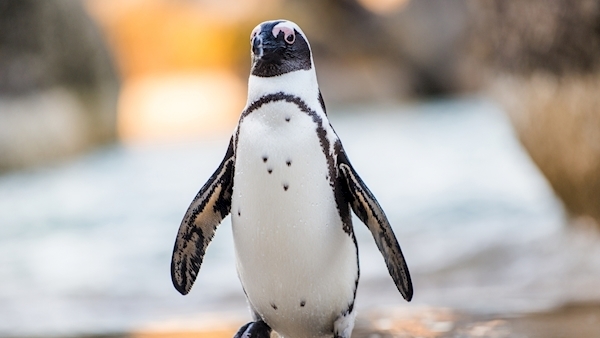
Now Favaro has turned his attention to jackass penguins, the vocalisations of which, he claims, show characteristics found, so far, only in the communications of humans and a few other primates.

According to the Law of Brevity, devised by the American linguist George Kingsley Zipf, the most frequently used sounds in English tend to be the shortest; ‘yes’ ‘no’ and ‘but’ are typical examples. ‘The’ appears in everyday language more than any other word, accounting for almost 7% of all discourse. Zipf’s Law seems to apply to all human languages.

Paul Menzerath and Gabriel Altmann, working in German, noticed that the longer the words we use, the shorter the syllables they tend to contain; there’s an inverse relationship between the two.

The vocalisations of gibbons and baboons obey both the Zipf’s and Menzerath-Altmann laws.

The jackass penguin, an endangered species, breeds only along the coasts of South Africa and Namibia. Visitors to Cape Town will know the bird; there’s an impressive breeding colony at Boulders Bay south of the city. Classified as ‘endangered’ by the IUCN, the jackasses are trusting creatures; some will even allow you to approach to within a metre of them. As a result, these penguins are often exhibited in zoos.

As the name implies, jackass calls resemble the complex braying of donkeys.

Favaro and colleagues analysed 590 recordings of vocalisations made by 28 jackass penguins in Italian zoos. The team was interested particularly in ‘ecstatic display’ calls, used mainly by males during the breeding season. The experiment showed that jackass ‘songs’ conform to Zipf’s Law of Brevity, the most frequently used syllables being the shortest ones. They also obey the Menzerath-Altmann Law; the longer a call, the shorter its individual elements tend to be. This is the first finding of its kind in birds.

Penguin ‘talk’, therefore, has similarities to human discourse, although it is far less complex. It seems that penguins, living as we do in large concentrations, have learned to compress their ‘language’, in order to communicate more efficiently. Calls transmit basic information about an individual’s identity and emotional state, but we still don’t know what else they may convey.

Livio Favaro et al. Do penguins’ vocal sequences conform to linguistic laws? Biology Letters, 2020.

More in this section

Revoiced

Newsletter

Sign up to the best reads of the week from irishexaminer.com selected just for you.

Cookie Policy Privacy Policy Brand Safety FAQ Help Contact Us Terms and Conditions

© Examiner Echo Group Limited