Richard Collins: Ever wondered why a panda cub is so tiny?
The partridge, of Christmas pear tree fame, lays the largest clutch of any bird species. A nest may contain up to 24 eggs, each weighing about 14.5g grams.
The mother is around 25 times heavier than each egg.
Smaller birds lay proportionally heavier eggs. A blue tit’s egg weighs just over 1g, and she is only ten times heavier.
The human mother-to-baby weight-ratio averages 26 to one, a figure remarkably similar to that of the partridge. Comparing the weights of birds and humans, however, isn’t valid.
Birds, being fliers, are the ultimate weight-watchers, and they have an entirely different breeding strategy to ours. But how do the mother-baby weight ratios of various mammals compare?
Marsupials, such as kangaroos and koalas, give birth to very small young. The tiny infant must find its way to the mother’s pouch, which is a virtual second womb. In a sense, the pregnancy continues there. Among large placental mammals, the human mother-to-baby weight-ratio, at 26 to 1, is fairly typical, but there are some spectacular exceptions.
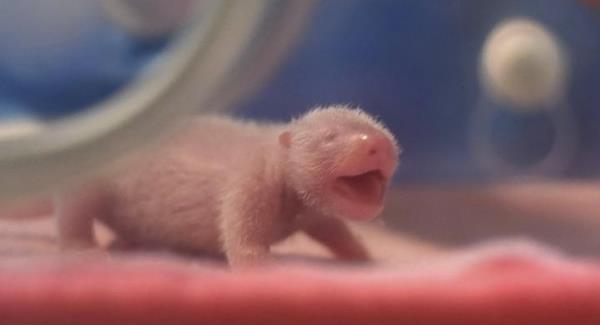
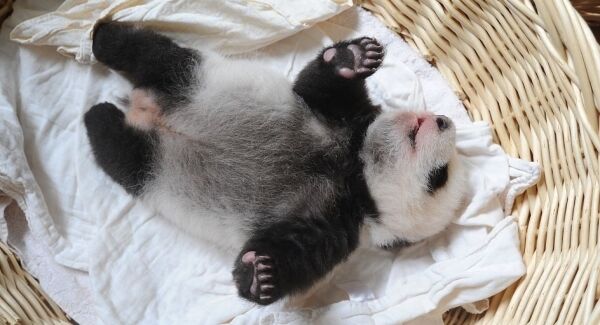
The giant panda is the most extreme one; a panda mother is 900 times heavier than her newborn cub.
A fetus makes huge demands on a mother’s resources, but the implications of having small babies are far-reaching; it’s a case of swings and roundabouts. According to Conservation International, a newborn panda baby won’t open its eyes for six to eight weeks, and will only begin moving around when it is three months old.
The mother nurses her infant for up to nine months, at which stage the youngster begins eating bamboo, the panda’s staple diet. The juvenile will be dependent on its mother for up to two years. About 40% of panda cubs fail to reach adulthood.
Members of the bear family, to which the panda belongs, all tend to give birth to small young. A polar bear mother, for example, is 400 times heavier than her cub. The trait might be down to hibernation. Bears spend the winter months sleeping, during which gestation and giving birth take place. A mother, relying on the limited amount of fat she accumulated prior to the big sleep, can’t afford the luxury of having large young.
Pandas, however, don’t hibernate, so producing small youngsters must be an inherited trait. But why are panda newborn babies even smaller than those of other bears? Zoologists can’t really answer this question, but a paper published in the Journal of Anatomy, goes some of the way towards an explanation. In it, Peishu Li and Kathleen Smith, of Duke University, describe their recent research on panda infancy.
Li and Smith used ‘micro-computer tomography’ scanners to develop 3D models of bear skeletons, and compare them with those of other mammals. Newborn pandas, they found, have underdeveloped skeletons compared to those of other bears and mammals generally.
While bear fetuses take two months to develop, following implantation in the uterine wall, those of pandas take only one. This, the researchers say, accounts for the small baby size — “a relatively short post-implantation gestation may be the proximal mechanism behind the giant panda neonate’s small size,” they say.
CONNECT WITH US TODAY



Be the first to know the latest news and updates